Work a second ticket without rebuilding the world: the git layer (#108) - #168
Merged
juanmaguitar merged 9 commits intoAug 10, 2026
Merged
Conversation


Part of #108. This is the main-process half — branches, parking, and the
diff base. The "Working on: #59234" switcher is a follow-up; nothing in
`src/renderer/index.jsx` calls the new bridge yet, so the observable
change today is that linking a ticket creates a branch and switching
back to one restores its files.

A site was one working tree and one implicit patch. Starting a second
ticket meant either a second clone (~54 MB, another `npm install`,
another first build) or piling both tickets into one tree and getting a
patch that mixes them. The site is the expensive substrate; a ticket is
a cheap branch on top of it.

## Two invariants

**`trunk` is never committed to.** It stays the pristine snapshot every
branch is diffed against. Work started on trunk is *carried* into a
ticket branch — `git.branch({checkout: true})` only moves HEAD, so
uncommitted edits come along and nothing is thrown away.

**A ticket branch holds exactly one WIP commit.** Parking passes
`parent: [baseOid]` explicitly rather than committing onto the previous
WIP commit, so re-parking rewrites that commit instead of stacking a
pile of saves nobody asked for.

## The diff base is the branch point, not `origin/trunk`

The issue asks for `origin/trunk`. That is wrong, and `src/main.js`
already said so: diffing against a trunk that has moved embeds reversed
upstream changes and the patch applies nowhere. It cannot be the live
`refs/heads/trunk` either, because `updateToLatestTrunk` moves that ref
while existing branches stay where they were born. So each branch
records the trunk oid it forked from, and `statusMatrix({ref: baseOid})`
diffs against it — which also sidesteps `findMergeBase` on a `depth: 1`
clone's truncated graph.

The `origin/trunk` fetch that was performed and never used is deleted
rather than put to work, saving a network round trip per "view patch".

## What this drags in

- `readTrunkInfo` read `HEAD` to date the snapshot. On a ticket branch
that is a WIP commit made minutes ago, so the staleness dot (#94) would
never light up. It reads `refs/heads/trunk` now.
- `discardChanges` checked out `trunk` by name, which would silently
move the contributor to another ticket. It checks out whatever is
current; parked work survives, since destroying a ticket is what
deleting its branch is for.
- `appliedPatch` and `updateIncomplete` describe the work, not the site,
so they moved under the branch. Left at site level, ticket A's "patch
applied · Revert" banner showed while on ticket B, offering to reverse
A's hunks against B's tree.
- The update runs from trunk, so it parks the ticket first — and returns
to it afterwards. When it fails it clears the stored ticket and says in
the log where the work is parked, rather than leaving the panel naming a
ticket the worktree is no longer on while every patch comes out empty.

## Two things that cannot be allowed to lose work

Leaving a **dirty trunk** cannot be parked (invariant 1) and
`checkout({force})` would eat it, so switching refuses with
`code: 'dirty-trunk'` for the caller to offer the honest options.

`git.checkout` writes HEAD only after every file operation succeeds, so
a failure part-way — an `EPERM` on Windows from an editor or an
antivirus holding a file — leaves HEAD on the source branch over a
half-swapped worktree. Parking then would commit the mixture over the
good WIP commit, and parking rewrites. The error is tagged
`stage: 'checkout'` (the contract `updateToLatestTrunk` already uses) and
the site is marked mid-switch until it is reconciled.

## Patch generation no longer touches the index

The `git.add` loop that staged every untracked file to get it into the
diff, and never unstaged it (#85), is redundant: `statusMatrix` reports
untracked files as `[path, 0, 2, 0]` on its own and the `head !== workdir`
filter keeps them. Verified through the handler, with an assertion that
the index is byte-identical afterwards.

`staleStagedPaths` stays — parking stages the worktree, and indexes
dirtied by earlier versions are still out there.

File deletions are still dropped from generated patches. That is #85's
other half, unchanged here and left to its own change: rewriting the
patch generator in the commit that introduces branches would make a
failure impossible to attribute.

## Migration

`siteMeta[sitePath]` gains `branches` and `currentBranch`. A site with a
linked ticket gets that branch created at the current trunk tip and its
work carried onto it; a site without one gains an empty map. It runs
only from handlers already about to move HEAD, never from a read — a
list call can land while an install or the Playground server is running
against that directory. Nothing is persisted when the git half fails, so
a site on an unmounted volume retries instead of being stranded on the
old shape forever.

## Tests

405 pass on `.nvmrc`'s Node and on Electron's. The new integration suite
drives real repositories in `tmpdir`; the wiring tests cover the three
new channels, the registry gate in front of them, and the mid-switch
refusal. The behaviour changes to `readTrunkInfo`, `discardChanges`,
per-branch applied state, and returning to the branch after an update
were each confirmed to fail with the previous code.

Reviewed with `/self-review` before this commit: 9 `[fix here]` findings,
all fixed. Two `[follow-up]` remain — the renderer does not call the new
bridge yet, and `mergeBranchMeta` inherits a read-modify-write race from
the existing metadata pattern. One partial: a ticket switch still
resolves an `invoke()` with no progress channel, so the window is quiet
during a large checkout; streaming that needs the UI change.

Co-Authored-By: Claude Opus 5 (1M context) <noreply@anthropic.com>

juanmaguitar
force-pushed
the
juanmaguitar/working-on-a-second-ticket-means-rebuilding-the
branch
from
August 8, 2026 08:39
56fc7df to
4760128
Compare
…-on-a-second-ticket-means-rebuilding-the

# Conflicts:
#	src/main.js
juanmaguitar
added a commit
that referenced
this pull request
Aug 8, 2026

… five minutes (#170)

## Why

Two things keep going wrong on pull requests here, and neither is
anybody's fault — nothing in the
repo says otherwise.

**Nobody says how to test the change by hand.** This app fails in the
places `node --test` cannot
reach: a real clone of `wordpress-develop`, a `node_modules` that takes
minutes to install, an OS
file dialog, a Windows path with a space in it. A green suite is not
evidence the feature works, and
a reviewer who has to guess how to drive the change usually does not
drive it at all.

**The descriptions are hard to read.** Detail arrives in the order it
was discovered rather than the
order a reviewer needs it, so the first screen is rarely the part that
explains the change. The cost
is not that the detail exists — it is that it sits in front of the
summary.

## What changes

A pull request template, plus the two rules it encodes, written down
where agents and humans both
read them.

`.github/pull_request_template.md` — GitHub loads it into every new PR,
including ones opened with
`gh pr create` (as long as no `--body` replaces it). The organising rule
is **a reviewer understands
the change in five minutes**: Why, What changes, How to test this,
Risks, Related stay visible, and
everything deeper goes into a `<details>` block collapsed by default.
Depth is not the enemy of a
readable PR; depth *in the way* is — so detail moves rather than
disappears.

`AGENTS.md` gains two subsections under "Before opening a pull request":
the shape of the
description, and the manual-testing requirement spelled out (starting
state, numbered steps in the
words on screen, expected results stated so they can come out false,
**what must not have happened**,
platforms, and what could not be tested by hand). `CONTRIBUTING.md` gets
the human-facing pointer and
a fourth step in the pre-PR checklist.

**Deliberately not in this PR:** any enforcement. No workflow fails a PR
with a missing section — the
same reasoning that keeps AI review off CI here (a public repo, no
credentials) applies, and a bot
that checks for a heading measures headings, not testability.

## How to test this

**Platforms:** any — nothing here executes.

**Starting state:** a clone of this branch, and a browser signed in to
GitHub.

1. Open
<trunk...juanmaguitar/pr-description-template>
and click **Create pull request**. → The description box is pre-filled
with the template: Why,
What changes, How to test this, Risks and limitations, Related, then
four collapsed blocks.
   **Close the tab without opening the PR.**
2. Expand one of the `<details>` blocks in the preview of
[`.github/pull_request_template.md`](.github/pull_request_template.md).
→ The guidance inside is
an HTML comment, so it never appears in the rendered description a
reviewer reads.
3. Read this PR's own description against the template. → It follows it
— this is the first PR
written to the new shape, and the "How to test this" you are reading now
is the section the rule
   requires.
4. From a checkout of this branch, run `gh pr create` on a throwaway
branch. → The body opens
pre-filled with the same template, confirming it is not a web-UI-only
feature.

**What must not have happened:**

- No second template file. GitHub shows **no picker** when a PR is
opened — several templates in
`.github/PULL_REQUEST_TEMPLATE/` are only reachable by appending
`?template=name.md` to the URL, so
the default loads anyway and the rest are never seen. `ls .github/`
should show one template and no
  `PULL_REQUEST_TEMPLATE/` directory.
- The review standard did not move or gain a copy.
`.github/instructions/code-review.instructions.md` is untouched; if it
had been restated in the
template it would drift, which is the failure mode this repo has already
designed against.
- No behaviour change. `git diff --stat trunk...HEAD` touches three
Markdown files and nothing under
  `src/`.

## Risks and limitations

Nothing enforces any of this, so it holds only as long as people follow
it — the honest ceiling of a
convention in a repo that deliberately runs no credentialed bots.

A template is a guess about what reviewers need. If a section turns out
to be dead weight in
practice, deleting it is a one-line PR and preferable to leaving a
heading everybody skips.

The "five minutes" is a target, not a measurement. A 1,500-line PR will
not hit it whatever the
description says — which is why the template ends by asking whether a
diff over ~800 lines should
have been two.

## Related

Follow-up to #168, where these commits were originally written. They
affect every PR rather than that
one, so they are split out to review and merge independently — which is
also the advice the template
itself gives.

---

<details>
<summary>Design decisions and alternatives considered</summary>

**One template, not one per kind of change.** The first draft was
written for bugfixes — `## Problem`
/ `## Solution` — and a feature PR does not have a problem in that
sense. The obvious fix is separate
`bug.md` and `feature.md` templates under
`.github/PULL_REQUEST_TEMPLATE/`. GitHub's documentation
rules this out: there is no picker UI at PR-creation time, and selecting
a non-default template means
appending `?template=name.md` to the URL by hand. In practice the
default would load every time and
the second file would be dead. So the headings became `## Why` and `##
What changes`, which fit a fix,
a feature and a process change, and the template calls out the three
places where those genuinely
want different things: a fix names its root cause and the test that
fails without it, a feature names
what it deliberately leaves out and shows its surface, and the testing
steps follow the path a
contributor actually takes.

**Guidance inside the sections, not a separate style guide.** The hints
live in HTML comments in the
template itself, at the moment they are needed. A style document nobody
opens while writing a PR
description does not change any PR description.

**The rule lives in `AGENTS.md`, not only in the template.** An agent
drafting a PR body may never
open the template file; it does read `AGENTS.md`. The template is the
shape, `AGENTS.md` is the
requirement, `CONTRIBUTING.md` points at both without restating either.

</details>

<details>
<summary>Review outcome (required — see AGENTS.md)</summary>

No `/self-review` pass. The standard's five dimensions — architecture,
security, performance,
cross-platform, tests — have no purchase on three Markdown files with no
executable content; running
it here would produce a paragraph saying so.

What was checked instead: that GitHub actually auto-loads a root
`pull_request_template.md` (it
does, including via `gh pr create`), that multiple templates require an
explicit `?template=`
parameter (they do — the reason there is one file), and that nothing
here duplicates the review
standard.

</details>

<details>
<summary>Implementation notes</summary>

Three commits, in the order the thinking went:

1. **Require a "How to test this" section on every pull request** — the
rule, in `AGENTS.md` and
   `CONTRIBUTING.md`, before any template existed.
2. **Add a pull request template built for a five-minute review** — the
template, and the
   visible-versus-collapsed split.
3. **Make the template fit features, not just fixes** — the
`Problem`/`Solution` → `Why`/`What
changes` rename, after the second commit's own template proved
bug-shaped when used on a feature
   PR (#168).

The collapsed blocks are Design decisions and alternatives considered,
Review outcome, Implementation
notes, and Screenshots or recording. Review outcome is collapsed rather
than dropped because
`AGENTS.md` requires it while a reviewer rarely needs it in the first
minute — the headline count
surfaces in **Risks and limitations** when it changes how the PR should
be read.

The **Screenshots or recording** block is deleted from this description
rather than left empty:
nothing in the app changed, and the only visible surface is GitHub's own
PR form, which step 1 above
walks you to directly.

</details>

---------

Co-authored-by: Claude Opus 5 (1M context) <noreply@anthropic.com>
This was referenced Aug 8, 2026
…-on-a-second-ticket-means-rebuilding-the

# Conflicts:
#	src/main.js
… turns

The Windows leg failed on "git:apply-patch never reported done" while
macOS passed. Nothing about the handler is platform-specific: the
helper polled a fixed 50 event-loop turns, and per-branch state (#108)
made these handlers read the worktree to decide where that state lives.
How many turns that takes is a property of the filesystem underneath,
and the same failing path lookup is slower on Windows.

Waiting on a budget of time instead still returns the instant the
message lands, so nothing gets slower in the normal case — and it
cannot start failing again because a handler grew one more await.

Co-Authored-By: Claude Fable 5 <noreply@anthropic.com>
…-on-a-second-ticket-means-rebuilding-the

# Conflicts:
#	src/main.js
…roke first

Windows failed again, in three tests that arrived with #189 and #184
and carry their own inline "poll 50 event-loop turns" loop — the same
shape already fixed for git:apply-patch, in code that had not been
written yet when that fix landed.

The cause is unchanged: per-branch state (#108) makes these handlers
read the worktree to decide where that state lives, so how many turns a
result takes belongs to the filesystem rather than to the code, and the
same failing path lookup is slower on Windows.

There is now one helper and no inline loops, with a line saying that a
new one is this bug waiting to happen again.

Co-Authored-By: Claude Fable 5 <noreply@anthropic.com>
…ns-rebuilding-the
…ns-rebuilding-the
…ns-rebuilding-the
juanmaguitar
added a commit
that referenced
this pull request
Aug 10, 2026
…een them (#185)

## Why

#168 made a second ticket cheap, but invisible: the branches exist, and
nothing on screen shows them. A contributor coming back to a ticket has
to remember its number and type it into the link field again — and
"delete this ticket's work", the destructive half of #108's model, has
no UI at all, so `branches:delete` ships unreachable.

## What changes

The **Trac ticket** panel lists the site's ticket branches, in both of
its states:

- **No ticket linked** — a "Your tickets on this site" list above the
input: *Continue working on #59234* as a link, with *edited 2 days ago*
under it. The input stays for tickets that are genuinely new.
- **A ticket linked** — "Other tickets on this site": *You also have
work on #61002 — switch*. Without this, seeing your other tickets would
require unlinking first — the exact friction #108 removes.

When a switch is refused because trunk has loose edits — they cannot be
parked, since trunk is never committed to — the message now carries its
two ways out: **save them as a patch**, or **discard them and
continue**. Separate steps on purpose: saving a patch does not empty the
working tree, so the panel says so before offering the destructive one.
Carrying the edits along into an existing ticket in one action is #196.

Each row carries a confirmed, destructive **Delete this ticket's work**
— the only UI for `branches:delete`, and deliberately a different
gesture from switching.

The decision a reviewer would otherwise reverse-engineer: **resuming
does not use the new `switchBranch` bridge call.** `sites:set-ticket`
already resumes a branch it recognises, with all the parking rules, and
the renderer's `saveTicket` already owns the busy state, the error alert
and the sidebar sync — so "Continue working on #N" is that same write,
and the new bridge surface this PR consumes is just `listBranches` and
`deleteBranch`.

Row selection, ordering and the "edited N days ago" label live in a pure
module, `src/renderer/ticket-branch-list.cjs`, per the `trac-ticket.cjs`
convention — the JSX renders what the module returns.

**Deliberately not in this PR:** tickets nested under the site in the
sidebar, any change to Unlink's semantics, and a per-row busy spinner
distinct from the shared saving state. The first two are the rest of
#108's UI; the last is cosmetic.

## How to test this

**Platforms:** any. **Stacked on #168** — its branch is the base, so
this diff is only the UI. The Buildkite artifact for this branch
exercises the whole stack; check it matches the head commit.

**Starting state:** a site that has finished its first install and
build, with no ticket linked and no ticket branches yet.

1. Open the site's **Trac ticket** panel. → No list renders in either
state — just the input, as today.
2. Link `62281`, then **Unlink**. Link `61002`, then **Unlink**. → The
panel now shows **Your tickets on this site** with *Continue working on
#62281* and *#61002*, most recently used first, each with an "edited…"
note.
3. Click **Continue working on #62281**. → In seconds the panel flips to
linked `#62281`, and the list becomes **Other tickets on this site** —
*You also have work on #61002 — switch*.
4. Edit `wp-login.php`, then click **switch** on #61002. → Seconds
again. Click **switch** back on #62281 → your edit is back, and the
"patch applied" banner (if any) always describes the ticket you are on.
5. On a row for a ticket you are **not** on, click **Delete this
ticket's work**. → A confirm dialog names the ticket and says it cannot
be undone. Cancel → nothing changes. Confirm → the row disappears; `git
-C <site> branch` no longer shows `ticket/N`.
6. From trunk with no ticket linked, edit any file, then click
**Continue working on #N** for a ticket that already exists. → The
switch is refused, and under the message: *Save these edits as a patch…*
and *Discard them and continue*. Save one → the panel confirms the path
and says the edits are still in the tree. Then discard and continue →
the switch completes.
7. Start **Update to latest trunk** (or an install/build). → Every row
action and the link/unlink controls are disabled until it finishes.

**What must not have happened:**

- **No install, no rebuild** during steps 3–5 — these are checkouts.
Minutes or streaming install output is the regression #108 exists to
prevent.
- **No work lost on the surviving tickets** after a delete — #62281's
edit from step 4 must still be there.
- **The refused switch changed nothing** — after step 6's refusal, the
edits are still on trunk and no ticket got linked.
- **No stale banner**: after a switch, the applied-patch banner and the
update-incomplete notice always describe the current ticket — never the
one you just left.

**What could not be tested by hand:** the mid-switch
(`switch-incomplete`) refusal — it needs a checkout to die part-way. Its
message surfaces through the panel's existing error alert, which is
exercised by the wiring tests on the base branch.

## Risks and limitations

- **The delete depends on the confirm dialog** — the app's established
`window.confirm` pattern. It destroys a branch and its parked WIP
commit; there is no undo.
- **`branches:delete` has no mid-switch guard on the base branch**
(`sites:set-ticket` and `branches:switch` both have one). This PR is
what first exposes the handler to users. Found by the review pass; it is
base-branch code, so it is a follow-up there rather than a change here.
- **The list loads once per mounted `SiteRow`**, matching the existing
`loadStatus` precedent — work that scales with the site registry. An
`isActive` gate is the follow-up shape if it ever shows up in practice.

## Related

Part of #108, on top of #168 (stacked; this PR's base is that branch).
Follow-up: #196 (carrying loose trunk edits into an existing ticket in
one action). The sidebar half of the UI remains, tracked in #108.

---

<details>
<summary>Review outcome (required — see AGENTS.md)</summary>

**2 [fix here] · 2 [follow-up] — both fixed**, judgement pass run in a
fresh context per the skill. Plus one found by driving the app (below).

1. 🟡 Switching refreshed the branch list but not the site status, so the
previous ticket's per-branch "patch applied · Revert" banner survived
onto a branch it does not describe — and Revert then reported nothing to
revert. Fixed: the status reload rides the same await as the list
reload.
2. 🟡 The new row actions blocked each other but not Unlink/Link, and
nothing blocked any ticket control during an install, build or trunk
update — operations that share the working directory a switch checks
out. Fixed: one `ticketActionsBlocked` guard, both directions, covering
the long-operation trio the panel's other destructive controls already
guard on.

3. 🟡 Found in manual testing, not by the review pass: right after a
switch the on-screen list can still be the one loaded before it, so its
`current` ref excluded nothing — and the panel offered "You also have
work on #59234" while linked to #59234. The linked ticket is now
excluded by its number as well, independently of the list's `current`,
with a regression test reproducing the stale-list state. The same pass
turned the unlinked state's row buttons into links, matching the linked
state.

Deferred, with reasons: the missing mid-switch guard on
`branches:delete` (base-branch code — see Risks) and the per-`SiteRow`
list load (matches the existing pattern; `isActive` gate if it ever
matters). Style notes from the pass (comment wording, the `'trunk'`
literal) were applied.

</details>

<details>
<summary>Implementation notes</summary>

- `src/renderer/ticket-branch-list.cjs` — `ticketBranchRows({branches,
current, now})` filters out foreign branches (`ticketId: null`) and the
checked-out ref (which also excludes the linked ticket, since
`sites:set-ticket` always leaves you on it), sorts `lastUsedAt` desc
with nulls last, and attaches `relativeTimeLabel`. Buckets are
hand-rolled rather than `Intl.RelativeTimeFormat` — with an injected
`now` they are testable to the millisecond, and past a week the label
switches to the absolute date.
- `test/ticket-branch-list.test.cjs` — 14 cases; the ≥7-day assertions
check only the `"edited on "` prefix so no CI locale can break them.
- `loadBranches` is deliberately not part of `loadStatus`: that one runs
after every long operation, and the branch list only changes on link,
resume and delete — the three paths that refresh it themselves.
- The duplicate link form in the "Attach to Trac" destination card does
**not** get the list — one home.

</details>

<details>
<summary>Screenshots or recording</summary>

Pending a manual pass — the walkthrough above is the script. A short
recording of steps 2–5 shows the thing a still frame cannot: that a
switch takes seconds, not a rebuild.

</details>

---------

Co-authored-by: Claude Fable 5 <noreply@anthropic.com>
juanmaguitar
added a commit
that referenced
this pull request
Aug 10, 2026
## Why

The patch is what a contributor hands over, so a change it does not
mention did not happen as far as anyone reviewing it can tell. It was
not saying what happened, in three ways:

- **A deleted file fell out of the patch entirely.** Remove a file for
your ticket and the diff simply never mentions it, with no warning. Its
status row survives the scan, but with no working copy to read, the new
side was defaulted to the old one — so the file compared equal to itself
and was skipped.
- **Both sides were always named `a/<path>` and `b/<path>`.** That
filename is the only thing this app's own parser reads an add or a
delete from. So a deletion came back as a *modification*, and the
applier would have written an empty file where the patch said remove.
Additions had the mirror problem and were refused with "is not in this
checkout".
- **Binary files were dropped in silence** — a patch missing a file the
contributor changed, and no way for them to know.

Two more surfaced while testing, neither reported, both live before this
PR:

- **Any patch for a file without a trailing newline failed to
re-apply**, modifications included. jsdiff keeps reading past the `\ No
newline at end of file` marker, so the blank line this generator put
between sections became a phantom context line.
- **`git apply` rejected every deletion** — see Risks; this one was
found by the review pass *after* the first commit here introduced
deletions, and it would have been worse than the bug it fixed.

## What changes

Root cause in all of it is one loop, `createMinimalPatchForDir` in
`src/main.js`:

- **The status matrix decides what happened, not the buffers.** `workdir
=== 0` is the file being gone; `head` is whether a base side exists.
This also keeps "deleted" apart from "present but will not open" —
emitting a deletion for the second would tell the next checkout to
remove a file nobody removed.
- **`/dev/null` names whichever side does not exist**, which is what
makes an add an add and a delete a delete to every reader, this app's
included.
- **The section separator is gone.** Each section already ends in a
newline.
- **Files the patch cannot carry are named in `#` lines above the diff**
— binaries, and files whose contents would not read. That is the
placement the mentor-handoff header (#166) already established: `git
apply` and `patch` skip leading comment lines, and this app's parser
starts at the first `---`.

The panel's "is there anything to attach" test moves from comparing
against the `No changes.` sentinel to asking whether a diff survives
under the commentary (`hasDiffLines` in
`src/renderer/diff-highlight.cjs`), since the notice now sits above it.

**Deliberately not in this PR:** adding or deleting an *empty* file is
still dropped — `a === b === ''` skips before the naming, and jsdiff
emits no hunks for it, so representing it needs more than a naming
change. Filed as #199 rather than bolted on here.

## How to test this

**Platforms:** any. Stacked on #185 — that branch is the base, so this
diff is only the patch generator.

**Starting state:** a site with a linked ticket, freshly on trunk.

1. Delete a file (say `src/wp-login.php`), edit a second, and create a
third. Click **Submit patch**. → All three appear. The deletion reads
`--- a/src/wp-login.php` / `+++ /dev/null`; the new file reads `---
/dev/null`.
2. Save that patch, and apply it to a **second** site through **Apply a
patch or PR**. → The deleted file is really gone there, the edit landed,
the new file exists.
3. The step that matters most, and the one the app cannot do for you:
run `git apply --check patch-file` against a real `wordpress-develop`
checkout. → Exit 0. This is what a core committer does with a Trac
attachment, and it is where the deletion bug in the first commit here
showed up.
4. Change only an image in the site, nothing else. Click **Submit
patch**. → The panel names the file above the diff — *1 file is not in
this patch — a text diff cannot carry binary content* — and offers
**no** destination, because there is no diff to attach.

**What must not have happened:**

- **No patch that applies only partway.** `git apply` is all-or-nothing:
if the deletion section is malformed, the contributor's unrelated edits
are refused with it, which is worse than the deletion being missing.
- **Nothing staged.** Generating a patch still leaves `git status` in
the site exactly as it was.
- **No file silently absent.** Anything changed and not in the diff must
be named in the `#` lines.

## Risks and limitations

**Review outcome: 3 `[fix here]` · 2 `[follow-up]` — all 3 fixed.** One
was serious enough to name here: the first commit's deletions each
carried a `\ No newline at end of file` marker jsdiff invents for the
empty new side, which asserts something false about the removed file and
makes **`git apply` refuse the entire patch**. It would have shipped a
fix that broke more than the bug did. Verified against real `git` in
both directions — refused with the marker on a file that ended in a
newline, clean without it, and still required when the file genuinely
lacked one.

- **Empty-file adds and deletes are still dropped** — #199.
- **A file present but unreadable is named, not carried.** There is no
test for it: provoking it needs a permission or lock state that does not
reproduce across macOS and Windows, and the repo's standard rules out a
platform-skipped test.
- **The binary notice puts a non-ASCII em dash in a plain patch** for
the first time. Fine for `git apply` and for Trac's UTF-8, worth knowing
if anything downstream guesses encodings.

## Related

Closes #85, and #174 with it — the deleted-file half was reported twice.

Stacked on #185 → #168, all part of #108's line of work.

**Since trunk moved:** #179 introduced `collectChangedFiles`, one walk
read by both the `.diff` and the pull request, so this branch's changes
moved into that shared shape rather than sitting beside it. It converged
well — that walk already reports `inHead`/`inWorkdir` per file, with a
comment saying the status codes and not the buffers are what decide
whether a file is gone. That is exactly the distinction this fix needed,
so the deletion test now reads a field the PR path had already
established rather than one invented here.

---

<details>
<summary>Design decisions and alternatives considered</summary>

**Why not emit `diff --git` headers and be conventionally git-shaped?**
The app's own parser is documented as reading `createTwoFilesPatch`
output without them, and `scanSections` in patch-provenance.cjs keys on
their absence. Adding them is a bigger change to the reading side than
to the writing side, and `/dev/null` alone is what both `git apply` and
this app need to tell an add from a delete.

**Why a notice rather than dropping binaries silently, or refusing the
patch?** Refusing would make one image block a working text patch.
Silence is the bug. Naming them costs three lines and tells the
contributor exactly what to attach by hand.

**Why strip jsdiff's marker instead of hand-writing deletion sections?**
The marker is wrong only in one case — a deletion whose old side ended
in a newline — and it is load-bearing in the adjacent case. A targeted
strip keeps jsdiff as the single producer of hunk text; hand-rolling the
section would put this app in the business of emitting unified diffs by
hand for one branch of the loop.

</details>

<details>
<summary>Review outcome (required — see AGENTS.md)</summary>

**3 [fix here] · 2 [follow-up] — all 3 fixed.** Judgement pass run in a
fresh context per the skill, on the first commit here.

| # | Dimension | What was wrong |
|---|---|---|
| 1 🔴 | Cross-platform | Every deletion claimed the removed file had no
trailing newline, and `git apply` refuses the whole patch over it. Fixed
by stripping the marker only when jsdiff invented it; both directions
verified against real `git`. |
| 2 🟡 | Architecture | Filenames were chosen from whether a buffer
loaded, so an unreadable base blob retyped an edit as an addition that
applies nowhere. They now follow the status matrix, and unreadable files
are named above the diff. |
| 3 🟡 | Tests | The round-trip test only exercised this app's own
applier, which tolerates the bad marker — which is why finding 1
survived a green suite. Now asserted on the bytes, with the adjacent
"marker is correct here" case pinned too. |

`[follow-up]`: empty-file adds/deletes (#199), and the unreadable-file
path having no test (both in Risks).

Worth flagging rather than burying: **finding 1 was introduced by this
PR**, not inherited. Emitting deletions at all is what exposed it, and
only a check against real `git` — not the suite, not the app — caught
it.

</details>

<details>
<summary>Implementation notes</summary>

Verified by running the code rather than reasoning about it:

- jsdiff emits the no-newline marker correctly for additions and
modifications; **only** the deletion case is wrong, because the empty
new side reads as "no trailing newline".
- `git apply --check` on a four-section patch (add, modify,
delete-with-newline, delete-without) → exit 0, and applying it produces
exactly the expected tree.
- `statusMatrix` takes a stat shortcut: a same-size rewrite in the same
millisecond reads as unchanged. Two tests here depend on differing file
sizes and say so — matching sizes would make them green while testing
nothing.

`src/renderer/index.js` is gitignored and built by `npm run build:once`,
so there is no bundle in the diff.

</details>

---------

Co-authored-by: Claude Fable 5 <noreply@anthropic.com>
juanmaguitar
added a commit
that referenced
this pull request
Aug 10, 2026
## Why

Switching tickets is a worktree scan and a full `git.checkout`. On a
real `wordpress-develop` that is seconds, and the window says nothing
for all of them.

Every other long operation here streams — installs, scripts, the dev
server — so this was the one place where *it is taking a while* looked
exactly like *it has hung*. The natural responses are clicking again, or
force-quitting. And force-quitting part-way through a checkout is
precisely what leaves the half-swapped worktree the mid-switch marker
exists to recover from: the app was silently inviting the state it then
has to rescue people from.

#185 turned switching into a link contributors actually click, so this
stopped being theoretical.

## What changes

The panel names each stage while it happens: saving your work on the
ticket you are leaving, then swapping the files, then ready.

**The park stages are the point, and they are entirely synthetic.**
`statusMatrix` reports nothing while it runs and is about a third of a
switch — and it covers the stretch where the contributor's edits are
committed *nowhere*. "Saving your work on #59234…" is the sentence that
stops someone quitting there. `git.checkout` reports its own progress;
the scan and the commit had to be given theirs.

Three decisions a reviewer would otherwise have to reverse-engineer, all
measured first:

- **Progress is additive.** The handlers still await and return exactly
as they did. The obvious alternative — return an id, stream, finish on a
`:done` channel — would mean the renderer subscribes *after* the invoke
answers, and the first event lands ~4ms in. The beginning of every
switch would be lost. That ordering gap is already documented in
`test/preload-listeners.test.cjs`.
- **Events are throttled**, one per stage change plus one per 100ms. A
checkout of 1500 files called back **4395 times in 143ms**; unthrottled
that is not a channel, it is a flood. The rule that earns its keep is
flushing whatever was held when the stage turns over — a line that stops
at 87% and jumps to done reads as a hang, which is the failure this
exists to prevent.
- **The subscription lives in `App`, not `SiteRow`.** Every row stays
mounted (the parent hides inactive ones), so subscribing per row would
open one listener per registered site and wake all of them for each
other's events. `App` already owns this shape for setup logs.

The trunk update feeds its **own** log rather than this channel — one
operation with two progress surfaces is how the two end up disagreeing.

**Deliberately not in this PR:** `deleteTicketBranch` also checks out
and stays silent; it runs under a different busy flag, so covering it
means a second progress surface for a rarely-used destructive action.

## How to test this

**Platforms:** any, but the effect is proportional to the checkout, so a
real `wordpress-develop` shows it and a toy repo will not. Stacked on
#198.

**Starting state:** a site with two ticket branches that have work on
them, sitting on one of them with uncommitted edits.

1. Click **switch** on the other ticket. → A spinner and a line appear
under the panel. The first thing it says is that it is **saving your
work on #<the ticket you are leaving>** — by number, not `ticket/59234`.
2. Watch it through. → The line moves: saving → checking which files
change → swapping files, with a percentage → gone. It never sits on one
sentence for the whole switch, and never freezes partway and then jumps.
3. Switch on a site with **no** changes to park. → The line still
appears for the checkout half.
4. Trigger a switch from the **Attach to Trac** card's *Link ticket*
field instead. → The same line appears there.
5. Open a second site in the sidebar, then switch tickets on the first.
→ Nothing renders on the second site's panel.
6. Run **Update to latest trunk** on a site with a linked ticket. → Its
terminal shows a handful of park/return stage lines among the update
output — and the ticket panel shows nothing, because that flow owns its
own log.

**What must not have happened:**

- **No silent stretch.** If any part of the switch shows no line, that
is the bug — particularly the beginning, which is the part a
`:done`-channel design would have lost.
- **The line never freezes.** A sentence that stops moving and is then
replaced by the finished panel means a suppressed frame was dropped.
- **No spinner on an idle panel.** After the switch completes (or
fails), the line is gone.
- **The switch is no slower.** The progress callback is on the
checkout's critical path — if a switch takes noticeably longer than
before, the throttle is not doing its job.

**What could not be tested by hand:** a checkout that dies part-way,
which needs an `EPERM` from an editor or antivirus holding a file.
Covered by a wiring test asserting the last held frame is still
delivered.

## Risks and limitations

**Review outcome: 3 `[fix here]` · 2 `[follow-up]` — all 3 fixed.** The
first is worth naming here because it is the feature's whole point: the
staging stage carried no `from`, so the sentence dropped to "Saving your
work… 41%" for the *bulk* of the park — losing the ticket number for
exactly the stretch where naming it is what stops a force-quit. The scan
and commit either side read correctly, which is why it would have looked
right in any screenshot.

- **`deleteTicketBranch` stays silent** (above).
- **`branches:switch` streams to a channel no renderer reaches yet.**
Deliberate: the send-only channel is invisible to the IPC classification
guard, so the day the switcher is wired to that door, silence would
arrive with nothing failing.
- **The percentage covers only part of the work.** `Analyzing workdir`
reports a count with no total, so that phase gets a sentence and no
number rather than an invented one.
- **When a site has no linked ticket and a patch exists, the line
renders in both the ticket card and the destination card** — two copies
of the same true sentence. Cosmetic; noted rather than fixed because
this component has no test coverage for its output.

## Related

Closes #173. Stacked on #198 → #185 → #168, all part of #108's line of
work.

---

<details>
<summary>Design decisions and alternatives considered</summary>

**Why not `nonBlocking`/`batchSize` on the checkout?** They yield to the
event loop between batches, which sounds like it would help the events
reach the renderer. Measured, they are not needed — the events already
arrive spread across the whole checkout (first at 4ms of 143ms, last at
141ms). And they are not free: yielding *widens* the window in which the
worktree is half-swapped, which is the state this issue is trying to
make less likely.

**Why our own stage vocabulary instead of passing isomorphic-git's
phases through?** `Analyzing workdir` is not a sentence for a
contributor, and the park stages have no library phase at all. Mapping
in one place means a version bump breaks a lookup, not the UI.

**Why a shared `src/switch-progress.cjs` rather than main-side text?**
The throttle belongs to the sender and the sentence to the renderer, but
they are two ends of one contract — payload shape and stage names.
Keeping them in one dependency-free module means `node --test` pins
both, and the trunk-update log reuses the throttle in a different mode
rather than growing its own.

</details>

<details>
<summary>Review outcome (required — see AGENTS.md)</summary>

**3 [fix here] · 2 [follow-up] — all 3 fixed.** Judgement pass in a
fresh context per the skill.

| # | Dimension | What was wrong |
|---|---|---|
| 1 🟡 | Architecture | The staging stage omitted `from`, so the sentence
lost the ticket number for the longest stretch of the park. Fixed at the
one call site; now asserted on the rendered sentence, not on the payload
fields — the fields were what let it through. |
| 2 🟡 | Architecture | A refused switch left its last frame in the map,
so the discard-and-switch that follows a dirty-trunk refusal ran under a
spinner describing the attempt that never happened. |
| 3 🔵 | Architecture | Every `flush()` was a bare statement after an
`await`, so a switch that threw mid-checkout dropped what the throttle
held — contradicting the module's own contract, and in the trunk update
losing the last line of the stage that failed. Now in a `finally`, with
a test that fails without it. |

`[follow-up]`: `deleteTicketBranch` staying silent, and the line
rendering twice when both link controls are on screen. Both in Risks.

The review also confirmed the parts most likely to be wrong and were
not: the throttle's stage-change flush, `emit` returning no thenable
(isomorphic-git awaits it), the `stageWorktree` filter being exactly
equivalent to the guard it replaced, and the subscription being
leak-free.

</details>

<details>
<summary>Implementation notes</summary>

Measured before designing, on 1500 files: `statusMatrix` 91ms · `commit`
14ms · `checkout` 143ms, and 4395 checkout callbacks — 3895 of them
`Analyzing workdir` with no `total`. `wordpress-develop` is several
times that.

`test/preload-listeners.test.cjs` gains the first coverage of the
`subscribe*` family — one listener per subscribe, removal by handler
rather than by channel, independent unsubscribes, payload without the
Electron event, double-unsubscribe safe. Pinned for the whole family,
not just the new member, because the leak shape (`App` subscribing once
per app rather than once per run) is what makes removal-by-handler
load-bearing.

</details>

---------

Co-authored-by: Claude Fable 5 <noreply@anthropic.com>
juanmaguitar
added a commit
that referenced
this pull request
Aug 10, 2026
## Why

Found by driving the app, not by the suite.

Link a ticket while you have uncommitted changes on trunk and one of two
things happens, depending on something you cannot see:

- **The ticket already has a branch on this site** → the switch is
refused, and the panel offers to save the changes as a patch or discard
them.
- **The ticket is new here** → the changes come along into the new
branch, **silently**.

Same starting state, same click, opposite outcomes, and nothing on
screen telling you which one you are in. The reporter's words were "algo
nos hemos cargado por el camino" — it read as a regression, because the
app had asked the last time. It had not regressed; they had linked a
ticket the other site happened to already have a branch for.

Carrying the work is the right behaviour and stays. *I started editing,
then realised which ticket this is* is a real sequence, and a
confirmation dialog on it would punish the correct flow. The bug is that
the app moves someone's work without saying so.

## What changes

Two sentences.

**Afterwards** — a notice naming how much came along and where: *"Your 2
uncommitted changes came along into #62281, and will go into its
patch."*

**Beforehand** — a line under the Link ticket field: *"Anything you have
edited so far will come along into a ticket this site has not worked on
yet."* Scoped on purpose: it is false for the tickets listed directly
above it, which are refused instead.

The decision a reviewer would otherwise have to reconstruct: **the count
runs after the answer, on its own channel.** Linking a ticket is a HEAD
move and is instant; counting is a walk of the whole worktree. Holding
the reply for it would make the most common Contributor Day sequence —
install a site, link a ticket, *then* start editing — pay a scan for an
answer that is always zero. It is counted against the new branch's own
HEAD, so the number says what this ticket's patch will contain rather
than what trunk happened to have.

And it is **not** a stage of the switch progress (#173), which was my
first attempt: on trunk with no ticket to name, a `scan` stage renders
as *"Saving your work…"* — about the one branch this whole feature
refuses to write to.

**Deliberately not in this PR:** the count is `statusMatrix`'s idea of
changed, so it includes untracked files a contributor may not think of
as edits. Naming the files instead of counting them would be truer; it
is also a different, larger design.

## How to test this

**Platforms:** any. Stacked on #205.

**Starting state:** a site with **no** ticket branches, sitting on
trunk.

1. Edit a file and create another. Do not link anything yet.
2. Look under the **Link ticket** field. → It says what will happen to
those edits.
3. Link a ticket number this site has never used. → The link is
**instant** — no pause while it thinks — and a moment later a notice
appears: *"Your 2 uncommitted changes came along into #N, and will go
into its patch."*
4. **Submit patch.** → Both files are in it. The notice told the truth.
5. **Unlink**, edit something on trunk again, and now click **Continue
working on #N** for the ticket you just created. → The other path:
refused, with *save as a patch* / *discard and continue*.
6. Link a ticket on a **clean** trunk. → No notice at all.
7. With two sites open, link a ticket on the first. → Nothing appears on
the second.

**What must not have happened:**

- **No pause on step 3.** If linking a ticket now takes a second on a
real `wordpress-develop`, the count is back on the reply path.
- **No claim about trunk.** Nothing in the switch progress line may say
"Saving your work…" while you are on trunk — trunk is never written to,
and saying so contradicts the refusal in step 5.
- **No notice when nothing moved** (step 6), and none on a site that did
not move anything (step 7).
- **The count matches the patch.** If it says 2 and the patch has 3
files, the sentence is worse than silence.

**What could not be tested by hand:** a worktree that cannot be walked
(a permission, a volume that went away). Covered by a wiring test
asserting the link still succeeds, no notice is sent, and the failure
reaches the log.

## Risks and limitations

**Review outcome: 6 `[fix here]` · 2 `[follow-up]` — all 6 fixed.** Two
are worth naming here because both were mine, introduced in the first
commit: the count sat in front of the reply, and the progress frames I
wrapped it in rendered as *"Saving your work…"* on trunk followed by
*"Ready to work on #N"* before the branch existed.

- **The count includes untracked files** the contributor may not think
of as theirs (above).
- **A failed count costs the notice, silently as far as the panel goes**
— deliberately: the link already happened and is not in doubt. It is
logged, so a bug report carries it.
- **The up-front line is static**, not a reading of the worktree. It
costs nothing and holds for the case it describes, but it appears
whether or not anything is actually edited.

## Related

Part of #108. Stacked on #205 → #198 → #185 → #168.

---

<details>
<summary>Design decisions and alternatives considered</summary>

**Why not ask before carrying?** Because the carrying case is the good
one. "I started editing, then realised which ticket this is" is the
sequence the behaviour was designed for, and a confirmation on every new
ticket would tax the correct flow to fix what is an information problem,
not an intent problem.

**Why a separate channel instead of the switch progress stream?** The
progress stream describes an operation while it runs, and its vocabulary
is stages. This is one fact after the fact. Forcing it into a stage
produced literally false sentences (above) — which is the argument,
rather than tidiness.

**Why count against the branch's HEAD rather than trunk?** They are the
same commit at that moment, since `git.branch({checkout:true})` only
moves HEAD. But counting against the branch says "what this ticket's
patch will contain", which is what the sentence claims; counting against
trunk would be describing where the work came from.

</details>

<details>
<summary>Review outcome (required — see AGENTS.md)</summary>

**6 [fix here] · 2 [follow-up] — all 6 fixed.** Judgement pass in a
fresh context per the skill, on the first commit here.

| # | Dimension | What was wrong |
|---|---|---|
| 1 🟡 | Performance | A full worktree walk in front of the reply, on a
path that was a HEAD move — and always zero in the most common flow.
Moved behind the answer, onto its own channel. |
| 2 🟡 | Architecture | The progress frames rendered as "Saving your
work…" on trunk, and "Ready to work on #N" before the branch existed.
Removed; a fact after the fact is not a stage. |
| 3 🟡 | Architecture | `.catch(() => 0)` was a silent catch against the
repo's explicit invariant — and `.catch` does not cover a synchronous
throw, which is exactly what a partial test stub produced. Now logged. |
| 4 🔵 | Tests | Nothing asserted where the scan does **not** run, so a
refactor could have moved it onto every switch with the suite green.
Added. |
| 5 🔵 | Architecture | The second render site was unreachable — it lived
in the no-ticket branch, and the notice only has content once a ticket
is linked. |
| 6 🔵 | Correctness | The up-front line promised work would come along,
directly under a list of tickets for which it is refused. Scoped. |

`[follow-up]`: the count including untracked files, and the
index-vs-worktree edge where a staged-then-reverted file is not counted.
Both in Risks.

Worth flagging rather than burying: **every one of the six was in code
this PR added.** The change is small; the first attempt at it still
managed to put a lie on screen and a scan on the critical path.

</details>

---------

Co-authored-by: Claude Fable 5 <noreply@anthropic.com>
juanmaguitar
added a commit
that referenced
this pull request
Aug 10, 2026
## Why

The card's unsubmitted-changes note never appears for the work its own
sentence describes. Link a
ticket, make a change, switch to another ticket, come back — the card
says nothing, while the patch
modal shows the change exactly as it was left. For anyone using more
than one ticket, that is all of
their work.

Observed on a real site, and the two readings disagree on disk:

```
git status                  ->  empty
git diff <baseOid>..HEAD    ->  src/wp-login.php, +3 lines
```

Both answers are correct. They answer different questions, and only one
of them is the question a
contributor is asking. `#239` has the reasoning.

## What changes

**Root cause.** The note measured the worktree against `HEAD`. Under the
ticket-as-branch model
(#108) a ticket parks its work in a WIP commit, so `HEAD`-relative is
*correctly* "clean" for every
change that has survived a ticket switch — which is the work the note
exists to speak about.
`changes-note.cjs` was written before tickets were branches, when "not
written down" and "not
submitted" described the same edits. Splitting them is what opened the
gap.

**The fix is to make the note ask the patch's question**, measured from
the ticket's branch point
rather than from the last time anything was written down. That is the
measurement
`createMinimalPatchForDir` already makes, so this is the two agreeing
rather than a third answer
being invented.

**Which reader wants which question** — the part worth reviewing:

| Reader | Question | Why |
| --- | --- | --- |
| The card's note | **wide** — `git:unsubmitted-work`, from the branch
point | Parked work is unsubmitted work. It is the whole subject of the
sentence. |
| `startTrunkUpdate`'s dirty dialog | narrow — `git:worktree-dirty` | It
protects what a force checkout would overwrite. Parked work survives
one; uncommitted edits do not. |
| The `dirty-trunk` switch refusal (`sites:set-ticket`) | narrow —
`countChangesAgainst` | Same thing: it is about edits on trunk that have
nowhere to go. Trunk is never committed to, so there is no parked work
there to see. |
| `git:preview-patch`'s collision scan | narrow — `collectDirtyFiles` |
It lists the files an incoming patch would collide with in the *working
tree*. |

So the narrow signal is untouched and keeps its channel; the wide one is
a new channel beside it,
and only the note reads it. Nothing was widened underneath a caller that
did not ask for it.

Two consequences that are not obvious from that summary:

- **A discard now reports what it left behind.** On a ticket branch a
discard rewinds to the last
park — the WIP commit is not its to take, since destroying a ticket is
what deleting its branch is
for. The old code asserted "clean" locally after a discard, which would
now hide the note over work
that is still there. `git:discard-changes` replies with a recount and
the card renders that.
- **A branch change re-takes the measurement.** A branch-point count is
*about a particular branch*,
so a stale one is not an old version of the new answer — it is about
different work. Linking,
unlinking, resuming and deleting a ticket now invalidate the note and
walk again. This was a
self-review finding, not part of the original design; see the review
block.

**Deliberately not in this PR:** the note's wording is unchanged (it was
already right — the
reassurance about unlinking is about work that outlives a link, which is
exactly the parked work it
could not see), and #236's applied-patch record is untouched.

## How to test this

**Platforms: any.** The change is git-graph logic through
`isomorphic-git`, with no path, spawn or
line-ending surface. Buildkite has signed artifacts for this branch —
check the build matches the
head commit.

**Starting state:** a site set up and built, with no ticket linked and a
clean tree.

1. Link ticket **12345**. Edit `src/wp-login.php` — add a comment line.
Return focus to the app.
→ The ticket card reads **"You have 1 unsubmitted change for ticket
#12345."**
2. Link ticket **54321** (a ticket this site has not worked on). The
switch parks #12345's work.
→ The card names #54321 and shows **no** changes note. It must **not**
say "1 unsubmitted change
for ticket #54321" — that is the stale-count bug the second commit
fixes, and it is the one thing
   here you have to be looking for to see.
3. Link **12345** again.
→ **This is the bug.** Before this PR the card is silent. Now it reads
**"You have 1 unsubmitted
change for ticket #12345"**, with *review and submit* and *discard your
changes*.
4. Click **review and submit**. → The modal's diff shows the same single
change to `wp-login.php`.
   The note and the modal now agree, which is the whole point.
5. Close the modal and click **discard your changes**, confirm.
   → The note goes away and the tree is clean.
6. Make two edits on #12345. Switch to #54321 and back, then click
**discard your changes**.
   → The note goes away. Nothing is left claiming changes that are gone.

**Then the narrow readers, which must be unchanged:**

7. On **trunk**, with an uncommitted edit, click **Update to latest
trunk**.
   → The dirty-tree dialog still appears and lists the file.
8. On **trunk** with an uncommitted edit, link a ticket.
→ The "decide what happens to it" panel from #238 still appears, with
the same three options.
(This one shares the area with #238 — worth a look for that reason as
much as this one.)
9. Delete a *different* ticket's work from the switcher while on #12345.
→ The note for #12345 stays on screen and does not blink out and back.
Deleting the ticket you are
   **on** does clear it.

**What must not have happened:**

- **No work discarded.** Step 3 is the load-bearing one: the parked
change must still be there and
must still be the only thing in the patch. If the note appears but the
patch is empty, or the patch
gained files from another ticket, the base being diffed against is
wrong.
- **The note must not outlive its branch.** A count from the ticket you
just left, rendered under the
number of the ticket you just arrived at, is the failure mode of this
design — with a live
  *discard your changes* link under it. Steps 2 and 9 are what catch it.
- **`node_modules` must not be rebuilt** by any switch here.
- **The trunk-update and ticket-switch guards must not have loosened.**
If step 7 or 8 stops asking,
the narrow signal was widened and a force checkout can now land on
uncommitted edits.

**Which tests cover it, and the check that they fail without the fix:**
the 10 new tests in
`test/ipc-wiring.test.cjs` and `test/changes-note.test.cjs`. Verified by
resetting `src/` to the
stack base with the tests held at their new state — all 10 fail, 124
pass. The end-to-end one is
`git:unsubmitted-work sees the parked ticket work a clean status hides
(#239)`, which builds a real
repository in the parked state and asserts both readings on the same
tree: `git:worktree-dirty`
clean, `git:unsubmitted-work` dirty.

**What could not be tested by hand:** nothing in this change; every path
above is reachable in the
app. What is *not* covered by the suite is the wiring in `index.jsx` —
`reprobeAfterBranchChange`
being called from the right places is a call, not a branch, so it is
verified by steps 2 and 9 rather
than by a test (see Risks).

## Risks and limitations

**Review outcome: 5 [fix here] · 1 [follow-up] — all 5 fixed, 1
deferred.** Two passes; the first
found a bug this PR introduced. Detail in the collapsed block.

- **The focus probe costs more than it did.** `collectChangedFiles`
reads both sides of every changed
row into buffers and decodes them, where `collectDirtyFiles` read a blob
only for CRLF candidates —
and the note probes on every window focus. `statusMatrix` still
dominates, and the changed-row count
is small for a normal ticket, so no user-visible path was identified.
Deferred rather than fixed:
the cheap version needs the buffers only up to the line-ending
comparison, which is a change to the
shared classifier and belongs on its own. **Follow-up issue not yet
filed** — happy to file it.
- **`index.jsx` wiring is not test-covered.** The re-probe calls live in
the component, which the
suite cannot load. The *decisions* are all in `changes-note.cjs` with
tests, per the repo
invariant; what is untested is that they are called from the right four
places. Steps 2 and 9 of
  the manual test are what stand in for that.
- **`branches:delete` gained a reply field** (`movedToTrunk`). Additive,
and no stored shape changed,
  so there is no migration.
- **This PR sits on #238, which touches the same handlers.** Rebased
onto its current tip (`0c9902c`)
  rather than merged, so the stack keeps one shape.

## Related

Closes #239.
Sits on #238 (base branch), the tip of #168 → #185 → #198 → #205 → #218
→ #238.
Related: #234 (the other decision that hangs on this reading of
"changes"), #236 (the same shape
again — one thing moved to a branch, another stayed behind), #108 (the
ticket-as-branch model that
split the two questions apart).

---

<details>
<summary>Design decisions and alternatives considered</summary>

**Rejected: widen `git:worktree-dirty` so everyone gets the branch-point
answer.** The smallest diff
and the wrong one. It would have made the trunk-update dialog offer to
save and discard *parked*
work, and made the `dirty-trunk` refusal fire for a ticket that has
nothing loose in its tree at all
— a switch refused over work that is already safely committed. The issue
calls this out directly, and
it is the finding I most expected to have to defend, so: two questions,
two channels, and a table in
"What changes" saying which caller asks which.

**Rejected: derive the note's count in the renderer from the patch
text.** The modal already fetches
a diff; counting its `+++` lines would have needed no new channel. But
it means generating and
transferring the full patch on every window focus to answer a yes/no,
and it makes the note's truth
depend on the patch *renderer* rather than on the walk. The count and
the diff should be two readings
of one walk, not one derived from the other's output.

**Why the classifier was extracted rather than the count re-derived.**
`collectUnsubmittedFiles`
could have filtered on its own rules — "skip binaries, skip
line-ending-only churn". It would have
drifted from the patch's rules within one change to either.
`classifyChangedFile` now holds that
decision once and both read it, which is what makes "the note and the
modal never disagree" a
property of the code rather than a promise. It also decides the *count*:
a binary change counts,
because the patch names it above the diff and the contributor has to
hear about it, while a
CRLF-only difference does not, because nothing would be in the patch.

**Why a discard reports a recount instead of the renderer re-probing.**
It could have called
`refreshDirty()` after the discard. The reply is better: it is one walk
instead of two, it cannot
race the probe already in flight, and it makes "what survived this" a
fact the main process states
rather than something the renderer infers from a second question. The
recount is non-fatal — if it
throws, the discard still succeeded and the reply just says less.

**`branches:delete` gained `movedToTrunk` rather than the renderer
inferring it.** `current` reports
`trunk` both when the delete took the checkout with it and when the
delete was simply *made* from
trunk. The renderer cannot tell those apart, and it now re-walks the
tree on this answer, so main
states the fact instead. Pinned by a test that asserts `current` is
`trunk` on a path where
`movedToTrunk` is false — the exact ambiguity that made the field
necessary.

</details>

<details>
<summary>Review outcome (required — see AGENTS.md)</summary>

**5 [fix here] · 1 [follow-up] — all 5 fixed, the follow-up deferred
with a reason.**

Run per `.claude/skills/self-review`, dispatching the judgement pass to
a subagent with the diff and
`.github/instructions/code-review.instructions.md` and nothing else from
the authoring session. Run
twice: the first pass found a bug the fix itself introduced, so the
second pass reviewed the
corrections. Deterministic layer clean throughout — `npm run lint`
passes, and the suite is green on
`.nvmrc`'s Node (24.18.0) and on Electron's bundled Node.

**First pass — 2 [fix here] · 1 [follow-up]:**

1. **🟡 architecture, `index.jsx` — the note was never re-taken when the
branch changed.** Introduced
by this PR: with a `HEAD`-relative probe the post-switch answer was
always "clean" and a stale
value was harmless; a branch-point measurement changes with the branch.
So resuming a ticket
showed the *previous* ticket's count next to the *new* ticket's number,
with a working discard
link, until the window lost focus. **Fixed** —
`reprobeAfterBranchChange` on every path that moves
the checkout, clearing the note while the new walk runs so no wrong
sentence is ever rendered. The
probe's `inFlight` guard also silently dropped a request made mid-walk,
which was safe only while
the answer could not change without the window losing focus; it now
queues and re-runs.
2. **🔵 architecture, `index.jsx` — an inline second answer to a question
the module already
answered.** `noteAfterDiscard` decided "does this reply carry a recount"
inline, slightly
differently from `discardOutcome`, and its three call sites disagreed
about whether they passed a
raw reply or a normalised one. Exactly the shape of #180, and against
the §1 invariant. **Fixed** —
the decision is `noteAfterDiscard` in `changes-note.cjs` with its own
tests; the component holds
   a state assignment and a call.
3. **🔵 performance, `main.js` — the focus probe reads and decodes more
than it used to.**
   **Deferred**, see Risks.

**Second pass — findings 1 and 2 confirmed resolved; 2 new [fix here],
both 🔵, both fixed:**

4. **architecture — `deleteTicketWork` re-walked unconditionally.**
Deleting a ticket you are not on
does not move the checkout, so the note blanked and rebuilt the
identical sentence, paying a full
walk for a tree that never changed; and the walk was started before
`loadStatus()`, so a fast
answer could render trunk's count under the ticket number the delete had
just cleared. **Fixed** —
`movedToTrunk` (new, tested) gates it, and it runs after the status
reload.
5. **architecture — the discard behind "discard them and start clean"
dropped its recount.** Harmless
on the happy path, since the switch that follows re-walks; but a switch
that *fails* returns
without re-probing, leaving the note offering to discard trunk work that
was already gone —
   finding 1's shape on a narrower path. **Fixed.**

The second pass also verified the parts most likely to be wrong and
found them sound: the `do/while`
probe queue cannot spin or leak `inFlight` (the only `await` is inside
the inner try, and no `await`
separates the loop test from the `finally`), the `useCallback`
dependency arrays are complete,
`setWorktreeDirty(null)` is safe for its single reader, and
`classifyChangedFile` preserves the
original precedence exactly so patch output is byte-identical.

</details>

<details>
<summary>Implementation notes</summary>

- **`src/main.js`** — `classifyChangedFile` extracted from
`createMinimalPatchForDir`, preserving its
precedence (unreadable workdir → unreadable base → binary →
line-ending-equal → text) so the patch
is unchanged. `collectUnsubmittedFiles` runs `patchBaseOid` +
`collectChangedFiles` and keeps
everything the patch would speak about. New `git:unsubmitted-work`
handler beside
`git:worktree-dirty`, same reply shape. `git:discard-changes` appends
the recount.
- **`src/preload.js`** — `hasUnsubmittedWork`, a named bridge function;
the surface is not widened.
- **`src/renderer/changes-note.cjs`** — `discardOutcome` passes a
recount through when there is one;
new `noteAfterDiscard` decides the post-discard card state, falling back
to clean when a reply
carries no recount (what the old `markTreeClean` asserted
unconditionally).
- **`src/renderer/index.jsx`** — the probe reads the new channel;
`markTreeClean` becomes
`applyDiscardToNote`; `reprobeAfterBranchChange` added and called from
`saveTicket` (which every
link, unlink, resume and carry funnels through) and `deleteTicketWork`.
- **On trunk** `patchBaseOid` returns `null` and the walk falls back to
`HEAD`, so a site that never
  linked a ticket gets exactly the answer it always got. Pinned by
  `git:unsubmitted-work matches git:worktree-dirty on trunk (#239)`.

</details>

---------

Co-authored-by: Claude Fable 5 <noreply@anthropic.com>
juanmaguitar
added a commit
that referenced
this pull request
Aug 10, 2026
…es that predate it (#245) > [!WARNING] > **Do not merge this before the ticket-branches stack (#168 #185 #198 #205 #218 #238 #241 #242 #243).** It documents features that are not on trunk yet. Merged first, the published guide describes an app nobody can download. ## Why The user guide describes a site as one working tree and one implicit patch, because that is what the app was when the guide was written. The ticket-branches stack makes a ticket a branch on the site, which leaves several pages not merely incomplete but wrong: what a patch contains, what **Unlink** costs you, what a trunk update does to work in progress, whether the applied-patch banner describes the ticket you are looking at. The stack also adds surface nothing documents at all — the tickets card, the question asked about edits made before a ticket was picked, the note about unsubmitted work, the switch progress line, coloured pull request states. ## What changes Docs only. The diff is `docs/` — guide pages, `docs/.vitepress/config.mjs` for the sidebar, and screenshots. No `src/`, no `scripts/`. **New page: `guide/ticket-branches.md`, "Working on several tickets".** The model (a site is the expensive substrate, a ticket is a cheap branch), starting a second ticket, the tickets card in both its states, what a switch says while it runs and what to do when one fails part-way, deleting one ticket's work, the four-choice question about loose trunk edits, the unsubmitted-work note, and what a ticket's patch does and does not contain. Added to the sidebar under "Contributing changes", after "Working on a Trac ticket". **Corrections to pages that describe the old model:** | Page | What was wrong | | --- | --- | | `trac-tickets.md` | Unlink described as only forgetting an association; no mention that a site holds many tickets, that linking asks about loose edits, or that PR states are now coloured pills with a third value | | `submitting-changes.md` | "everything this site has that its copy of trunk does not" — the diff is now the ticket's own work, measured from its branch point. Also gained what a patch can and cannot carry: deletions now travel, binaries and unreadable files are named above the diff rather than dropped | | `trunk-updates.md` | Said nothing about being on a ticket — that the update parks and returns, and that the branch point deliberately does not move | | `applying-patches.md` | Applied-patch state is per ticket now; and "use Update to latest trunk to reset the checkout" does not hold on a ticket branch, where the update puts you back exactly where you were | | `creating-a-site.md` | Implied a site per piece of work | | `managing-sites.md` | **Delete this site** takes every ticket's work with it; and its dirty-tree dialog is about loose edits only, never parked ticket work | | `troubleshooting.md` | New entry for the refused-switch message, which is what someone will search for | | `getting-started.md`, `setup-wizard.md`, `submit-*.md`, `running-the-site.md` | The button is **Review & submit changes**; the guide still quoted **Submit changes** everywhere | **Deliberately not in this PR:** new entries in `scripts/screenshots/shots.cjs` for the panels the stack adds. A shot definition belongs with the code that draws the panel, and one added here would fail on trunk where the panel does not exist — see Risks. ## How to test this **Platforms:** any. This is a static site; nothing here touches the app. **Starting state:** this branch checked out. 1. `npm run docs:build` → completes. This is the real check: `ignoreDeadLinks: false`, so a broken link or a missing image fails it. 2. `npm run docs:dev` and open `/guide/ticket-branches` → the page renders, the six screenshots load, and "Working on several tickets" is in the sidebar under **Contributing changes**, between "Working on a Trac ticket" and "Applying patches and PRs". 3. Follow the internal links out of that page — `#what-a-patch-contains`, `#edits-you-made-before-picking-a-ticket`, `#deleting-a-ticket-s-work`, `trunk-updates#updating-while-you-are-on-a-ticket`, `submitting-changes#what-a-patch-can-and-cannot-carry` → each lands on the heading it names, not at the top of the page. 4. `npm run lint` → clean. **And the part a build cannot check** — drive the stack (the Buildkite artifact for `juanmaguitar/pr-state-colours` exercises all nine PRs) with the new page open, and check the prose against the app: 5. On a site with two tickets, read "Starting a second ticket" and follow it literally. → Unlink, then type the second number. The page should not describe a control that is not on screen. 6. Read the switch progress sentences in the page against the ones the panel actually shows. 7. Compare the six screenshots against the panels as they render for you. **What must not have happened:** - **No `src/` or `scripts/` file in the diff.** `git diff --stat origin/trunk...HEAD` must list only `docs/`. If a screenshot-harness change slipped in, it will fail on trunk. - **No invented UI string.** Every label quoted in these pages was read out of the stack's source or seen in the app. A plausible-sounding button that does not exist is worse than no documentation. - **No page left describing the old model.** The table above is the list; if another page still says a site carries one ticket, it was missed. ## Risks and limitations **This PR must merge after the stack.** It is the only real risk here and it is not defended by anything automated: nothing in CI knows the difference. The Pages deploy runs on trunk, so merging early publishes it immediately. - **`scripts/screenshots/shots.cjs` has no entries for the new panels**, so the six new images are not reproducible with `npm run shots` as things stand. They were taken by driving the stack through the same Playwright harness in a throwaway worktree, with fixture and shot definitions that were not committed anywhere. Follow-up, and it belongs on a branch that has the panels: the fixtures need real repositories with ticket branches, where the current ones are empty directories. **Follow-up issue not yet filed** — happy to file it. - **`site-view.png` is re-shot** and is the only existing image replaced. Its button still read **Submit changes**, which was already stale on trunk after #235 renamed it — so that image and the text corrections around it are true of trunk today, stack or no stack. - **The `MERGED` pill is documented but not screenshotted.** A repository-wide search returns no merged pull requests on `wordpress-develop`; the state is real in the API and unit-tested, and #243 says the same. - **The screenshots name a real ticket and its real pull requests** (#29798), pulled live from GitHub when the images were taken. They will age the way any screenshot of live data ages. - Review outcome: **5 [fix here] · 1 [follow-up] — all 6 addressed.** Every one was a factual claim about the app, not prose. Details in the collapsed block. ## Related Documents #168, #185, #198, #205, #218, #238, #241, #242, #243 — the ticket-branches stack, tip branch `juanmaguitar/pr-state-colours`. Part of the contribution-flow tracker #110. Follows the docs site (#230), its screenshot harness (#231) and the guide itself (#232). --- <details> <summary>Design decisions and alternatives considered</summary> **A new page rather than growing `trac-tickets.md`.** That page is about one ticket: linking it, and reading the work that already exists on it. Several tickets is a different subject with its own vocabulary — parking, switching, deleting a branch — and folding it in would have doubled the length of a page a first-time contributor reads on their first ticket, to describe something they do not do yet. `trac-tickets.md` gains pointers instead. **Corrections before additions.** A page that is wrong costs more than a page that is missing: someone acts on it. So the pass over the existing guide came first, and the new page was written to fill what was left. **Screenshots taken by hand rather than by adding shot definitions.** The harness lives on trunk and the panels live on the stack, so a shot definition committed here would fail every `npm run shots` on trunk until the stack lands. The images were taken by assembling the two in a scratch worktree — stack tip, plus trunk's `scripts/screenshots/` and the `TOOLKIT_USER_DATA_DIR` hook, plus fixtures that build real repositories with ticket branches — and only the resulting PNGs were copied here. That worktree is gone; nothing of it is in this diff. **Quoting the app rather than paraphrasing it.** Where a sentence in the app is the thing being explained — the question about loose edits, the switch stages, the confirm before a delete — the page quotes it verbatim, so someone reading with the app open can match what they see. Every quote was read out of the stack's source. </details> <details> <summary>Review outcome (5 [fix here] · 1 [follow-up] — all addressed)</summary> Run per `.github/instructions/code-review.instructions.md`. Deterministic layer inline and clean — `npm run lint` clean, `npm test` 638/638, `npm run docs:build` clean. The judgement pass went to a subagent with the diff, the instructions file and the stack's source, and nothing from the session that wrote the pages; it was asked to check every quoted string and every behavioural claim against the code rather than to read the prose. Every finding was an accuracy finding — the guide asserting something the app does not do. All five were verified against the source before being fixed. | # | What was wrong | | --- | --- | | 1 🔴 | The new page's central how-to. "Type the number into the **Trac ticket** panel" — the panel holds no input while a ticket is linked; the field is in the unlinked branch only. The route is **Unlink**, then link the new number. Unfollowable as written. | | 2 🟡 | The mid-switch advice described a recovery that does not exist: the marker is written only when a checkout throws inside a running app, so a force-quit leaves nothing behind, and `midSwitchBlock` refuses the retry along with everything else. The one action it allows is **Unlink**, which is now what the page and `troubleshooting.md` say. | | 3 🟡 | `applying-patches.md`'s "use **Update to latest trunk** to reset the checkout" escape hatch. On a ticket the update parks, resets trunk and checks the branch back out — applied patch included — so it leaves you where you started. | | 4 🟡 | "Nothing is rebuilt" was true and misleading: a switch does not rebuild, so a running dev server keeps serving the previous ticket's assets. The page now says to run `npm run build` after a switch, which is what the site view itself says. | | 5 🔵 | "If the note says two changes, the patch has two files." The note counts everything the patch speaks about, binaries included, and those are named above the diff rather than carried — so one text file and one image is two in the note and one in the diff. It also contradicted this PR's own `submitting-changes.md`. | | 6 🔵 | The by-hand replay recipe skipped the trunk update that gives the new branch a newer base, and offered **Delete this ticket's work** for the ticket you are on, which the card never lists. | **`[follow-up]`, both taken here rather than deferred** because they were two sentences each: `managing-sites.md` and `trunk-updates.md` described the same dirty-tree dialog differently, and `troubleshooting.md` had no entry for the refused-switch message. Style notes, also applied: the tickets card is additionally gated on the setup checklist being finished or skipped, and the loose-edits question can be raised from the **Attach to Trac** card's link field too. The pass also confirmed what was most likely to be wrong and was not: every other quoted label and message is verbatim, all six screenshots match their alt text, `#deleting-a-ticket-s-work` resolves under VitePress's slugifier, and the new page is in the sidebar. </details> <details> <summary>Implementation notes</summary> **How the screenshots were taken.** `git worktree add` from the stack tip, then `git checkout <trunk> -- scripts/screenshots docs/…`, `playwright-core` installed, and the `TOOLKIT_USER_DATA_DIR` hook from `src/main.js` re-applied — the stack predates all of it, so `npm run shots` does not exist on that branch. Two throwaway fixture variants were added, both building real repositories through the app's own `src/ticket-branches.js` (`startTicketBranch`, `parkCurrentWork`, `switchToBranch`) so the state is the state the app makes: one site on `ticket/29798` with parked work and a second branch, one parked back on trunk with a loose edit. Same 1200×800 window and `--force-device-scale-factor=1` as `capture.cjs`, so the new images sit beside the existing ones without a size jump. The worktree has been removed. **The new slugs**, none of which `shots.cjs` knows about: `ticket-list-card`, `ticket-list-unlinked`, `trunk-work-question`, `carried-work-notice`, `linked-pull-requests`, `site-with-tickets`. **`linked-pull-requests.png` is one image doing three jobs** — the coloured state pills (#243), the unsubmitted-changes note (#241), and the reorganised ticket card with the tickets list no longer inside it (#242). **`docs/` is its own npm package**, so `npm run docs:build` needs `npm --prefix docs ci` first on a fresh checkout. </details> <details> <summary>Screenshots or recording</summary> Six new images, and one replaced. **The tickets card, linked** — `ticket-list-card.png`:  **The tickets card, unlinked** — `ticket-list-unlinked.png`:  **The question about loose trunk edits** — `trunk-work-question.png`: 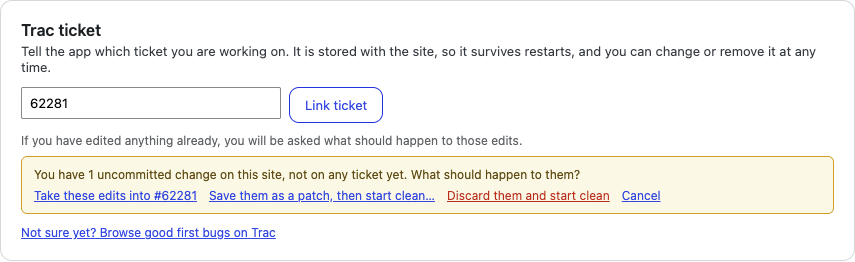 **After choosing to carry them** — `carried-work-notice.png`: 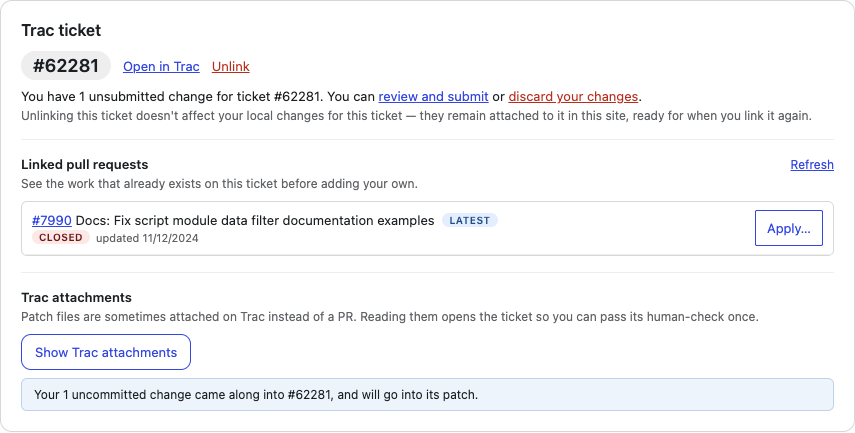 **The ticket card with coloured pull request states and the unsubmitted-work note** — `linked-pull-requests.png`: 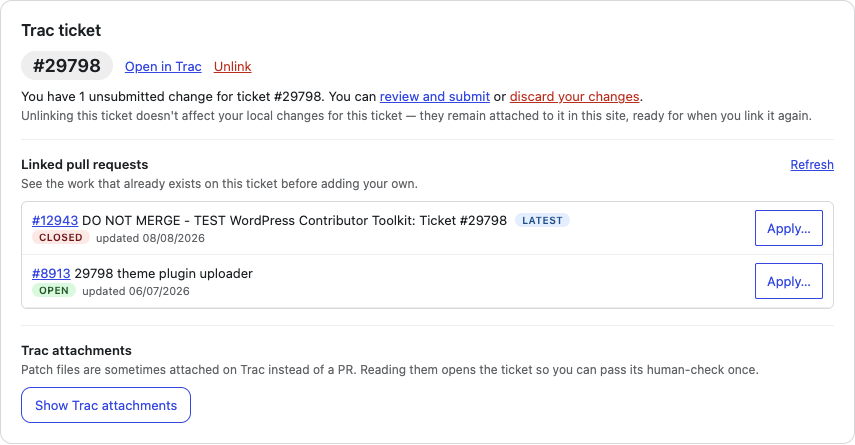 **The three cards in their new order** — `site-with-tickets.png`: 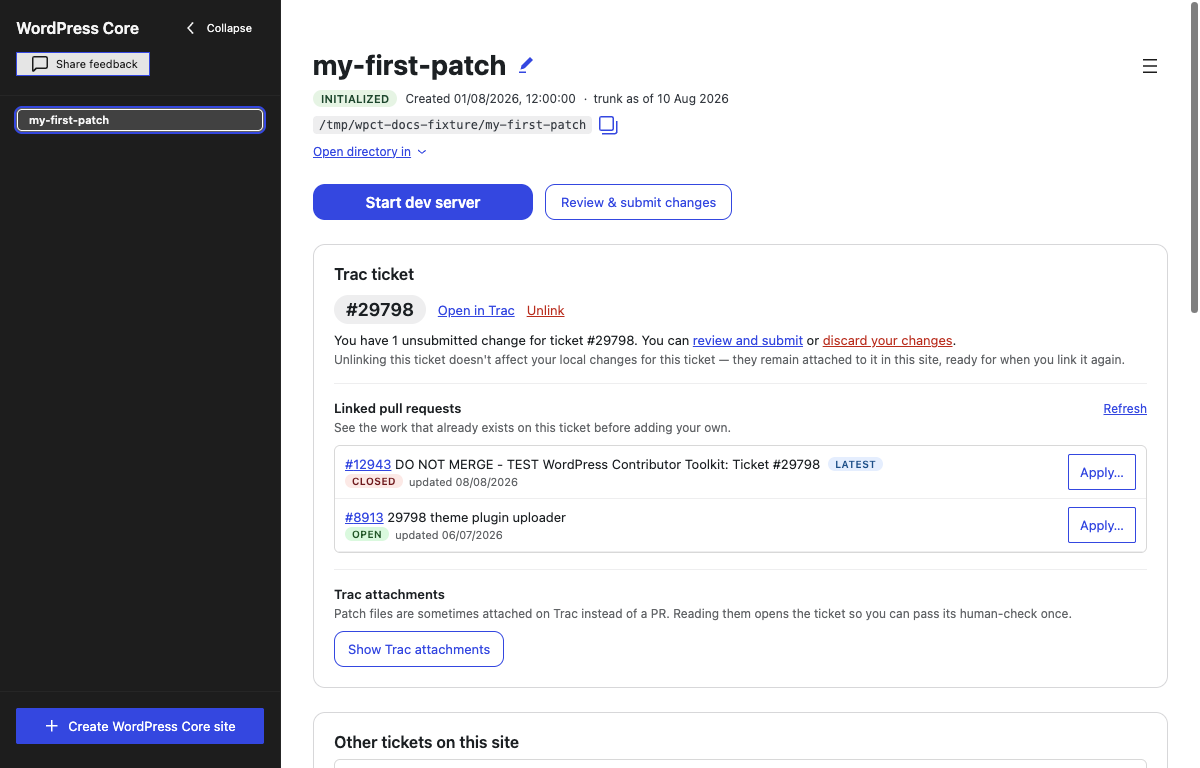 **Replaced:** `site-view.png`, whose action bar read **Submit changes**. No stack behaviour is visible in it — it is a straight re-take of a stale image. </details> --------- Co-authored-by: Claude Opus 5 (1M context) <noreply@anthropic.com>
juanmaguitar
deleted the
juanmaguitar/working-on-a-second-ticket-means-rebuilding-the
branch
August 11, 2026 11:29
This file contains hidden or bidirectional Unicode text that may be interpreted or compiled differently than what appears below. To review, open the file in an editor that reveals hidden Unicode characters.
Learn more about bidirectional Unicode characters
Sign up for free
to join this conversation on GitHub.
Already have an account?
Sign in to comment







Add this suggestion to a batch that can be applied as a single commit.This suggestion is invalid because no changes were made to the code.Suggestions cannot be applied while the pull request is closed.Suggestions cannot be applied while viewing a subset of changes.Only one suggestion per line can be applied in a batch.Add this suggestion to a batch that can be applied as a single commit.Applying suggestions on deleted lines is not supported.You must change the existing code in this line in order to create a valid suggestion.Outdated suggestions cannot be applied.This suggestion has been applied or marked resolved.Suggestions cannot be applied from pending reviews.Suggestions cannot be applied on multi-line comments.Suggestions cannot be applied while the pull request is queued to merge.Suggestion cannot be applied right now. Please check back later.
Why
A site is one working tree and one implicit patch. There is no branching, stashing or committing anywhere in the app.
So a contributor who finishes ticket #59234 and wants to start #61002 has two options, and both are bad: clone a second site — another ~54 MB fetch, another
npm install, another first build, which is exactly the setup cost this app exists to remove — or keep working in the same tree, where the second ticket's changes pile onto the first and the generated patch mixes both with no way to separate them afterwards.Finishing a first ticket and starting a second is the moment a first-time contributor becomes a repeat one. It is currently the worst-supported transition in the app.
What changes
The site is the expensive substrate (clone +
node_modules+ build output). A ticket becomes a cheap branch on top of it, so switching costs seconds instead of a rebuild.Two invariants hold it up:
trunkis never committed to. It stays the pristine snapshot every branch is diffed against. Work started on trunk is carried into a ticket branch —git.branch({checkout: true})only moves HEAD, so uncommitted edits come along and nothing is thrown away.parent: [baseOid]explicitly instead of committing onto the previous WIP commit, so re-parking rewrites that commit rather than stacking a pile of saves nobody asked for.The diff base becomes the branch point each branch records, which is what makes a patch mean "only my work on this ticket" once WIP commits exist.
Deliberately not in this PR: the "Working on:" switcher and splitting today's single Unlink into switch and delete this ticket's work — this is the main-process half, and nothing in
src/renderer/index.jsxcalls the new bridge yet, so a ticket is linked and resumed through the existing Trac ticket panel. Also left out: replaying an old branch onto an updated trunk, and the half of #85 that drops file deletions from patches. Each is named under Risks with its reason.How to test this
Any platform. Windows is the more interesting one — this touches paths, line endings and checkout behaviour. Buildkite builds signed artifacts for this branch; check the build matches the current head commit.
Starting state: a site that has finished its first install and build, on no ticket.
59234. → The panel shows#59234.wp-login.php— add a comment line you will recognise.wp-login.phpand that line, and nothing else.61002in the same panel. → Completes in seconds, with no install or build output.wp-login.php. → Your step-2 edit is gone — this is #61002's tree. Now edit a different file, saywp-comments-post.php.59234again. → Your step-2 edit is back exactly as you left it.wp-login.php.Then the case the invariants exist for: with
59234linked and an uncommitted edit in the tree, click Update to latest trunk. The log says it is parking your work, then that it is returning to your branch. Afterwards the panel still names the ticket and Submit patch still produces your change — not an empty patch.What must not have happened:
node_moduleswas never reinstalled and the site was never rebuilt. Steps 4 and 6 are checkouts; if either took minutes or streamed install output, that is the regression this whole change exists to prevent.Risks and limitations
Review outcome: 9
[fix here]· 2[follow-up]— all 9 fixed. Breakdown in the collapsed section below. The serious one was user-visible: "Update to latest trunk" parked the ticket and never came back, so the site sat on trunk while the panel still named the ticket, every patch came out empty, and the only route back to a morning's work was to unlink and re-link.Known limitations, all deliberate:
branches:deleteis unreachable in the shipped app until the switcher lands.invoke(), so the window is quiet during a large checkout. The duplicated worktree scan is gone, but streaming the progress needs the UI change.rebase. A branch born three weeks ago keeps producing a patch that is correct against its own base but no longer applies on current trunk. The route without rebase — generate patch → branch off new trunk →applyPatchToDir— is the flow already designed in Sites have no update path: patches age against a frozen trunk #94's comments, and is its own issue.mergeBranchMetainherits a read-modify-write race from the existing metadata pattern. Narrow and pre-existing, but the value at stake isbaseOid. Filed as Overlapping writes to a site's metadata can drop a ticket branch's patch base #172.What could not be tested by hand: the mid-switch recovery. It needs
git.checkoutto fail part-way — realistically a WindowsEPERMfrom an editor or antivirus holding a file — which I could not stage reliably. Its guard is covered by a wiring test instead.Related
Part of #108. Part of the contribution-flow tracker #110. Touches ground shared with #94 (trunk update) and #85 (patch generation), neither of which this closes.
The PR-description template this description follows started life on this branch and now lives in #170, which reviews and merges independently — it affects every PR rather than this one.
This branch has #169 merged into it. That PR added the mentor-handoff header to
git:save-patch, which reads the base the patch was diffed against — so the conflict was a real one, not a textual overlap. See the resolution note in the collapsed design section.Design decisions and alternatives considered
The diff base is the branch point, not
origin/trunk— against what #108 asks for#108 states the diff base "must become
origin/trunk". I did not do that, and the codebase already argued why:src/main.jsdocumented that diffing local edits against a trunk that has moved embeds reversed upstream changes and foreign context lines, producing a patch that applies nowhere.It cannot be the live
refs/heads/trunkeither, becauseupdateToLatestTrunkmoves that ref while existing ticket branches stay where they were born — reading it would reintroduce the same drift for every branch created before an update.So each branch records the trunk oid it forked from, and
statusMatrix({ref: baseOid})diffs against it. This also sidestepsfindMergeBase, which operates on a truncated graph in adepth: 1clone.Consequence: the
origin/trunkfetch that was performed and never used — the "dangling diff base" flagged in both #94 and #108 — is deleted rather than put to work, saving a network round trip on every "view patch".Merging #169: a handoff header must name the base the patch was diffed against
#169 landed on trunk while this branch was open, and gave
git:save-patcha provenance header carryingtrunkOidandtrunkDateread from the site record. Taking either side of the conflict verbatim would have been wrong: keeping this branch's version drops the header entirely, and keeping trunk's version diffs against the implicitHEADagain — a ticket branch's WIP commit — producing an empty patch under a header that looks authoritative.The resolution diffs against the branch's recorded
baseOidand puts that commit in the header. The date comes off the commit itself rather than the site record, because on a ticket branch the two describe different commits as soon as anyone updates trunk: the oid would say "born at the July snapshot" and the date would say "August 8th". A mentor applying the patch would go to the wrong tree. When there is no branch base — a site on trunk, which is every site today — the site record is used exactly as #169 wrote it, so nothing on that path changes.Covered by a new wiring test that builds a repository whose trunk has moved past the branch point; it fails on the naive resolution.
Parking amends rather than accumulates
Passing
parent: [baseOid]on every park keeps exactly one WIP commit per branch. Accumulating would leave a trail of saves the user never asked for, which every later operation — patch, delete, switch — would then have to stay correct in the presence of. That is the risk #108 itself flags at the end.WIP commits use a synthetic author
isomorphic-git requires
author.name/emailand there is no hostgit configto read — a contributor having no git installed is the premise of the project. These commits never leave the disk; the deliverable is still the patch, and its real author is the name on the Trac ticket.Rejected:
git.stashIt would avoid inventing commits, but it is a single stack per repository rather than per branch, and reading a stash back requires the same worktree state it was taken from. Branches are what the model actually wants.
Review outcome (9 [fix here] · 2 [follow-up] — all 9 fixed)
Run per AGENTS.md before opening, with the judgement pass in a fresh context so the session that wrote the code was not the one grading it.
stage: 'checkout'and the site is marked mid-switch until reconciled.appliedPatch/updateIncompletewere declared per-branch but no handler was moved, so ticket A's "patch applied · Revert" banner showed while on ticket B. One reader and one writer now.branches:deleteresetcurrentBranch/tracTicketunconditionally, silently unlinking the ticket you were working on when deleting a different one.branchesmap on failure — permanently, via its own "already migrated" guard.withRegisteredSiteswallowed failures withoutlogError.git.addloop was safe was only asserted by re-implementing the filter inline, never through the real handler with an untracked file present.git:update-trunktest's own comment said it exercised the park path; it did not — the block could be deleted and the suite stayed green.[follow-up], both in Risks above: the renderer not calling the new bridge, and themergeBranchMetarace.One thing worth flagging rather than burying: the test written for finding 3 passed against the broken code on the first attempt, because it seeded no site-level value that could leak. It was hardened until it failed for the right reason. That is the "green while proving nothing" pattern the review standard names, produced while fixing a finding about it.
Second pass, after merging trunk (#169): 0 [fix here] · 1 [follow-up]. A fresh-context review of the merge resolution confirmed
baseProvenanceon both paths, the completeness of the merge from both parents, and that nothing renderer-controlled reaches the handoff filename or header. The one finding: the handoff header's base now follows the worktree while its ticket and filename still follow the registry, so an out-of-band checkout can produce a correctly-diffed file attributed to the wrong ticket. Filed as #175 rather than fixed here — three other surfaces read the registry the same way, and one authority applied to all four is a separate change.Implementation notes
New:
src/ticket-branches.js— park / start / switch / delete / list, with no Electron dependency sonode --testdrives it against real repositories, reusingensureAutocrlffromtrunk-update.js.Changed behaviour this dragged in:
readTrunkInforesolvedHEADto date the trunk snapshot. On a ticket branch that is a WIP commit made minutes ago, so the staleness dot (Sites have no update path: patches age against a frozen trunk #94) would never light up. It readsrefs/heads/trunk, falling back toHEADfor an adopted repository with no trunk branch.discardChangeschecked outtrunkby name, which under this model would silently move the contributor to another ticket. It checks out whatever is current; parked work survives, since destroying a ticket is what deleting its branch is for.Patch generation no longer touches the index. The
git.addloop that staged every untracked file and never unstaged it (#85) is redundant —statusMatrixreports untracked files as[path, 0, 2, 0]unaided, and thehead !== workdirfilter keeps them. Verified empirically before removal, and now through the handler with an assertion that the index is byte-identical afterwards.staleStagedPathsstays: parking stages the worktree, and indexes dirtied by earlier app versions are still out there.Migration.
siteMeta[sitePath]gainsbranchesandcurrentBranch;tracTicket,appliedPatchandupdateIncompletemove under the branch. A site with a linked ticket gets that branch created at the current trunk tip with its work carried onto it; a site without one gains an empty map. It runs only from handlers already about to move HEAD — a list call can land while an install or the Playground server is running against that directory.Tests: 405 pass on
.nvmrc's Node and on Electron's bundled Node;npm run lintclean. The behaviour changes toreadTrunkInfo,discardChanges, per-branch applied state and returning to the branch after an update were each confirmed to fail with the previous code by reverting the source and re-running.Screenshots or recording
Nothing on screen changed. This PR is the main-process layer; the visible surface — the "Working on:" switcher, and splitting today's single Unlink into switch and delete this ticket's work — is the follow-up.