

Founder & CEO, SAGE7 AI — a one-person AI company, run like a 65-person org.
In the last twelve months, one person shipped: four papers (IEEE Access, SSRN), 25 open-source libraries, 13 upstream fixes to vLLM, litellm, mem0 and others, 5,500+ GitHub contributions, a production platform on my own Kubernetes cluster, and agent deployments inside an enterprise finance team. No team. Agents draft everything; I own every decision that touches money, data or a customer, and the audit line is written before anything acts.
That is also the product. SAGE7 builds the trust boundary that lets one accountable person run a fleet of agents — and lets a bank or an insurer do the same at their scale. This page is the working prototype.
Before this: 20 years leading engineering and data-science organizations — Sr. Director at SpotHero (2 teams → 7, 15 → 65 people, two countries), Sr. Director of Applied ML & Data Platforms at Apple (17 engineers), Tier-1 speech services at Amazon Alexa (~1B devices), a decade of devices and connectivity at Motorola/Google/Lenovo. 48 granted patents, 604 citations.
Operating principle: the guardrail is the design, not the heroics. Everything below — the leadership record, the papers, the libraries — is the same idea at different scales.
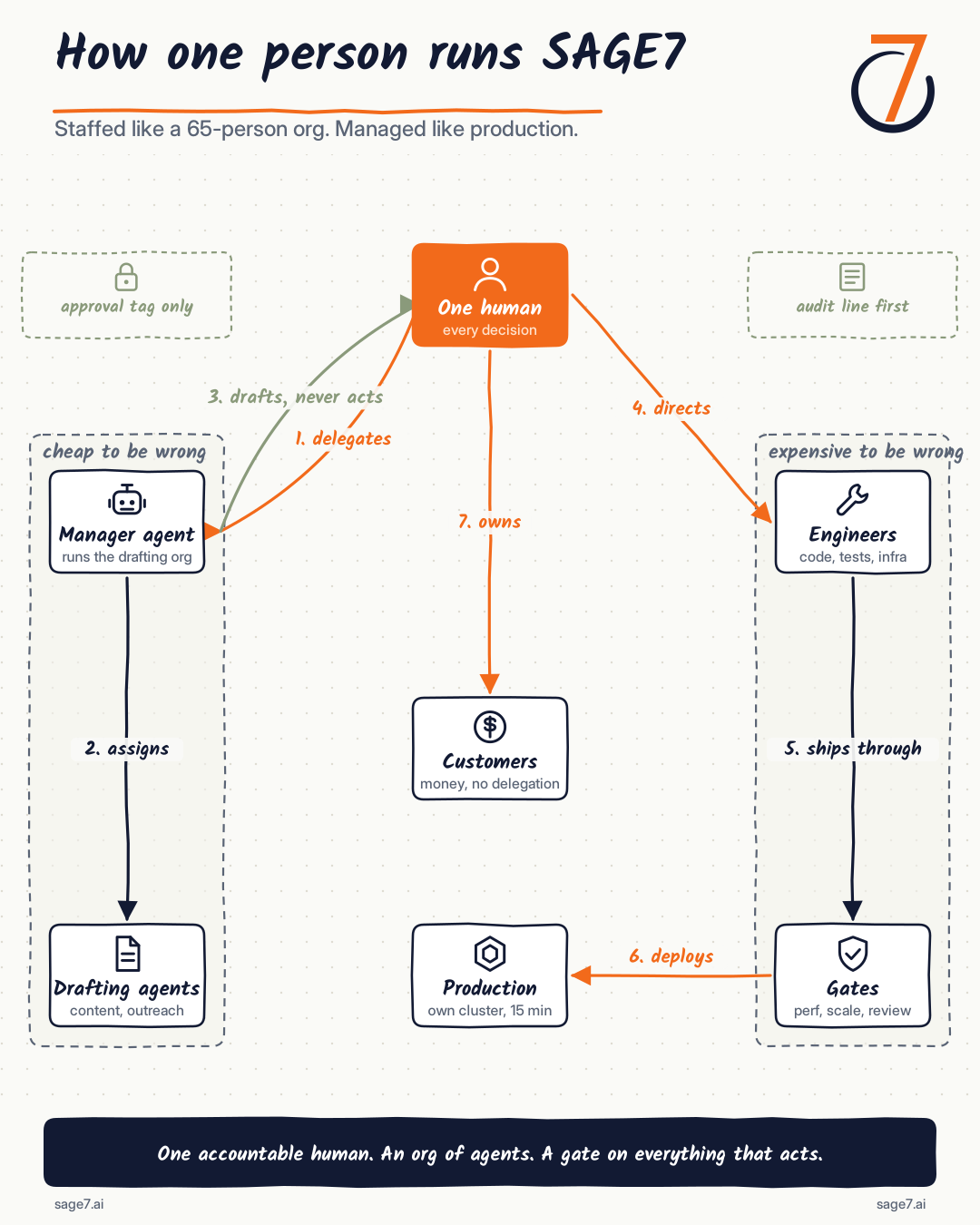
An org chart, not a chatbot. SAGE7 is staffed like a 65-person company. Every agent has a charter, a scope and the statuses it is allowed to move work into. A manager agent runs the drafting functions; I run the agents that touch production, customers or money myself. Nothing acts without an approval tag, and the audit line is written before the action.
| Function | Who runs it | Gate |
|---|---|---|
| Content, research, visibility | Manager agent → drafting agents | I approve every post; every number traces to a source |
| Outreach and pipeline | Manager agent → outreach agents | I approve every send; nothing goes out from a draft |
| Engineering: code, tests, infra | Agents reporting to me directly — e.g. a nightly PR agent across a portfolio company's 7 repos that scans, fixes and verifies | Performance, scalability and architecture gates before merge; the PR agent is not allowed to merge |
| Customers, production, money | Me | No delegation |
Repo to production in under 15 minutes. One standing platform — own Kubernetes cluster, GitOps (ArgoCD), CI that builds and pins images, a namespace and database per product, observability — so a new product goes from first commit to a live URL in under 15 minutes, on infrastructure sized for ~100k customer interactions a day. Agents can only ship through the same gates: performant, scalable, reviewed.
Customers. GreenBridge AI (agentic platform for power generation and storage), Austin IBN, Intellect Capital Group, AlgebraIT and Upsimpl, plus engagements under NDA in IT services and staffing, and talent management — FDE-style training, agent-architecture patterns and production delivery. Working on agents that touch money, data or memory? Reach out.
sage7.ai/blog · LinkedIn · Technical notes · sudhir.vissa@sage7.ai
What changed because I was in the room — the decision, then the result.
| Where | Situation → decision | Result |
|---|---|---|
| SpotHero · Sr. Director, Data Science / Insights & Forecasting | Pricing was rule-based and the data org was 15 people in 2 teams. Split ML engineering from data science, stood up a platform team, built the forecasting and experimentation practice, and architected SpotHero IQ (precision pricing) plus time-based reservation reselling. | ~6× revenue on the priced inventory by deployment, with measured ROI. Org grew to 7 teams / 65 people across the US and Canada with predictable delivery; KPIs and forecasts set executive pricing and spend decisions. |
| Apple · Sr. Director, Applied ML & Data Platforms | Model builders across the org each shipped their own way. Led 17 engineers on two teams to make the governed path the default — versioning, lineage, monitoring and rollback as platform primitives, plus a technical-debt framework. | Shorter model-deployment timelines and higher reliability across dozens of use cases. The same lineage-first idea is now the thesis of my IEEE Access paper. |
| Amazon Alexa · Sr. SDM, Alexa Services | Tier-1 services delivering ASR, TTS, speech-to-intent and wake-word models to the whole fleet needed to scale and stay certified. Re-architected on DynamoDB + S3; embedded threat modeling into daily delivery. | ~1B devices served at tens of thousands of TPS with cost-based dynamic scaling; security certification retained through the rebuild. |
| Uptake · Director of Engineering, Platform Data Sciences | Enterprise IIoT customers on Tier-1 model-management and DBaaS services with no operating discipline. Managed EMs, TPMs, principals, data scientists and SREs; instituted SLAs/SLOs and monthly cost/reliability reviews. | Operational-excellence controls (rate limiting, load testing, scaling) became routine; an invention-sprint program produced the lab's patent and white-paper portfolio. |
| Motorola → Google → Lenovo · Engineering Manager | From kernel Wi-Fi drivers and board bring-up to running 12-engineer connectivity and R&D teams (sensors, indoor positioning, biometrics) with silicon vendors and ODMs across Asia. | A patented cloud-decision geolocation feature shipped in Android M; the group's IP portfolio and ~40 upstream Linux-kernel contributions. |
Also: Head of Engineering at Next Step Dynamics (Sweden) — distributed full-stack, data and ML teams on a GDPR-regulated multi-tenant care platform with edge ML on wearable sensor streams.
From people who worked with me (all recommendations)
"A strong leader that any engineering organization could benefit from … thoughtful in how he grew his engineers." — Ashwin Sawh, fellow Director at SpotHero
"His technical expertise is outstanding, and as a mentor, his guidance is invaluable." — Luis M. Antunes, Staff Data Scientist, SpotHero
"We counted on him as a technical leader for our development team." — Roland Labana, CTO Altafid; ex Snap, Google, Motorola
| Focus | Now |
|---|---|
| memharness | Neutral eval harness for agent memory — vendors shouldn't grade their own homework. Latest verified run: 1,986 questions across the suite |
| Papers | Lineage-aware memory governance (IEEE Access), the autonomous agentic store (SSRN) — full list below |
| SAGE7 AI | Agent trust boundary for teams shipping agents in production. Recent client work (enterprise finance team, 2026): Oracle Fusion AR automation — ~70% of the receivables workload automated, refunds from 3–5 days to under 24h, error rate 12% → under 1%. Shipped eHire (autonomous outbound-sales workflow). |
| Open-source contributions | 13 open PRs, 3 approved — hands-on fixes to the LLM/ML libraries production runs on: litellm, vLLM, lancedb, mem0, qdrant-client, weaviate-python-client (full record at the bottom) |
One argument, four papers: when an agent acts on money, data or memory, the trust boundary is an architecture decision, not a prompt. Agentic Store sets the safety requirements for agents that transact; Lineage-Aware Memory says an agent may act on a memory only if its provenance is checked first; After Attention works out the market economics when the buyer is an agent; IT-IFC keeps PII/PCI from leaking into AI-augmented analytics at ingestion.
Earlier articles: Optimizing Large-Scale MLOps Pipelines for Continuous ML Deployment (2025), The Evolution of Cloud-Native Data Pipelines.
48 granted patents, 604 citations. What matters is how often later inventors build on them — the most-cited, by 88. The work spans biometrics, sensing, location, and audio — plus cloud and AI.
| Patent | Cited by |
|---|---|
| Methods and devices for negotiating performance of control operations with acoustic signals (US10902855B2) | 88 |
| Peer-to-peer group re-formation (US9560129B2) | 55 |
| Location correlation in a region based on signal strength indications (US10499194B1) | 28 |
| Electronic device with gesture actuation of companion devices (US10251056B2) | 18 |
Full list on Google Patents.
Writing — the flagship essay plus 12 technical posts
Essays at sage7.ai/blog; technical notes at shadowmodder.github.io; earlier writing on Medium.
Open source — 25 small, dependency-light libraries: eval, threshold, memory, tool loop
Small, dependency-light libraries my teams ship with — the pieces where the decision actually gets made: the eval, the threshold, the memory, the tool loop.
| Repo | What it does |
|---|---|
| tool-loop | Agentic tool-use loop: parallel dispatch, error isolation, auto-schema |
| mcp-quickserver | MCP server template: tools, resources, prompts; stdio + SSE |
| stream-parse | Streaming LLM output parser: incremental JSON, tool-call deltas, SSE |
| agent-scratchpad | Persistent vector memory for agents |
| prompt-cache-bench | Prompt-caching benchmarks: hit rate, latency, cost |
| llm-eval-lite | Eval harness for LLM/agent outputs (AllOf, AnyOf) |
| rag-eval | RAG eval: chunking, retrieval quality, faithfulness |
| llm-gateway | Production Anthropic proxy: rate limiting, retry, cost tracking |
| rag-demo | End-to-end RAG demo: BM25 + agent + faithfulness eval |
| Repo | What it does |
|---|---|
| ml-eval-report | Classifier eval reports: metrics, ROC/PR, threshold sweep, ECE |
| calibrate-ml | Probability calibration: Platt, isotonic, ECE, reliability diagrams |
| thresholdkit | Operating thresholds under precision / FPR / cost constraints |
| rankeval | Ranking metrics: NDCG, MRR, AP@K, P@K, R@K |
| Repo | What it does |
|---|---|
| featurecheck | Feature drift (PSI/KS/chi-squared) + schema validation |
| idgraph | Identity graphs: synthetic-identity rings + risk scoring |
| pii-redactor | PII detection & redaction (email, phone, SSN, cards) |
| capture-qa | Image capture-quality gates |
| modelcard-gen | Model Card markdown from JSON config |
| semantic_search | Semantic search: SentenceTransformers, Flask, Parquet; Milvus experiment |
| Repo | What it does |
|---|---|
| tps-bench | HTTP throughput & p50/p90/p99 latency benchmark |
| cmsketch | Count-Min Sketch: sublinear-memory counters |
Upstream work — 13 PRs to litellm, vLLM, lancedb, mem0 and others, plus 2013–15 Linux-kernel patches
Correctness and security fixes in the ML/LLM libraries production runs on, plus the kernel work underneath. Also tracked at PORTFOLIO.md.
Full list of the upstream commits carrying my name: GitHub commit search.
SAGE7 AI (2024– ) · Apple · SpotHero · Next Step Dynamics · Uptake · Amazon Alexa · Motorola / Google / Lenovo (2007–2017). Georgetown, Texas.
M.S. Electrical Engineering, New Jersey Institute of Technology · B.Tech Electronics & Communication, MCET Hyderabad.
Working on agent trust boundaries, agent memory governance or FDE-style AI adoption in your org? Compare notes.