Repository navigation
fix(provider): show exit details when ACP session startup crashes - #28419
Conversation




…ess dies during startup

An ACP process that crashed while a session opened showed only
"Failed to open <driver> provider session <id>." The signal (SIGILL in
#28401) was only in the server trace.

The curated failure walk now recognizes AcpProcessExitedError and reports
the enclosing stage plus the structured signal or exit code, pointing to
the server logs. stderr and the spawner cause stay out of the message.

Co-Authored-By: Claude Opus 5.5 <noreply@anthropic.com>
 github-actions
Bot
added
vouch:trusted


ApprovabilityVerdict: Approved at Macroscope's review found this PR approvable — ACP startup failures now show a validated exit code or signal with troubleshooting guidance. The change is limited to error presentation and does not expose raw provider output or alter execution behavior. You can add or adjust custom eligibility rules. Learn more. |

Thread transfer impact✅ Thread transfer remains within every enforced ceiling.
Baseline: Scenario and decoded snapshot size10 historical turns, 5 command tools per turn, 878.9 KiB retained MCP result per historical turn, and a 1.05 MiB retained result in the measured turn.
Updated in place by a trusted workflow. PR artifacts are strictly validated and never executed. |

|
No actionable comments were generated in the recent review.
 |


| Layer / File(s) | Summary |
|---|---|
Format and verify process-exit messages packages/provider-core/src/server/failure.ts, packages/provider-core/src/server/failure.test.ts |
The formatter adds a curated message for AcpProcessExitedError. It reports a valid signal or safe-integer exit code when available. Tests verify that the message omits unsafe or absent status, stderr, nested causes, and private identifiers. |
Estimated code review effort: 2 (Simple) | ~10 minutes
Change: Bug fix · Severity of issue fixed: Medium
Possibly related issues
pingdotgg/t3code#28345— Reports the same Antigravity ACP startup signal, and this change surfaces the signal in the startup error.
Possibly related PRs
- pingdotgg/t3code#25693 — Adds ACP process-exit diagnostics to the failure formatter.
- pingdotgg/t3code#26242 — Adds curated user-facing diagnostics for CLI startup exits.
- pingdotgg/t3code#28355 — Formats Antigravity sign-in process exits with a safe signal or exit code.
Suggested labels: bugfix
Suggested reviewers: t3dotgg
Merge Risk: 
3f3e5

-
No merge-blocking risk is established; normal checks should run before merge.
Pre-merge checks: 

-
Check name Status Explanation Title check The title clearly and concisely describes the main change: showing exit details when an ACP session startup crashes. Linked Issues check The changes satisfy the coding requirements in #28401.curatedCauseMessagesrecognizesAcpProcessExitedErrorand reports the provider session-open category, a validated signal or safe-integer exit…Out of Scope Changes check The pull request changes only provider failure formatting and its focused tests. The changes support the diagnostics requested by #28401. They do not change the upstream runtime, CPU state, authentica…Description check The pull request description is complete and follows the required structure. It explains the problem, change, scope, linked issue, verification steps, observed results, limitations, and implementation… Full details: Linked Issues check
-
Explanation
The changes satisfy the coding requirements in
#28401.curatedCauseMessagesrecognizesAcpProcessExitedErrorand reports the provider session-open category, a validated signal or safe-integer exit code, and server-log guidance.processExitStatusexcludes stderr and nested cause text. The focused tests cover signal, exit-code, missing-status, unsafe-signal, nested-output, and direct-error cases. The resulting runtime failure message distinguishes startup failure from the saved authentication state without changing that state.
Full details: Out of Scope Changes check
-
Explanation
The pull request changes only provider failure formatting and its focused tests. The changes support the diagnostics requested by
#28401. They do not change the upstream runtime, CPU state, authentication state, or unrelated provider behavior.
Full details: Description check
-
Explanation
The pull request description is complete and follows the required structure. It explains the problem, change, scope, linked issue, verification steps, observed results, limitations, and implementation tools. The scope section does not include an explicit maintainer approval comment, but the focused bug fix and linked issue provide sufficient context.
-

Finishing Touches
-
Generate docstrings
-
- Commit to this branch
- Create a new PR
Generate unit tests (beta)
-
- Commit to this branch
- Create a new PR
-
- Autofix · Keep fixing CodeRabbit findings and required CI, and resolving merge conflicts

|
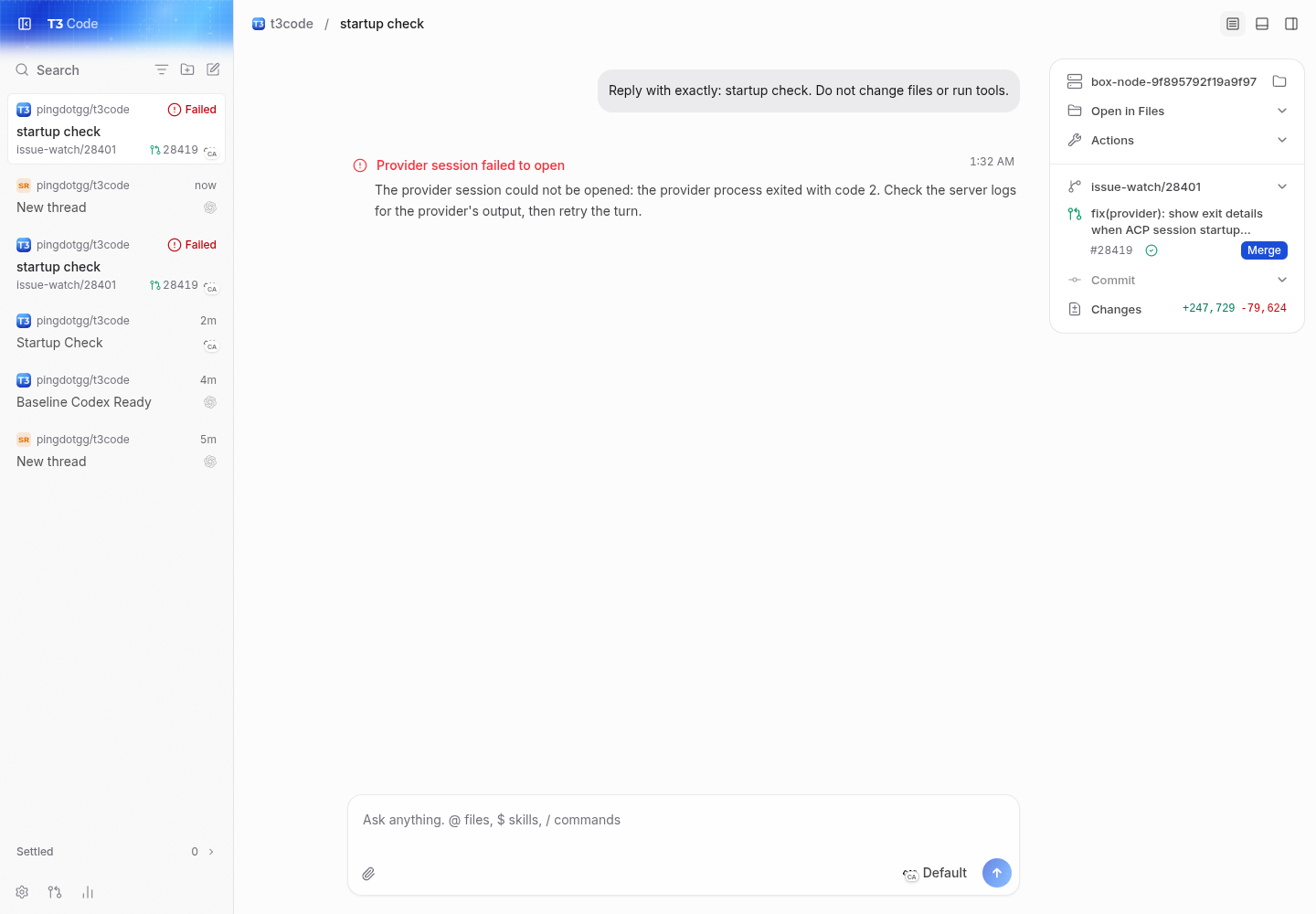
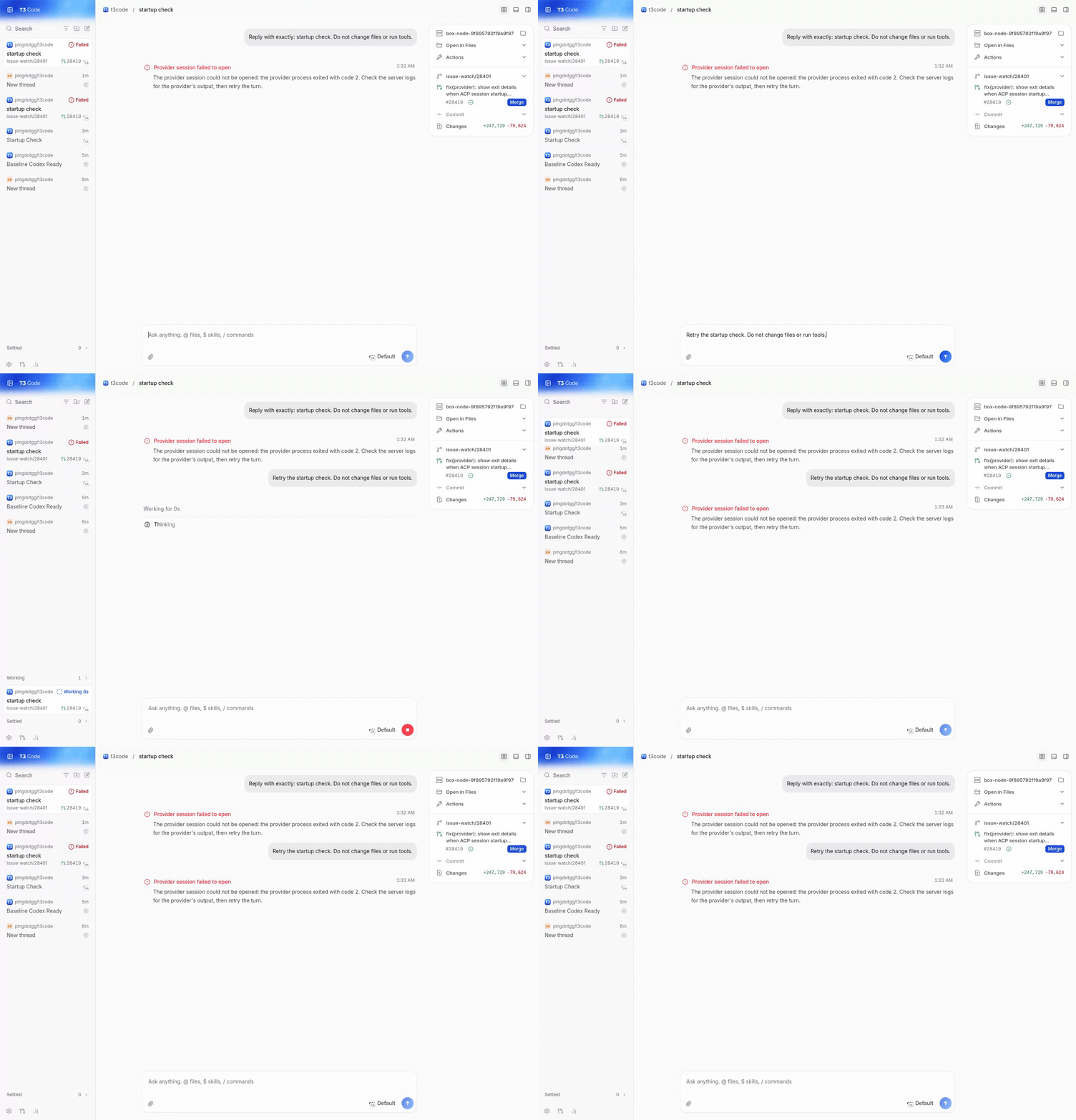
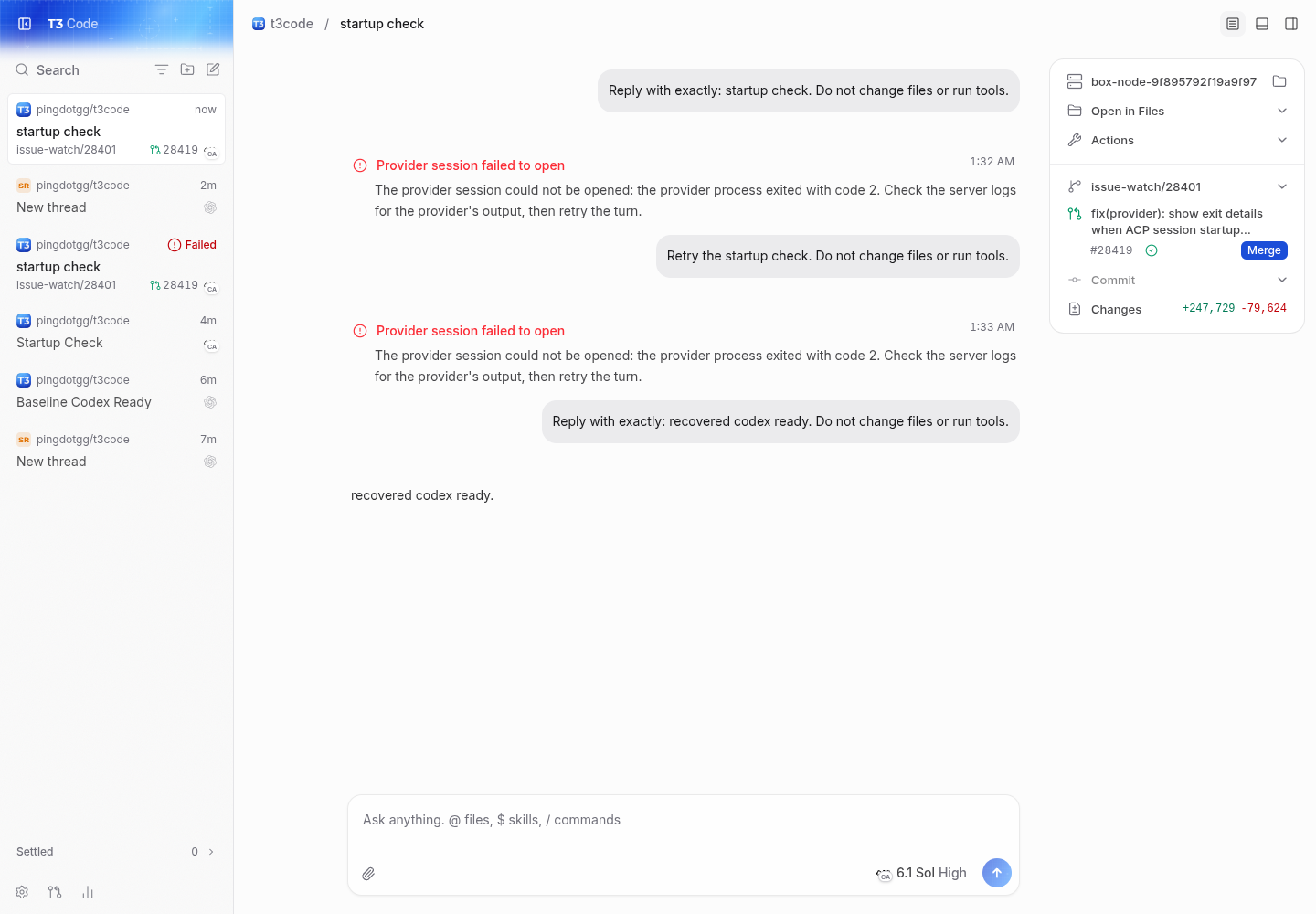
Note Written by Verified in a real dev environmentverified head configured the genuine codex-acp 0.16.0 linux executable as a local ACP provider with the unsupported launch argument retry produced the same useful error. both failures survived page reload. the recording shows submitting the follow-up and the second failure. nearby behavior passed: switched the local ACP configuration to codex-acp 2.5.0 without the invalid argument, then completed a real short runtime transcript: blacksmith checks passed: the focused failure suite (12 tests) and Not verifiedthis vm did not reproduce the reporter's CPU-topology-specific Antigravity SIGILL crash. the real-app scenario exercised the exit-code branch; signal and absent-status variants were covered by the existing focused tests, not a real crashing Antigravity process. native desktop shells, ios/android clients, macos/windows, and remote/tunnel connections were not exercised. |


Problem
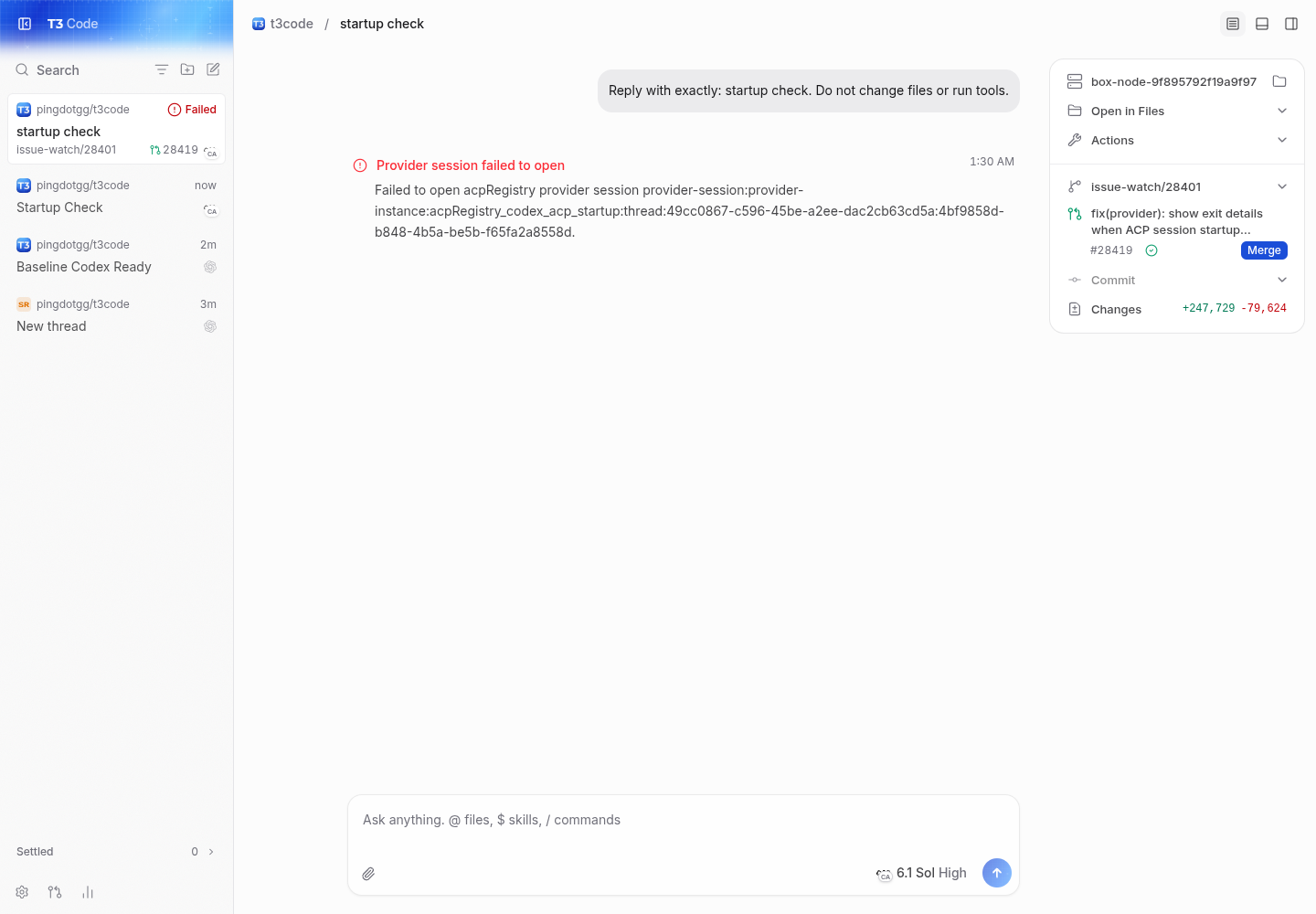
An ACP process crash during session startup showed a generic error and an internal session identifier, even when the server knew the termination signal.
Closes #28401
Change
The existing error formatter now shows the session-open stage and structured signal or exit code, with guidance to check the server logs. It keeps stderr and nested provider output out of the message.
Scope and approval
This changes shared ACP failure diagnostics. It does not fix the upstream runtime crash or change saved authentication state. No provider execution, UI, or wire-contract changes.
Verification
Evidence
Recorded on physical corex Linux in the v0.1.6 Electron desktop shell, using server sources from the commits below and an isolated T3 home. The desktop renderer was captured directly through its own debug endpoint, so other agents' foreground windows are excluded. These recordings replace the earlier stand-in-process evidence.
Both runs use Google's unmodified managed Antigravity ACP runtime 1.4.1, resolved by the real installer as
source: managed. Its archive SHA-256 is2e37012ceb2a5c7fc7309b6e6596234fb637ee3c62a5199f65d4cbe777871384. A temporary launch hook records the spawned PID, waits for the ACPinitializewrite, checks/proc/<pid>/exeis the managedagy_acp_server.par, and sends that process SIGILL after 400 ms. It does not replace the runtime or inject an error into the formatter.Before, main
575579d68ac4bae09f8426a345d4a3eac1e90c67: the initial failure remains visible in history, then the recording shows a follow-up retry ending with the same generic error and internal session identifier.before-managed.mp4
After, head
3f3e50b35526ae98692567d0c23ba23cc64cc1d6: a new startup attempt and another follow-up retry both show the session-open stage, SIGILL, and server-log guidance. Earlier failed turns remain in the history with their original generic messages.after-managed.mp4
Runtime transcript
The retry messages were sent through
t3 thread send <thread> <message> --base-dir <isolated-home> --wait --json. The server also makes its normal automatic startup attempts, each terminated during initialization. The CLI exits nonzero because the deliberately crashed provider fails; the desktop displays the same persisted error.Validation for head
3f3e50b35526ae98692567d0c23ba23cc64cc1d6:vp test run packages/provider-core/src/server/failure.test.ts, 12 tests passed.vp run check:changedpassed format, lint, both knip checks, typechecks for 25 packages, and 13 tests across 2 files.Unverified: the reporter's CPU-topology-specific cause of SIGILL, a successful authenticated Antigravity turn, mobile rendering, and clicking the desktop retry controls. These recordings verify the actual managed-runtime startup crash and follow-up-message retry, not the cause or repair of that crash. Exit-code and unsafe-status variants are covered by focused tests.
Implemented with Claude Opus 5.5 in Claude Code. Investigated, tested, and independently reviewed with GPT-6.1-Sol in Codex.