
A native, open-source desktop simulation suite — written in Rust, no browser, no subscription, no vendor lock-in — and AI-drivable end to end (every workbench exposes named accessible widgets + an agent-command bridge, so an AI agent can operate the whole app, not just a human). One app spanning: engineering — aerospace (launch-vehicle ascent, orbital mechanics, re-entry), CFD (plus a GPU-compute path), FEA, electromagnetics, multibody dynamics, thermal, thermodynamics (equations of state), acoustics, optics, topology optimization, large-deformation (MPM), battery, and a parametric CAD/CAM suite (with a B-Rep solid kernel); chemistry & materials — molecular dynamics, quantum chemistry, reaction dynamics, and cheminformatics; and computational biology — genomics, sequence alignment, phylogenetics, population genetics, protein structure & design, RNA/mRNA design, CRISPR gene-editing, cryo-EM, and systems biology; and neuroengineering — neural-interface / BCI stimulation (extracellular fields, Hodgkin–Huxley cable models, bioheat); and gravitational physics — an in-house general-relativity / black-hole engine (Kerr–Newman spacetimes, geodesics, Hawking thermodynamics, and a shadow ray-tracer); quantum computing — a state-vector circuit simulator; and defense / mission planning — a map-based tactical planner (OSM basemap, MIL-STD-2525 symbology, A* routing, line-of-sight), analysis / planning only. A complete in-house suite — its own native Rust solvers across every domain above, validated against published ground truth — with optional adapters to external tools when you want them.
Status: 0.1.0-alpha.1 — pre-release. The workflow loop is
usable end-to-end (load project, click a case, Prepare, Run,
inspect results) but real-world testing is just beginning. Expect
sharp edges; please file issues.
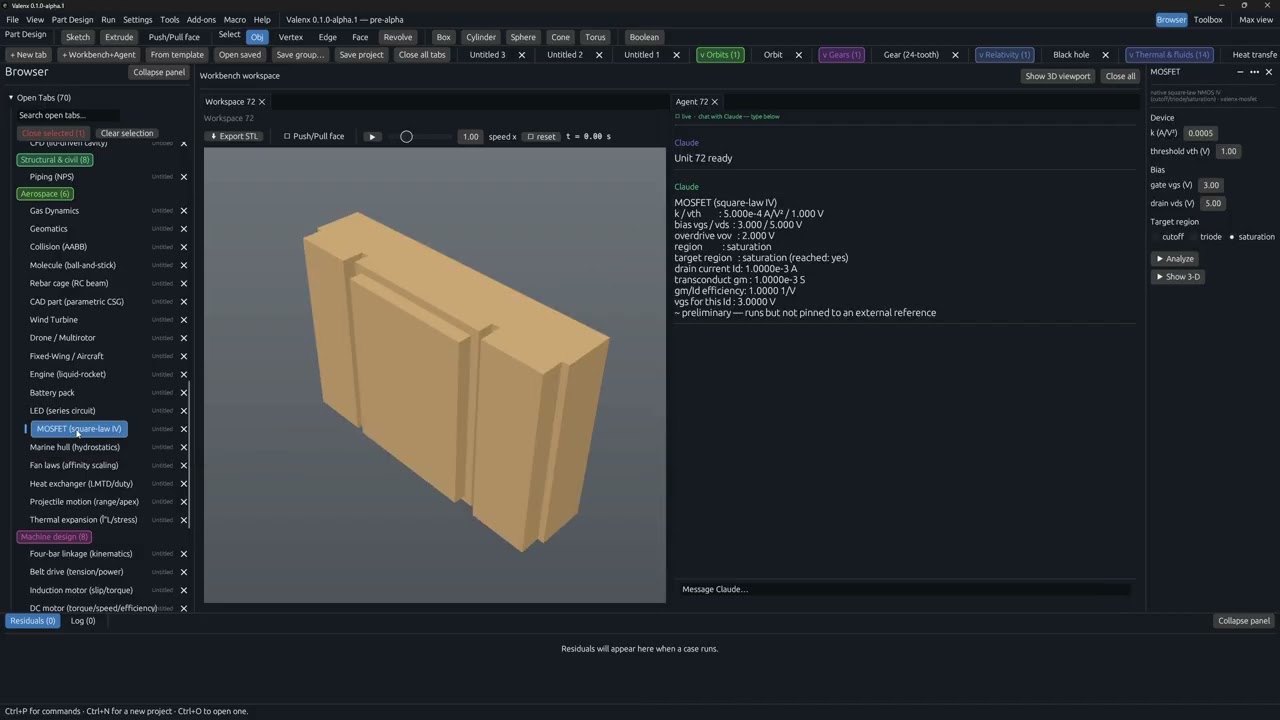
A walkthrough of Valenx — generating and simulating ~190 products from one app, the 3-D editor, and the in-app AI agent. It's an early developer build, not a commercial release — contributors wanted.
Valenx is a complete, native simulation suite — its own from-scratch Rust solvers across engineering, physics, chemistry, and biology, in one desktop app, on your laptop. The native engines are the product, and they're validated against published ground truth:
- Aerospace — launch-vehicle ascent to orbit, 3-D orbital mechanics (J2), a 6-DOF attitude core, impulsive + Lambert-rendezvous maneuvers
- CFD / FEA / EM / multibody / thermal — a 3-D wind-tunnel aero workbench, k-ω SST CFD, 8 FEA solvers, topology optimization, MPM large-deformation
- Chemistry & materials — molecular dynamics, quantum chemistry (Hartree–Fock / MP2 / DFT), reaction dynamics (AIMD), cheminformatics
- Computational biology — a 14-panel Genetics Workbench: alignment, phylogenetics, population genetics, RNA/mRNA design, protein structure, docking, CRISPR gene-editing
- More native engines — general relativity / black-holes, neural-interface / BCI, geometric optics, a quantum-circuit simulator, and a parametric CAD / CAM / CAE suite with a B-Rep solid kernel
Everything is AI-drivable end to end — every workbench exposes named accessible widgets + an agent-command bridge, so an AI agent can set parameters, run, and read results across the whole app, not just a human.
Optional interop: when you specifically want a reference implementation, a GPU/ML model (e.g. AlphaFold), or a domain not yet native, Valenx can also drive external tools through optional adapters — a convenience layer, never a requirement. No cloud, no API keys, your data never leaves your machine.
A large part of Valenx runs without any external tool — native in-house Rust solvers ship inside the app and work out of the box:
- Computational biology — a 14-panel Genetics Workbench: sequence
analysis, pairwise + multiple alignment, phylogenetics, population genetics,
RNA secondary structure, RNA/mRNA design, molecular dynamics,
cheminformatics, macromolecular structure (PDB/mmCIF, DSSP, superposition),
quantum chemistry (Hartree–Fock / MP2 / Kohn–Sham DFT), genomics, systems biology, docking,
and CRISPR / gene-edit design — all native (
valenx-bioseq,valenx-align,valenx-phylo,valenx-rnastruct,valenx-md,valenx-qchem, …). - Aerospace / GN&C — a launch-vehicle + orbital engine: multi-stage
gravity-turn ascent to orbit, 3-D orbital mechanics with J2 oblateness, a
6-DOF rigid-body attitude core, and impulsive maneuvers (Hohmann,
bi-elliptic, plane-change, Lambert rendezvous) — validated against
textbook/analytic results (
valenx-astro; see Validation). - Fluids & structures — a 3-D external-aerodynamics wind-tunnel workbench and 2-D CFD with Menter k-ω SST turbulence, plus finite-element analysis (8 native solvers: static, modal, thermal, nonlinear, plasticity, beam, buckling, transient dynamics).
- CAD / CAM / CAE — a geometry kernel (primitives, booleans, fillets, NURBS surfaces), a parametric feature-tree history, CAM toolpaths + G-code post-processing, technical drafting (DXF / SVG / PDF), assemblies with interference detection, architectural / structural modelling (IFC4, Eurocode), surface modelling (NURBS fitting + blends), and JT / STEP-AP242 / IGES interop.
- Engineering design workbenches — a growing set of native parametric design
calculators, each a right-side panel (View menu) with a form → compute → readout
and, where the geometry suits it, a live wireframe preview: helical springs
(spring index, axial stiffness, Wahl factor, developed wire length + a 3-D helix
preview), involute gears (pitch / base / addendum / dedendum diameters, mesh
ratio + a tooth-profile preview), piping (NPS bore, flow + metal area, wetted +
external surface), structural frames (section area + perimeter), sheet-metal
bends (bend allowance / deduction), fasteners (ISO 4017 bolt dimensions),
collision (AABB volume / surface / overlap), geodesics (haversine + rhumb
distance, bearings, cross-track), and field statistics — all closed-form and
computed in-process (
valenx-springs,valenx-gears,valenx-frames, …). These are research-grade design readouts, not a commercial parametric-modelling replacement (the roadmap targets FreeCAD-class parity, not Fusion 360 / SolidWorks). - Reaction dynamics & graphics — a reaction-dynamics / AIMD simulator (velocity-Verlet on quantum-chemistry forces) and a physically-based path tracer (light-tree importance sampling, bidirectional path tracing, subsurface scattering).
- Gravitational physics / general relativity — an in-house GR & black-hole
engine (
valenx-relativity): Schwarzschild / Kerr / Reissner–Nordström / Kerr–Newman spacetimes, curvature tensors via automatic differentiation, null + timelike geodesics, observables (photon sphere, ISCO, shadow radius), Hawking thermodynamics, and a black-hole shadow ray-tracer — checked against closed-form results (Schwarzschild photon sphere = 3M, shadow radius = √27·M). - Neuroengineering / BCI — a neural-interface stimulation and recording
suite (
valenx-neuro): an implanted electrode's extracellular FEM field (reusing the FEA solver), Hodgkin–Huxley cable axons, the Rattay activating function coupling the two (an electrode recruits nearby neurons), bioheat tissue heating, and electrode–tissue impedance, plus an unconditionally-stable implicit cable solver, myelinated saltatory fibers (conduction velocity matched to the empirical 6·D rule), strength–duration curves, an anisotropic-tensor FEM field, and multi-contact current steering, and extracellular recording (the forward-EAP read-out model) — each validated against a textbook or closed-form result (see Validation). - Thermo-fluids & acoustics — fluid thermodynamics (Peng–Robinson / SRK
cubic equations of state, compressibility, saturation pressure — validated vs
NIST), free-field acoustic radiation (monopole / dipole directivity), and a
GPU-compute pressure-Poisson sweep for the CFD core (
valenx-thermo,valenx-acoustics,valenx-cfd-native). - Mechanics depth — topology optimization (SIMP, generative
minimum-weight structures), the Material Point Method (2-D MLS-MPM for
large-deformation / failure where mesh FEM inverts), and porous-media /
groundwater flow (Darcy + unsaturated Richards) on the FEM core
(
valenx-topopt,valenx-mpm,valenx-fem). - Optics, quantum & signals — geometric optics (thin-lens + paraxial
ABCD ray-transfer), a quantum-circuit state-vector simulator
(H/X/Y/Z/S/T/CNOT/CZ + Born-rule measurement, Bell + GHZ validated), and a
digital-waveform (VCD) viewer (
valenx-optics,valenx-quantum,valenx-waveform). - Defense / mission planning — a map-based tactical planner: real OSM basemap tiles, MIL-STD-2525 / APP-6 affiliation symbology, A* routing over a terrain cost grid, and terrain-masked line-of-sight. Analysis / planning posture only — no weapons-lethality / targeting.
- AI-drivable everywhere — every workbench is a reactive panel with named,
accessible widgets (an AccessKit tree) plus an agent-command bridge, so an
AI agent — or any MCP client, via the in-tree
valenx-mcpserver — can set parameters, run, and read results across the whole app. This is the "AI-controlled" half of the name.
The external tools below are optional — reach for them when you want a reference implementation, a GPU/ML model, or a domain not yet native. A few domains are still external-only or only partly native and on the roadmap: a native electromagnetics solver, fuller unstructured meshing (a native voxel→hex mesher ships now; general tet meshing is next), and large-scale 3-D / industrial CFD (a GPU-compute pressure-Poisson path ships now; full industrial scale is next). Contributors welcome — AI-assisted included (see CONTRIBUTING.md + AGENTS.md).
Native solvers are checked against published references or analytic results — the figures below are reproduced by the test suite, not asserted. Full detail — every per-crate validation suite and the ~200 bugs surfaced and fixed by running them — lives in docs/VALIDATION.md.
Or verify it yourself in seconds — valenx --self-test drives all 56
products' real compute and prints a machine-parseable PASS / FAIL / value
report (53 PASS · 0 FAIL · 3 SKIP; 50 of them deep known-value checks). It
needs no GUI and exits non-zero on any failure, so it doubles as a CI gate — and
its line-oriented output is consumable by any agent or script, not just a human
(see Self-validation).
| Solver | Benchmark / reference | Result |
|---|---|---|
Orbital — valenx-astro |
LEO→GEO Hohmann Δv vs textbook ~3.9 km/s | 3,892 m/s total (2,425 + 1,467), ToF 5.27 h — test |
Orbital — valenx-astro |
J2 secular nodal regression vs closed-form rate | within 5% of the analytic dΩ/dt; a, i secularly unchanged — test |
CFD — valenx-cfd-native |
Lid-driven cavity vs Ghia, Ghia & Shin 1982 | centerline MAE 0.035 / 0.016 / 0.024 at Re 100 / 400 / 1000 |
CFD — valenx-cfd-native |
Poiseuille channel vs analytic | u_max 1.4949 vs 1.5000 (0.34% error) |
CFD — valenx-cfd-native |
Backward-facing step vs Armaly / Gartling | reattachment x_r/h ≈ 4.5, inside the published envelope |
FEA — valenx-fem |
Constant-strain patch test | satisfied to ~1e-9; Hex8 90% / Tet10 112% of the Euler–Bernoulli tip |
MD — valenx-md |
Argon NVE energy conservation | std-to-mean < 1%, no secular drift; lattice sum < 0.5% vs analytic |
Quantum chem — valenx-qchem |
Hydrogen atom, exact Kohn–Sham | reproduces −0.212742 Ha; LDA → uniform-gas and PBE → LDA limits hold |
Docking — valenx-dock-screen |
1HVR / 3PTB / 1STP redocking | RMSD 0.305 / 0.263 / 0.139 Å (mean 0.236), 100% < 2 Å |
Neuro — valenx-neuro |
Hodgkin–Huxley axon | textbook action potential (~100 mV overshoot, threshold, refractory) + propagating cable |
Neuro — valenx-neuro |
field + activating function | point source φ = I/(4πσr); cathodic depolarizes, anodic hyperpolarizes (Rattay) |
Neuro — valenx-neuro |
electrode recruitment | threshold rises with electrode–fiber distance; recruitment monotone in current |
Neuro — valenx-neuro |
bioheat + impedance | ΔT = Q/(4πk r); electrode access resistance R = 1/(4σa) |
Neuro — valenx-neuro |
implicit cable + myelinated fiber | unconditionally-stable implicit solver (stable at 100 µm, fixes the v1 RK4 limit); myelinated CV ≈ 6·D within ~6% (57 / 113 m/s at 10 / 20 µm), ∝ D not √D |
Neuro — valenx-neuro |
strength–duration | rheobase + chronaxie 1.65 ms (≈ ½ membrane τ); Lapicque constant-charge law holds to < 1% at short widths |
Neuro — valenx-neuro |
anisotropic FEM + steering | tensor-σ point source matches the closed-form anisotropic Green's function within ~10%; multi-contact current steering shifts the focus |
Neuro — valenx-neuro |
extracellular recording (forward-EAP) | biphasic spike with a dominant-negative (sink) phase; amplitude falls off with electrode distance; membrane currents conserve charge (Σ ≈ 0) |
Pre-alpha (
0.1.0-alpha.1). Pre-built portable binaries for Windows and Linux are published on the Releases page. They're tested-build (they compile + link in CI on every release) but real-world runtime testing is just beginning — expect sharp edges. You can always build from source instead.GPU drivers required. Valenx renders with
wgpu, so you need working GPU drivers: Vulkan or DX12 on Windows, Vulkan or OpenGL on Linux.
Grab the archive for your OS from the latest release:
| Platform | Download | Status |
|---|---|---|
| Windows (x86_64) | valenx-<ver>-x86_64-pc-windows-msvc.zip |
tested-build |
| Linux (x86_64) | valenx-<ver>-x86_64-unknown-linux-gnu.tar.gz |
tested-build |
| macOS (Apple Silicon) | valenx-<ver>-aarch64-apple-darwin.tar.gz |
experimental |
Windows
- Download the
.zipand unzip it. - Run
valenx.exe.
SmartScreen may warn — the binary is unsigned in this pre-alpha. Choose More info → Run anyway.
Linux
tar -xzf valenx-<ver>-x86_64-unknown-linux-gnu.tar.gz
cd valenx-<ver>-x86_64-unknown-linux-gnu
chmod +x valenx
./valenx
macOS — experimental
The macOS build compiles in CI but the GUI is not yet verified on macOS, so treat it as experimental (and the archive may be absent if that best-effort build didn't complete). To try it:
tar -xzf valenx-<ver>-aarch64-apple-darwin.tar.gz
cd valenx-<ver>-aarch64-apple-darwin
xattr -dr com.apple.quarantine valenx   # clear Gatekeeper quarantine (unsigned)
chmod +x valenx
./valenx
Each archive also bundles LICENSE-MIT, LICENSE-APACHE, and a short
README.txt. Signed native installers (.msi / .dmg / .deb / .rpm) are
the planned 1.0 distribution — see docs/INSTALLER.md.
# Linux / macOS
git clone https://github.com/nochallenge/valenx
cd valenx
cargo build --release -p valenx-app
./target/release/valenx
# Windows (PowerShell)
git clone https://github.com/nochallenge/valenx
cd valenx
cargo build --release -p valenx-app
.\target\release\valenx.exeRequires Rust 1.88+. See CONTRIBUTING.md for full dev setup.
- QUICKSTART.md — five-minute walkthrough
- docs/INSTALLER.md — install + pin to dock/taskbar
- STATUS.md — what's done, scaffolded, documentation-only
- ARCHITECTURE.md — how the pieces fit together
- ROADMAP.md — 20-year plan
- CHANGELOG.md — release history
- docs/CI.md — CI policy (auto-runs on every push + PR; the
CI OKgate) - CONTRIBUTING.md — how to contribute + dev setup
- SECURITY.md — vulnerability disclosure
- CODE_OF_CONDUCT.md — Contributor Covenant v2.1
- POLICIES.md — SemVer, deprecation, MSRV, dependency rules
- rfcs/ — RFC process + accepted proposals
| Native solvers | 150+ in-house workbenches across aerospace, CFD/FEA, MD, quantum chemistry, biology, neuro, GR, optics, and CAD/CAM — written from scratch in Rust and validated against published ground truth (see Validation) |
| Optional adapters | 141 external open-source tools also integrate (CFD / FEA / MD / chemistry / protein / RNA / CRISPR / cryo-EM / workflows) for reference implementations + GPU-ML models — a convenience layer, not the core |
| Tests | 10,000+ passing, 0 failed, 0 clippy warnings, 0 rustdoc warnings (workspace-wide) |
| Workflow loop | load project → click case → Run / Prepare / Open workdir / Run-from-prepared, all live |
| Sweeps + export | grid / Latin-hypercube / gradient-descent optimisers, materialise → run (sync or threaded) → assemble dataset (csv / npy / npz / manifest.json) |
| Mesh quality | Equiangle skewness · cell-face orthogonality · aspect-ratio + skewness histograms · cell-face + edge adjacency. Surfaced in the GUI Quality panel and via the headless valenx-mesh-info CLI (text / JSON / --check METRIC=THRESHOLD for CI gates) |
| HPC | valenx-executor-slurm does end-to-end remote-cluster submission: rsync staging + ssh-dispatched sbatch / squeue / sacct / scancel, sacct fallback for terminal state, GPU (--gres) + multi-rank srun, post-completion fetch_results |
| Visual results | OpenFOAM + Elmer + CalculiX + SU2 populate Results.fields with parsed .vtu / .vtk legacy / .frd / appended-binary data; auto-routed via vtk_dispatch. Vector + tensor fields render as magnitude / Frobenius norm. Viewport paints filled triangles + wireframe by field value with colour-bar legend + time-scrubbing |
| Compliance | RBAC (3 roles + per-project override) + append-only audit log with SHA-256 chain. valenx-audit verify and valenx-audit tail CLIs for offline integrity checks + headless inspection |
| CLI tooling | valenx-init scaffolds a project. valenx-validate runs a structural pre-flight on a project bundle. valenx-results inspects the results.json sidecar a finished run leaves on disk. valenx-report writes a self-contained HTML report and/or a flat scalar history CSV from a finished run. All four are exit-code-driven; the inspectors offer JSON output for downstream CI tooling |
Beyond its native engines,
Valenx integrates 141 external open-source tools as optional adapters — for
reference implementations, GPU/ML models, and domains not yet native. Each tool
below is wrapped by a Valenx adapter crate
(crates/valenx-adapters/<domain>/valenx-adapter-<tool>) that handles probing,
case preparation, subprocess execution, and result collection. You install only
the ones you actually use.
CFD / FEA / EM / multiphysics OpenFOAM, SU2, gmsh, Netgen, FreeCAD, CalculiX, Elmer, Code_Aster, OpenRadioss, Cantera, openEMS, Meep, PyBaMM, MuJoCo, preCICE.
Molecular dynamics GROMACS, LAMMPS, OpenMM, NAMD, AmberTools sander, HOOMD-blue. Trajectory analysis: MDAnalysis, MDTraj, PLUMED, ProDy, cpptraj.
Protein structure prediction + design AlphaFold 2, AlphaFold 3, ESMFold, OpenFold, RoseTTAFold, OmegaFold, ColabFold, FoldSeek. Design: RFdiffusion, ProteinMPNN, ESM-IF, Chroma, RFantibody, ESM3, ESM Cambrian.
Sequence alignment + search + variant calling BWA, minimap2, Bowtie2, HISAT2, STAR, MMseqs2, DIAMOND, BLAST+, MAFFT, MUSCLE, Clustal Omega, T-Coffee, HMMER, samtools, bcftools, GATK HaplotypeCaller, DeepVariant.
Transcript quantification + single-cell Salmon, Kallisto, Scanpy, scVI, Seurat, AnnData.
Cheminformatics + quantum chemistry RDKit, DeepChem, Open Babel, Avogadro 2, Psi4, NWChem, xTB.
Molecular docking + viewers AutoDock Vina, AutoDock 4. PyMOL, VMD, ChimeraX, IGV, Mol*, NGL.
CRISPR design + edit-outcome prediction CHOPCHOP, CRISPOR, Cas-OFFinder. Base/prime: BE-Designer, BE-Hive, PrimeDesign, pegFinder. Outcomes: inDelphi, FORECasT, AlphaMissense, CRISPRitz.
RNA structure + mRNA design ViennaRNA, RNAstructure, NUPACK, mfold, EternaFold, LinearFold. mRNA: DNA Chisel, LinearDesign, iCodon. Tertiary: SimRNA.
Cryo-EM + microscopy RELION, EMAN2, CTFFIND. Bioimage: Fiji, CellProfiler, Ilastik.
Phylogenetics + population genetics IQ-TREE, RAxML-NG, FastTree, BEAST 2, MrBayes. PopGen: SLiM, msprime, tskit.
Systems / synthetic biology COPASI, BioNetGen, PhysiCell, Smoldyn, MCell. SynBio: pySBOL, j5, Cello, pydna, Jalview.
Sequencing read simulators + Rosetta family ART, wgsim, Badread. Rosetta, PyRosetta.
DNA structural geometry + pharmacokinetics X3DNA, Curves+, DSSR. PK-Sim.
Workflow managers Snakemake, Nextflow, planemo, Cromwell, cwltool.
Several upstream tools ship under academic / non-commercial terms
(AlphaFold 3, NAMD, VMD, CTFFIND, Rosetta, ViennaRNA, NUPACK, mfold,
AlphaMissense, X3DNA family, Curves+). Valenx surfaces these via
mandatory "academic"-keyworded probe warnings — you choose whether
to install the binary based on your use case.
Full per-tool status and capability matrix: STATUS.md.
- Native desktop app. No browser. No localhost. Downloads like FreeCAD, runs like FreeCAD.
- Open source, dual MIT / Apache-2.0. Free forever, commercial friendly, ecosystem-standard.
- Rust first. Safe, fast, modern tooling.
- Native-first. The core science is our own from-scratch Rust solvers, validated against published ground truth — that's the product, not a wrapper.
- Optional interop, not dependency. External tools integrate through optional adapters (reference implementations, GPU/ML models, not-yet-native domains) — a convenience layer you reach for only when you want it.
- AI-drivable first. Every workbench exposes named accessible widgets + an agent-command bridge, so AI agents operate the app as first-class users — not just humans.
Dual-licensed under either of:
- MIT License (LICENSE-MIT)
- Apache License, Version 2.0 (LICENSE-APACHE)
at your option.
This is the Rust ecosystem standard — the same dual layout used by rustc, Tokio, Serde, Bevy, and most of the Rust crate ecosystem.
Unless you explicitly state otherwise, any contribution intentionally submitted for inclusion in Valenx by you, as defined in the Apache-2.0 license, shall be dual-licensed as above, without any additional terms or conditions.
See CONTRIBUTING.md for guidelines.
We're pre-alpha. If you want to help — shell scaffolding, adapters, physics solvers, documentation — start here:
- Read CONTRIBUTING.md for dev setup and workflow
- Big ideas → file an RFC (see rfcs/README.md)
- Small fixes → open a PR directly
- Security issues → SECURITY.md (please don't file public issues)
- Be respectful → CODE_OF_CONDUCT.md