


DeepSeek-V4-Flash gives you a lot of model for very little money: fast and strong, but its built-in web search is weak, and most third-party gateways ship no search at all. A model that cannot look things up or read a web page is a real handicap these days.
ModSearch fixes this with a completely free setup. It never touches your config and never adds a local proxy. It's just a search-engine plug-in, usable as a CLI or as an Agent Skill, that returns structured web search results and can parse pages too. Under the hood it runs on Antigravity CLI (agy), whose search comes from free-quota Google Search. And Google Search is, without much argument, the best search engine on earth. How it works:
your text-only model ──▶ modsearch skill (auto-triggers on fresh-info needs)
                              │
                    ┌─────────┴─────────┐
                    ▼                   ▼
              -q "query"            -u <url>
               web search           page fetch
                    └─────────┬─────────┘
                              ▼
                   agy · Gemini 3.6 Flash (free quota)
                              │
                              ▼
              structured JSON evidence ──▶ model answers with sources
Install the skill once and your agent starts searching and reading the web on its own. No model swap, no API key, no prompt surgery.
1. Install Antigravity CLI and sign in (one-time):
curl -fsSL https://antigravity.google/cli/install.sh | bash
agy    # opens browser sign-in, then exit
2. Install the skill. Just tell your agent (Claude Code, Codex, OpenClaw, Cursor, ...):
Install the skill from https://github.com/liustack/modsearch
or do it yourself:
npx -y skills add liustack/modsearch3. Use it. Ask anything time-sensitive, or paste in a URL. The skill fires whenever the model needs the live web.
Search:
npx @liustack/modsearch -q "DeepSeek V4 Flash release date and context window" --max-results 3Real output, truncated:
{
  "mode": "search",
  "provider": "antigravity-cli",
  "result": {
    "summary": "DeepSeek V4 Flash was initially released as a preview on April 24, 2026, followed by its official production API release (DeepSeek-V4-Flash-0731) on July 31, 2026. Across both releases it features a 1 million (1M) token context window.",
    "items": [
      {
        "title": "DeepSeek-V4-Flash Official Release & API Specs",
        "url": "https://deepseek.com",
        "snippet": "...284B total parameters and 13B active parameters with enhanced post-training.",
        "published_at": "2026-07-31"
      }
    ],
    "uncertainty": []
  },
  "meta": { "model": "gemini-3.6-flash-low", "durationSeconds": 5.5 }
}
Fetch a page, with a focus for the answer:
npx @liustack/modsearch -u "https://github.com/liustack/liustack" -q "what skills does it ship"{
"mode": "fetch",
"result": {
"summary": "Extracted structured evidence from liustack/liustack GitHub README focused on the skills shipped by the package.",
"content": "#### Shipped Skills\n1. **`shaping`** (Before you start) ...\n2. **`coding`** (While coding) ...\n3. **`dig`** (When there's a bug) ...\n4. **`snapshot`** (When handing off) ...",
"links": [
{
"text": "shaping SKILL.md",
"url": "https://github.com/liustack/liustack/blob/main/skills/shaping/SKILL.md"
}
],
"uncertainty": []
}
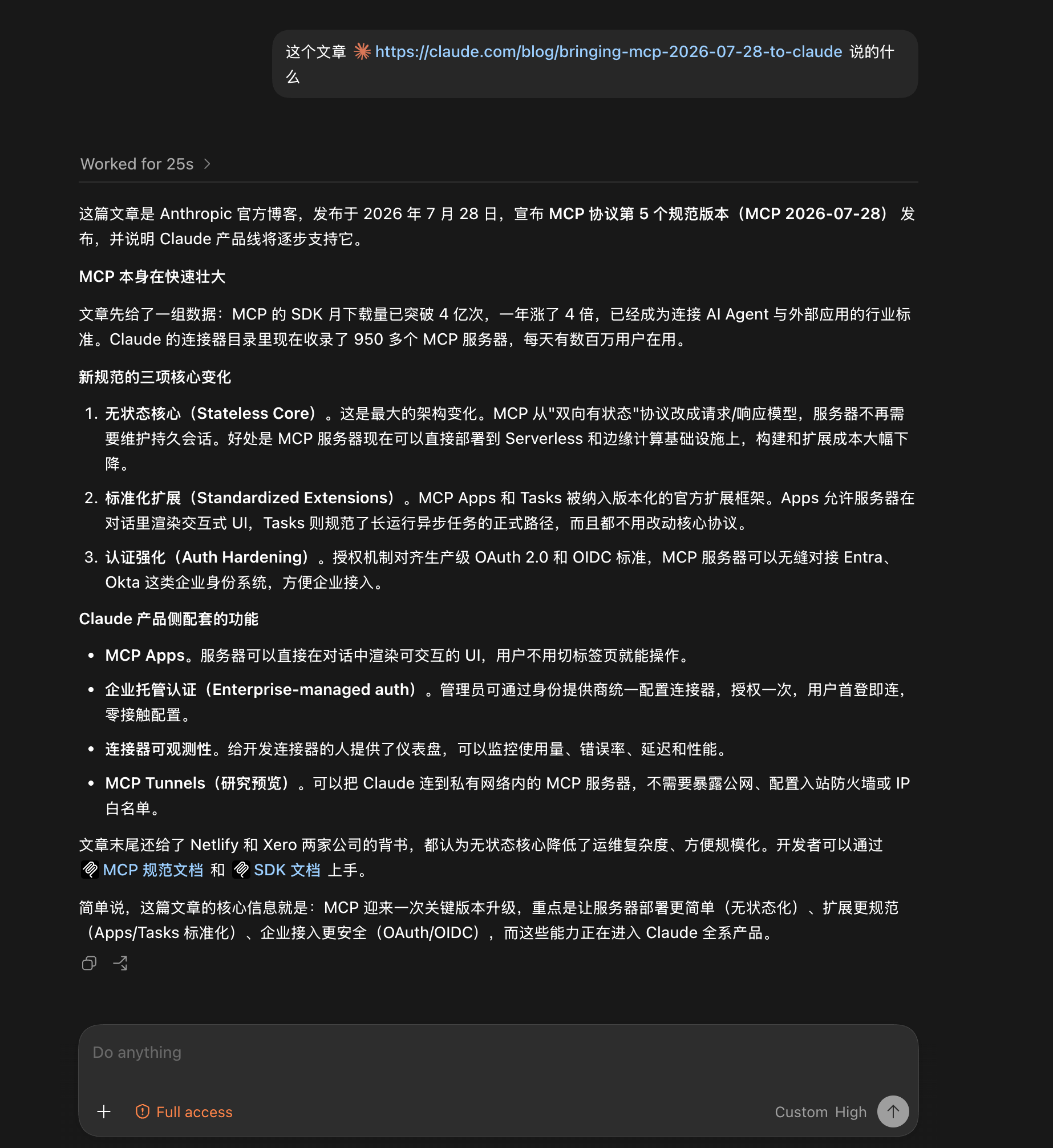
}Here is fetch mode inside the Codex desktop app: drop a blog URL, ask what it says, and get a structured summary back in 25 seconds. No browser tab involved.
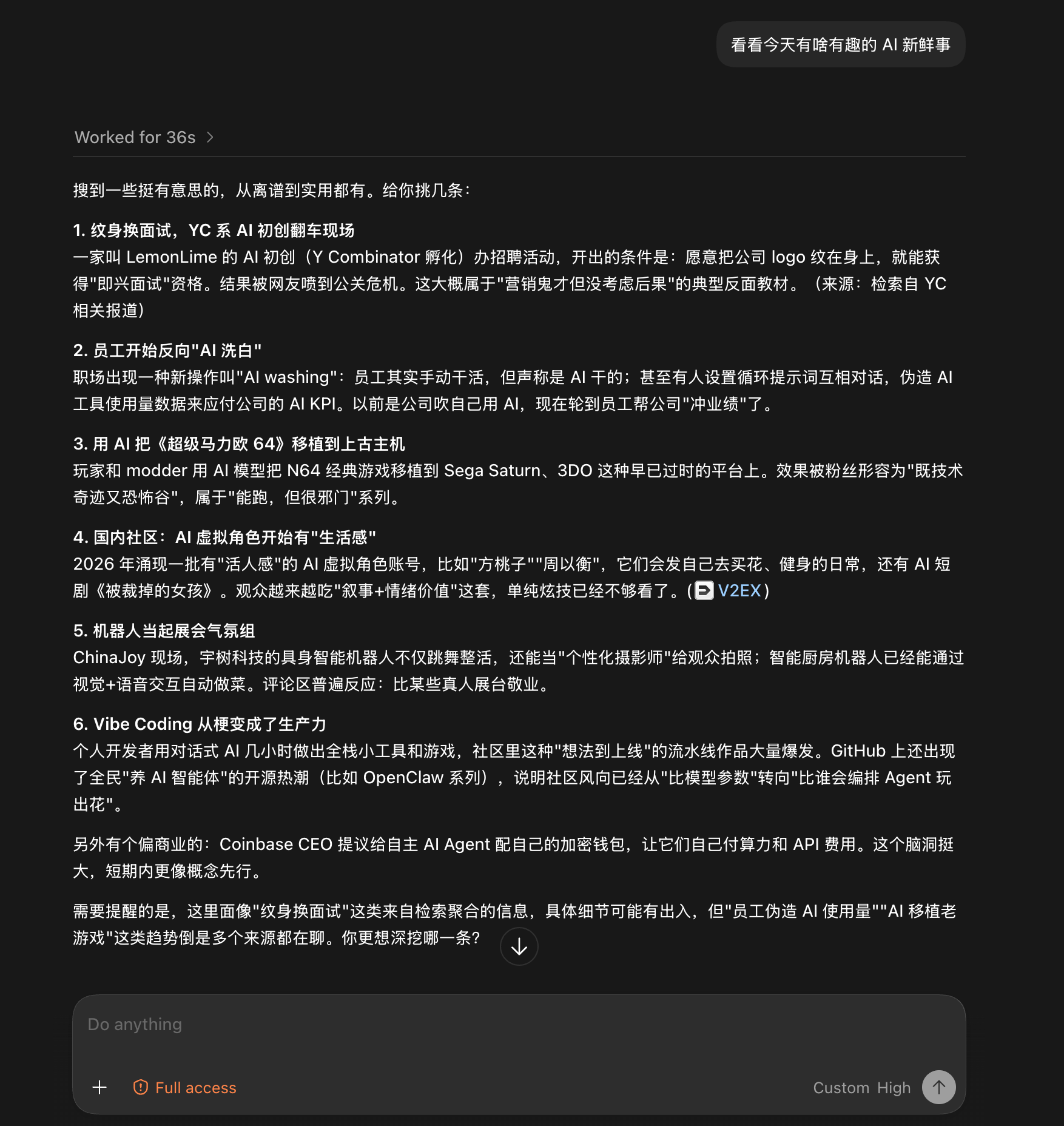
Open-ended questions work too: ask "anything fun in AI today" and get six sourced stories back in 36 seconds, with an honest note about which details came from aggregated retrieval.
modsearch -q "<query>"              # search mode
modsearch -u <url> [-q "<focus>"] # fetch mode| Flag | Meaning | Default |
|---|---|---|
-q, --query <text> |
Search query, or answer focus with -u |
|
-u, --url <url> |
Fetch this page instead of searching | |
-o, --output <path> |
Also write JSON to a file | |
-m, --model <name> |
Provider model | gemini-3.6-flash-low |
-p, --provider <name> |
Provider | antigravity-cli |
--max-results <n> |
Max search results | 8 |
--prompt <text> |
Extra constraints | |
--timeout <ms> |
Provider timeout | 180000 |
--provider-bin <path> |
Provider binary | agy |
--workdir <path> |
Working directory for the provider |
Reach for -m gemini-3.1-pro-high on harder research questions. Output contract: skills/modsearch/references/output-schema.md.
DeepSeek's official Responses endpoint ships a server-side web_search tool, so Codex configured with web_search = "live" against api.deepseek.com already covers plain searching (see the official integration guide). ModSearch earns its keep in three cases: your channel has no built-in search (DashScope and most third-party gateways), you need to read one specific page (-u fetch, which built-in search cannot do), or your harness has no native search tools at all.
- Keep your model. You picked DeepSeek-V4-Flash (or gpt-oss, or whatever else) for its price and its reasoning, not its search skills. ModSearch adds the live web without touching that choice.
- Evidence beats vibes. Answers come back with URLs, dates, and an explicit
uncertaintylist, so your agent cites sources instead of guessing. - Engines die, the bridge survives. v1 ran on Gemini CLI's free tier until Google shut it down in June 2026. v2 moved to its successor, Antigravity CLI, behind the same provider interface, so the next engine swap costs one file, not a rewrite. v2 also absorbed page fetching, which used to be its own project (modfetch, now retired).
ModLens, ModSearch's sibling project, plays the same trick for vision: liustack/modlens.
This project runs on LIUSTACK Skills. ModSearch v2 was shaped, coded, and shipped with liustack end to end: shaping before you build, coding while you build, dig when it breaks, snapshot when you hand off. Lighter than Superpowers, and sharper.
ModSearch gives your model a network cable. LIUSTACK Skills gives your dev workflow wings:
npx -y skills add liustack/liustack -g⭐ Like it? Star ModSearch and star liustack. Stars are how the next developer finds them.
- ModSearch runs
agywith--dangerously-skip-permissions, because print mode can fail in some setups without it. The prompt keeps the agent to searching and fetching only, and tells it to treat page content as data, never as instructions. Even so, fetched pages are untrusted input, so prefer running inside a sandboxed workspace. - Search output is evidence. Whatever the engine cannot verify lands in
uncertainty. The precise-looking but fabricated numericrelevancescore from v1 is gone, item order carries the ranking.
Personal learning and experimentation only, not for commercial use. Antigravity CLI usage runs under your own Google account's terms and quota.
MIT