
📖 Full documentation available at https://joaompinto.github.io/janito/
⚠️ Disclaimer: The code on this repo has been developed mostly using AI.
- 🔧 Function Calling - Built-in tools for file operations, web search, and more
- 🔌 Plugins - Gmail, code search, OneDrive, and more via the plugin system
- 🔌 MCP Support - Connect to Model Context Protocol servers
- 🧩 Skills - Install and use task-specific skills from GitHub
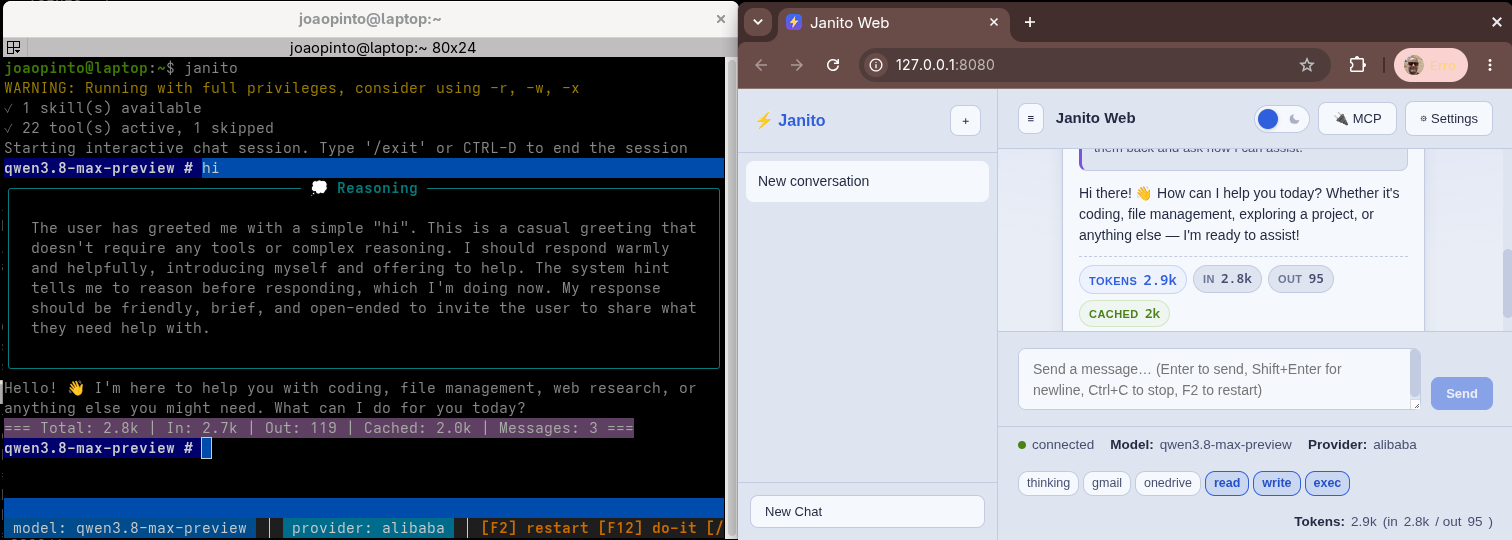
- 🌐 Web UI (Alpha) - Chat through a browser instead of the terminal with
--web - ↪️ Session Resume - Exit a terminal chat and reopen it with
janito -C(full conversation restored) - 📊 Real-time Progress - Watch tool execution progress as it happens
- 🚀 Easy Setup - Interactive configuration with
--configor quick setup with--setflags - 🔗 OpenAI-Compatible & Native APIs - Works with any OpenAI-compatible endpoint (OpenAI, LM Studio, Ollama, custom) and native SDKs (Anthropic, DashScope)
NOTE: Janito should be used on development systems on which data loss is tolerable and there are no critical secrets
# Install
pip install janito

# Or, with uv (recommended)
uv tool install janito

# Configure interactively
janito --config

# Or set options directly (two steps: config, then API key)
janito --set provider=openai --set model=gpt-6-luna
janito --set-api-key="sk-your-key" --provider openai

# Start chatting
janito "Hello!"pip install janitoOr, with uv:
uv tool install janitoFor development setup, see README_DEV.md.
janito --configYou'll be prompted for:
- Provider -
openaiorcustom - API Key - Masked for security
- Model - e.g.,
gpt-6-luna - Max Output Tokens - Maximum output tokens (default: 65536)
- Max Input Tokens - Maximum input tokens / context window (default: 128000)
Set options directly from the command line:
# Single key-value
janito --set model=gpt-6-luna
You can also use --get, --unset, and --set-secret with multiple values.
janito --show-config| Provider | Last Model | Price |
|---|---|---|
| Alibaba | qwen3.8-flash | Pay as you go |
| Moonshot | kimi-k3 | $15/month (Moderato) |
| z.ai | glm-5.3-flash | $12.6/month (Lite) |
| openai | gpt-6 | Pay as you go |
For custom endpoints (base-url), see README_custom.md.
janito "What is the capital of France?"echo "Tell me a joke" | janitojanitoCommands in chat mode:
/exit- End the sessionclear- Clear conversation and start a new oneCtrl+D/Ctrl+Zthen Enter - Exit (EOF)/help- List all commands (with descriptions) and shortcuts
⚠️ Alpha — The--webmode is currently in alpha. It works, but the interface, CLI flags, and API may change between releases.
Janito can serve a browser-based chat interface instead of the terminal. This requires optional dependencies that are not part of the core install:
# Install with the web extra
pip install janito[web]
# or
uv tool install janito[web]
Then start the server (opens your browser automatically):
janito --web

# All normal Janito flags still apply, plus web-specific ones:
janito --web -r -w --web-port 9090    # privileges + web, custom port
janito --web --no-web-open                      # don't auto-open the browser
The server binds to 127.0.0.1 by default (localhost only). For full details
(features, security, API endpoints, architecture), see the
Web UI documentation.
Control how the system prompt is handled:
# Use default system prompt (with tools enabled)
janito "What can you do?"

# Disable system prompt entirely (no tools at all)
janito -Z "Simple prompt without system context"

# Override with a custom system prompt (tools stay enabled)
janito -S "You are a concise coding assistant" "Explain recursion"

# Keep the system prompt but skip tool loading (skill tools stay enabled)
janito --no-tools "Explain recursion"

# Skip only the parallel-tasks toolset (StartTask/StopTask/WaitForTask/ListTasks)
janito --no-tasks "Refactor this file"| Flag | Description |
|---|---|
-Z, --no-system-prompt |
Skip system prompt and disable tools |
-S, --system-prompt |
Custom system prompt |
--no-tools |
Do not load tools (skill tools stay enabled) |
--no-tasks |
Do not load the tasks toolset (StartTask, StopTask, WaitForTask, ListTasks); all other tools stay enabled |
Note: When using
-Z, built-in tools (file operations, MCP) are disabled. Use the default mode or-Sflag when you need tool access.Note:
--no-toolsdisables loading of all non-skill tools (file operations, MCP) while keeping the skill tools (load_skill,read_skill_resource) available, so the model can still load installed skills on demand.Note:
--no-tasksdisables only the tasks toolset (theStartTask/StopTask/WaitForTask/ListTaskstools that spawn parallel child processes). File, system, net and skill tools stay available.
janito --log=info "Your prompt"      # Info level
janito --log=debug "Your prompt"     # Debug level
janito --log=info,debug "Your prompt" # Multiple levels# Step 1: Set provider and model
janito --set provider=openai --set model=gpt-6-luna
# Step 2: Store API key
janito --set-api-key="sk-your-key" --provider openai
# Then run any prompt
janito "Explain quantum computing"# Step 1: Set provider and model
janito --set provider=alibaba --set model=qwen3.8-flash
# Step 2: Store API key
janito --set-api-key="your-dashscope-api-key" --provider alibaba
# Then run any prompt
janito "Explain quantum computing"janito --set provider=custom --set base-url=http://localhost:8000/v1janito includes tools for common tasks:
# List files
python -m janito.tools.files.list_files . --recursive --pattern "*.py"

# Read file
python -m janito.tools.files.read_file README.md --max-lines 20Connect to MCP servers using the /mcp command inside the interactive shell:
# Add a stdio-based MCP server
/mcp add myserver stdio python -m mcp.server

# Add an HTTP-based MCP server
/mcp add remote http https://api.example.com/mcp

# List configured servers
/mcp list
For full MCP documentation, see README_MCP.md.
Tools report progress in real-time:
🔄 Reading files...
📊 Processing: 50/100 files
✅ Completed: 100 files (2.3MB)
Progress messages go to stderr so they don't interfere with tool output.
| Exit Code | Meaning |
|---|---|
0 |
Success |
1 |
Configuration or runtime error |
130 |
User cancelled (Ctrl+C or Enter) |
- Python 3.10+
openai>=1.0.0rich>=10.0.0prompt-toolkit>=3.0.0requests>=2.28.0(for MCP support)pathspec>=0.11.0(for.gitignore-aware file listing)questionary>=2.1.1(for the interactive--configwizard)
Optional extras: janito[web] adds fastapi/uvicorn (for --web); the
native API types need anthropic (--api-type Anthropic), dashscope
(DashScope) or google-genai (Gemini).
MIT License