



Your coding agent keeps undoing decisions your team already made. Lore stops it.
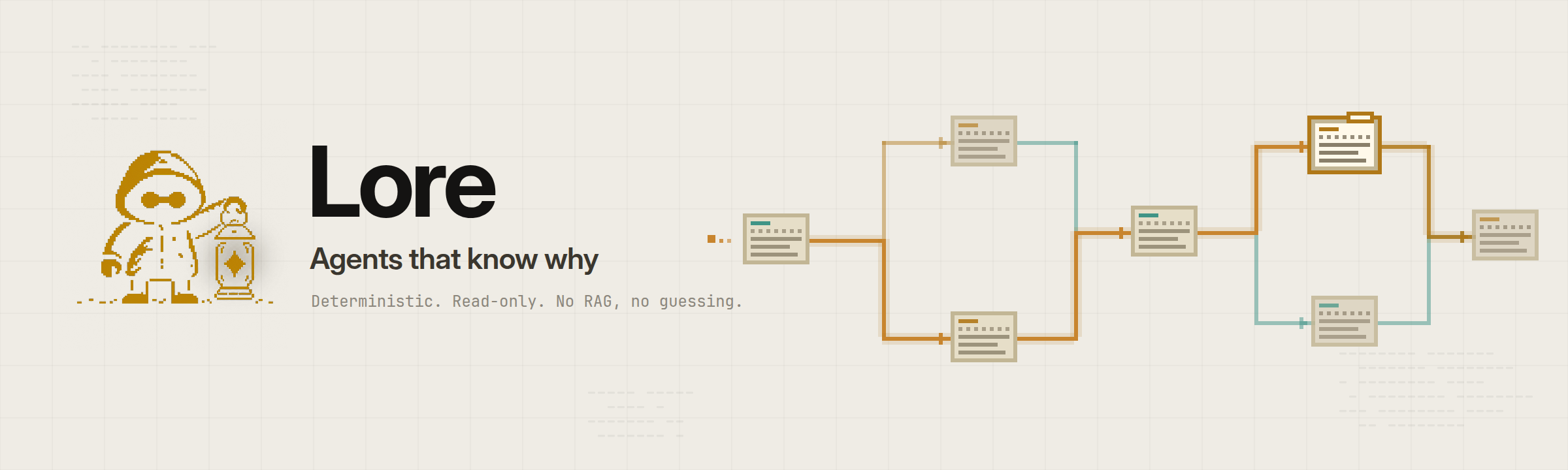
Agents that know why. Deterministic. Read-only. No RAG, no guessing.
Lore keeps your team's recorded knowledge — requirements, decisions, designs, roadmaps, and prompts — as typed Markdown in your repo, validates it in CI, and serves it read-only to Claude Code, Cursor, and Claude Desktop over MCP. When the agent is about to touch something a decision already covers, it retrieves that decision and cites it by ID instead of relitigating it.
Lore is built on RAC — Requirements as Code, the open-source engine underneath. The package, CLI, and MCP server ship under the rac name; the brand is Lore.
Coding agents have no memory of decisions they did not personally make. Your team wrote an ADR ruling out hard deletes; six weeks later the agent implements UserRepository.delete() as a hard delete because nothing put the decision in front of it. The cost of an agent isn't the code it writes — it's the reviewed decisions it quietly reverses, and the review cycles you burn catching them.
CLAUDE.md and pasted context don't solve this at team scale: they're unstructured, unenforced, and drift the moment a decision changes. Lore makes the why a typed, validated artifact that lives next to the code and is served to the agent on demand.
record          →   validate (CI)        →   serve (MCP)            →   agent cites
typed Markdown      reject malformed,         four read-only tools       retrieves the
ADRs/requirements   broken, or superseded     over MCP                   decision and
in your repo        artifacts at write time                              cites it by ID
No model in the core. No embeddings. No retrieval roulette. An artifact is found by ID and keyword, returned verbatim, and the agent cannot edit it.
pip install requirements-as-codeRequires Python 3.11+. uv tool install requirements-as-code also works.
Claude Code (from your repo root):
claude mcp add lore -- rac mcp --root /path/to/your/repoClaude Desktop / Cursor — add to your client's mcpServers config (.cursor/mcp.json for Cursor, claude_desktop_config.json for Claude Desktop):
{
  "mcpServers": {
    "lore": {
      "command": "rac",
      "args": ["mcp", "--root", "/path/to/your/repo"]
    }
  }
}
--root is the directory holding your artifacts — the same path you'd pass to rac validate. It doesn't have to be the top of a Git repo.
The MCP surface is deliberately small and entirely read-only. The tool descriptions carry the trigger language, so well-tuned agents call them without being told to.
| Tool | When the agent calls it |
|---|---|
get_summary |
Once at session start — counts artifacts, flags health issues |
search_artifacts |
Before designing or implementing anything a recorded decision might cover |
get_artifact |
When an artifact ID appears, or before changing anything a decision covers |
get_related |
After retrieving an artifact — finds what else the change could affect |
There is no fifth tool, and none of them write.
Lore ships with an example corpus — one requirement, decision, design, and roadmap for a fictional user-management service — so you can see the loop before touching your own repo:
rac mcp --root examples/guideThen ask your connected agent:
What decisions has this repository recorded about data deletion?
The agent calls search_artifacts for "soft-delete", retrieves ADR-001: Soft-Delete User Records via get_artifact, and cites the decision ID in its answer — rather than guessing or proposing a hard delete.
rac quickstart                                  # set up identity + scaffold your first artifact
rac validate rac/                               # check every artifact in a directory
rac inspect requirement.md                      # see its type and completeness
rac review rac/                                 # full repository review, worst problems first
rac relationships --validate rac/               # check the cross-artifact graph
rac export rac/ --html --out lore-export.html   # the Portal, one self-contained file
Run rac validate (and rac relationships --validate) in CI to reject malformed artifacts, broken or ambiguous links, references to superseded decisions, and relationship edges a type doesn't support — deterministically, before the knowledge lands.
Already have decisions in Confluence, Notion, or loose Markdown? The rac-import agent skill turns one existing document into one valid RAC artifact, with a human-review step before anything is written:
rac skill install rac-import # installs into .claude/skills/ (Claude Code / Cursor auto-discover)Then ask your agent, in plain language: "import this decision doc into RAC." It reads the real schema, drafts the artifact from only what your document says, shows you the proposed type, title, and relationships to confirm or correct, and closes on rac validate so it never leaves an invalid artifact behind. For bulk or multi-format conversion, use rac-ingest.
- Not RAG. No embeddings, no vector store, no nearest-neighbour guessing. Artifacts are found by ID and keyword and returned verbatim.
- Not a writer. The MCP server is read-only. The agent can read your decisions; it cannot rewrite them.
- Not an AI product with a model in the loop. The validation and serving core is deterministic. The same artifact, queried the same way, returns the same bytes every time. That determinism is the point — it's what makes the grounding trustworthy.
Google's Open Knowledge Format (OKF) standardises the carrier — a Git tree of Markdown with YAML front matter — and is deliberately permissive: an OKF consumer must not reject a bundle for missing fields, unknown types, or broken links. RAC writes that same carrier and adds what OKF leaves to the consumer: write-time enforcement in CI. OKF is read-optimised interchange; RAC is write-time enforcement. rac export --okf turns any RAC repo into a conformant OKF bundle, so the two compose rather than compete.
- Teams running coding agents heavily (Claude Code, Cursor) who are tired of the agent ignoring decisions the team already made.
- Teams who already write ADRs and want those decisions to actually shape what the agent does.
- Anyone who wants the why behind their software versioned alongside the code.
Full documentation: https://tcballard.github.io/requirements-as-code/
- Quickstart — install and author your first artifact
- MCP server — tools, client configuration, examples
- CLI reference — every command, flag, and exit code
Lore is early and evolving quickly. The MCP server ships today. Contributions, ideas, and experiments are welcome — see CONTRIBUTING.md.
MIT