
Checks a Stake Engine game before you submit it. It serves your build the way Stake's CDN does, plays it against a mock RGS, and writes a report with a screenshot of everything it looked at.
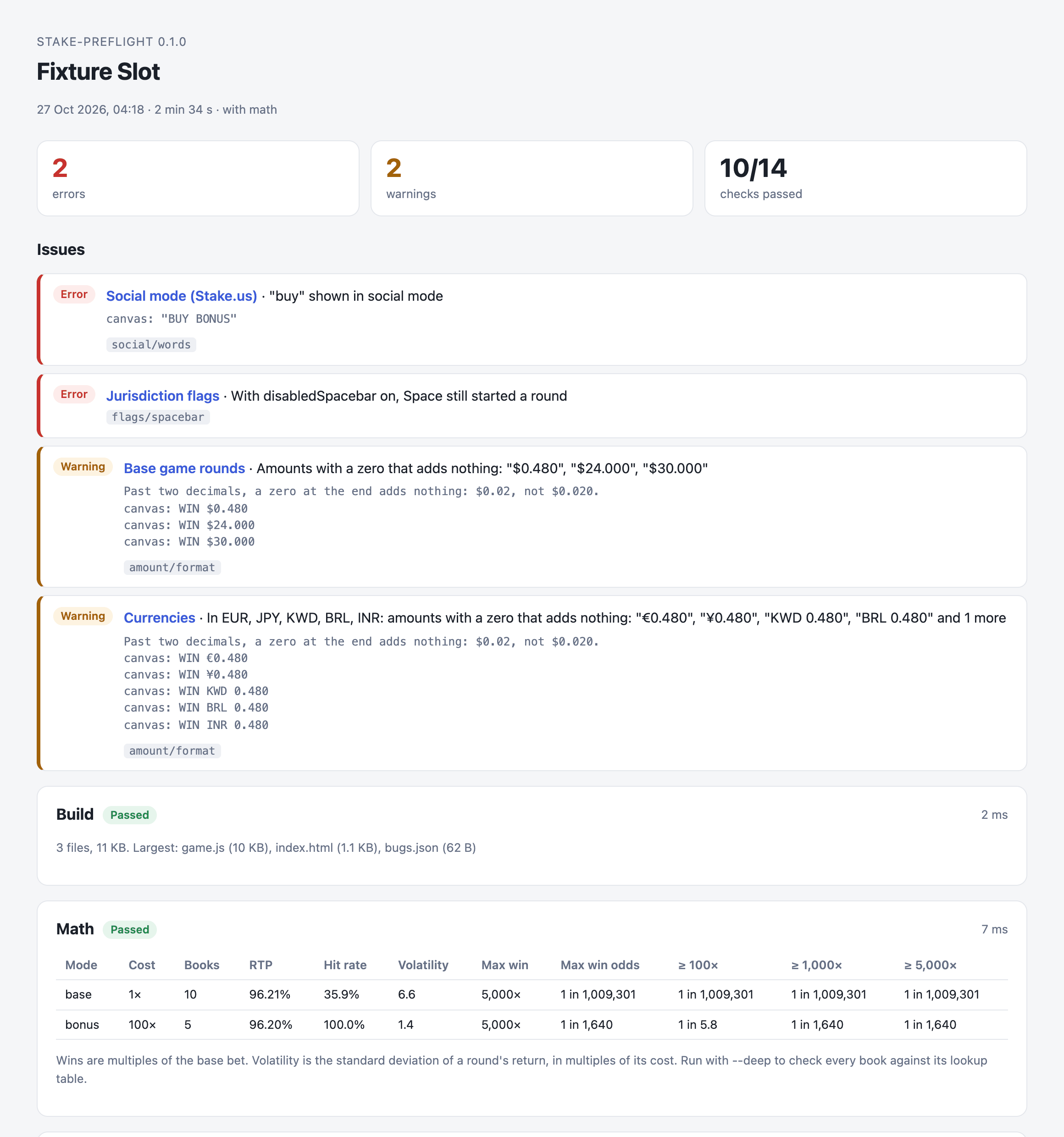
I made this while shipping slots on Stake Engine. Review kept sending games back for things that take a minute to fix and an hour to find: a bet that ignored the RGS's bet levels, $0.020 on a win label, the word "buy" in social mode, a replay that called the wallet. Each of those is a check here now.
Needs Node 22.15 or newer and Google Chrome (or Chromium).
npx stake-preflight ./build --math ./mathOr add it to the project with npm install -D stake-preflight, or run the latest from GitHub with npx github:egedev0/stake-preflight.
./build is the folder you upload as the frontend. --math is the folder you upload as the math: index.json, the lookup tables and the books. Without it, the checks that play rounds are skipped.
A full run takes five to ten minutes; --quick covers the main checks in about two. The report goes to preflight-report/index.html, with a report.json next to it. --open opens it when the run is done.
Ctrl+C stops the run and still writes the report for the checks that ran. On a Mac the run keeps the machine from sleeping, which would stall the game mid-round.
The command exits with 0 when nothing failed, 1 when a check found an error (or a warning, with --strict), 2 when it couldn't run and 130 when it was stopped, so it also works in CI.
To see it on the small demo game in this repo:
git clone https://github.com/egedev0/stake-preflight
cd stake-preflight && npm install && npm run demo| Check | |
|---|---|
build |
index.html loads nothing by an absolute path or from another host. No .env or .DS_Store in the upload. |
math |
index.json, the lookup tables and the books agree. RTP, hit rate, volatility, max win and tail odds for every mode. --deep checks every book. |
load |
The game opens from /<game>/<version>/index.html and authenticates. No console errors, failed or external requests, or page scroll. |
play |
A loss, a small win, a big win and a free spins round. Bets use the levels and default the RGS sends, wins end with /wallet/end-round, the balance and amounts are formatted right. |
input |
Spin pressed ten times a second, then again with a slow RGS. A second bet must never go out while a round is open. |
resume |
An unfinished round from /wallet/authenticate, with and without event. The game plays it out, ends it and carries on at its bet. |
replay |
Every mode replayed through /bet/replay. The bet and payout show before it plays, no wallet calls. Also a replay with only the required parameters, and one that doesn't exist. |
social |
social=true and jurisdiction.socialCasino: no real-money words anywhere the game shows text. |
flags |
disabledSpacebar, minimumRoundDuration, and the RTP, session timer and net position display flags. |
balance |
With a zero balance no bet goes out. |
errors |
An expired session, a failed bet, an RGS that can't be reached. RGS requests go to the host in rgs_url. |
screens |
The seven sizes of Stake's launcher, and resizing without a reload. |
locales |
The game opened in other languages. |
currencies |
The balance keeps two decimals in yen, dinar and the rest. |
Run some with --only play,replay or leave some out with --skip locales.
Nothing has to be added to the game. It watches from the outside:
- The RGS is a mock that answers like the real one. Amounts are in millionths, a win stays open until
/wallet/end-round, an unfinished round comes back withouteventuntil the game saves one. - Rounds start with Space, which every Stake game supports. An intro screen is passed with its Continue, Start or Play button, or with the steps you configure.
- Text is read from the page and from what the game draws: canvas
fillTextcalls (Pixi, Phaser and most engines draw text that way) and the SVG behind Pixi'sHTMLText. Text baked into images or drawn with bitmap fonts can't be read, so check the screenshots for those. - Each mode plays the same books every run: the first loss, small win, big win and max win in its lookup table, and the shortest of its first free spins rounds.
- The build is served as files only, matched by exact name, the way Stake's CDN serves it. A path that only works because your disk ignores case shows up as a 404.
Optional. Put preflight.config.json where you run the command, or pass --config <file>:
{
  "spin": [{ "key": "Space" }],
  "start": [{ "click": [0.5, 0.62] }],
  "screens": {
    "rules": [{ "click": [0.96, 0.05] }],
    "buy": [{ "selector": "button.buy-bonus" }]
  },
  "social": { "extra": ["coins"], "allow": [] },
  "langs": ["de", "es", "br", "ja"],
  "currencies": ["EUR", "JPY", "KWD"],
  "minimumRoundDuration": 3,
  "limits": { "rtp": [0.96, 0.97], "maxWin": 25000 },
  "timeouts": { "load": 60, "round": 120, "replay": 45 }
}
timeouts are in seconds. round is how long a round may go without saving progress (/bet/event) or ending, so a long bonus round that keeps moving gets the time it needs.
A step is one of { "key": "Enter" }, { "click": [x, y] } with x and y as fractions of the screen, { "selector": "css selector" } or { "wait": 500 }.
screens opens the game's own windows (rules, buy menu, settings) so their text gets read in social mode. If there's a buy entry, it's also tried with disabledBuyFeature on.
The words of the game's own name (its <title>) are never flagged in social mode, and neither is "Stake" as in Stake Engine. social.allow takes more, social.extra adds your own.
limits are your own targets for the math report; nothing is assumed when they're left out.
import { preflight } from 'stake-preflight';

const report = await preflight({ build: 'build', math: 'math', quick: true });
console.log(report.summary); // { errors, warnings, passed, skipped, sections }
The package ships its types. onProgress gets an event as each check starts and ends, and signal takes an AbortSignal to stop a run early.
It doesn't judge art, animation or the feel of the game, which is most of what review scores. A clean report means the mechanical things are right. Look through the screenshots and play it on a phone too.
Some checks come from review feedback rather than Stake's docs, and the rules change. If a check disagrees with what review told you, please open an issue.
Not affiliated with Stake.
The code is TypeScript and runs from source with Node 22.18 or newer, no build step needed:
npm install
npm test            # unit tests, then the demo game in a real browser
npm run typecheck
npm run build # compiles to dist/, which is what gets publishedMIT