
Your codebase already knows how it works. ProDocs makes it explain itself—with receipts.




Quickstart · Knowledge · Impact · Agents · Commands · Vision
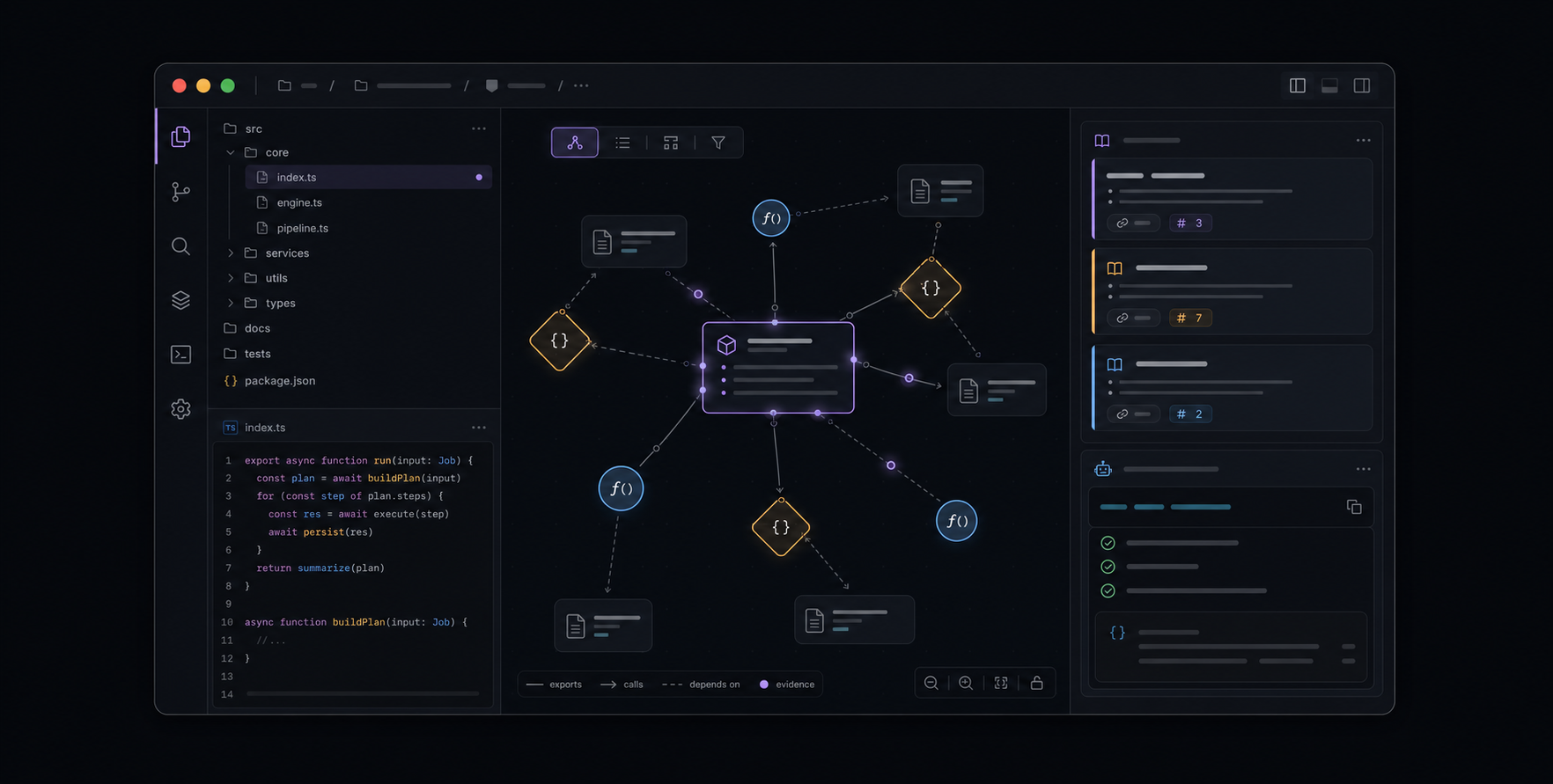
Code is evidence. Documentation is a set of claims. ProDocs keeps the link between them.
ProDocs is an open-source, local-first product knowledge system for humans and coding agents. It connects code, tests, APIs, database schemas, ownership, claims, decisions, features, runbooks, and customer impact in one versioned graph.
The deterministic core requires no model and no hosted service. Optional model providers can propose cited prose only after explicit network approval.
| Conventional documentation | ProDocs |
|---|---|
| Pages drift silently | CI checks source, configuration, and authored knowledge freshness |
| Generated prose sounds plausible | Every claim records resolvable evidence |
| Change review starts from guesswork | prodocs impact maps a diff to behavior, tests, owners, decisions, and runbooks |
| Agents ingest the repository | Agents request task-shaped context with hard file/token budgets |
| AI can overwrite human intent | Writes require a reviewable proposal and exact approval hash |
| Each tool builds another index | Humans, agents, MCP clients, and views share one graph |
| Knowledge lives in a vendor cloud | SQLite, JSON, Markdown, and history remain in the repository |
ProDocs supports Node.js 20, 22, and 24 on Linux, macOS, and Windows.
npm install --global @danielesuga/prodocs

cd /path/to/your/repository
prodocs init
prodocs adopt
# Review the cited proposal, then run the exact apply command it prints.
prodocs doctor
prodocs status
prodocs adopt does the onboarding research: it infers structured product
identity, framework entrypoints, likely GitHub ownership, and starter product
knowledge with confidence and evidence citations. It writes a content-bound
proposal under .prodocs; no inferred intent is applied until the exact
approval hash is supplied:
prodocs adopt --json
prodocs adopt \
  --apply .prodocs/adoption-proposal.json \
  --approve <approvalHash>
Application also creates any missing agent recipes, refreshes generated views,
and returns doctor and policy results. Agents can request the same proposal
without writes through the read-only prodocs_adopt MCP tool.
Try the product without modifying an existing repository:
prodocs tutorial --output prodocs-tutorial
cd prodocs-tutorial
prodocs sync
prodocs doctor
Generated output includes:
docs/prodocs/
├── SYSTEM_OVERVIEW.md
├── CODE_MAP.md
├── FEATURE_MAP.md
├── KNOWLEDGE_HEALTH.md
├── views/
│   ├── product.md
│   ├── technical.md
│   ├── support.md
│   ├── security.md
│   ├── operations.md
│   └── coding-agents.md
├── knowledge.json
└── manifest.json
The reusable incremental index is stored at .prodocs/index.sqlite; portable
JSON remains the interoperability and debugging format.

Reviewed intent lives in ordinary Markdown under docs/knowledge. ProDocs can
draft the initial cited document through adopt; thereafter it parses a strict,
safe YAML front matter contract and never rewrites these files during sync.
---
kind: feature
id: delivery-retries
title: Delivery retry behavior
status: active
audiences:
  - product
  - support
evidence:
  - src/delivery/retry.ts#retryDelivery
  - test/delivery/retry.test.ts
customerImpact: Failed deliveries are retried without manual intervention.
---
Deliveries use the reviewed retry policy.
Supported kinds are claim, decision, invariant, feature, and runbook.
Evidence references may target a file or file#symbol. The graph reports:
- supported and unsupported knowledge;
- explicit contradictions and supersession;
- evidence coverage;
- feature-to-code and feature-to-customer-impact relationships;
- applicable owners, tests, and runbooks.
# Compare a branch with main
prodocs impact --base main --json

# Or use an explicit range and write a review proposal
prodocs impact main...HEAD \
  --patch .prodocs/impact-proposal.json \
  --json

# Evaluate documentation contracts
prodocs policy

# Create a deterministic cited narrative
prodocs propose \
  --impact .prodocs/impact.json \
  --provider template \
  --output .prodocs/narrative.json
Impact traversal returns affected files, claims, decisions, invariants, features, runbooks, tests, and owners. Proposal application is separate:
prodocs proposal validate proposal.json
prodocs proposal apply proposal.json --approve <approvalHash>
The approval hash binds authorization to the exact operations and content. Only authored Markdown paths are writable; generated output, symlinks, stale files, and repository escapes are rejected.
Install the local pre-push gate:
prodocs hooks installIt configures a repository-owned hook that runs freshness, policy, and impact checks. CI runs the same production checks and builds pull-request impact evidence.
Use bounded context from any command-capable agent:
prodocs context \
  --path src/billing \
  --task "change invoice retry behavior" \
  --max-files 20 \
  --max-tokens 8000 \
  --json
Context packets use schemaVersion: 2. They include code and applicable
knowledge, deterministic relevance, freshness, truncation metadata, exact byte
measurements, token estimates, and an explicit untrusted-repository boundary.
Start the local MCP server:
prodocs mcpIt implements the current MCP 2025-11-25 stdio protocol with read-only tools:
prodocs_adopt;prodocs_context;prodocs_impact;prodocs_policy;- graph and policy resources.
prodocs init creates recipes for Codex, Claude Code, OpenCode, VS Code/editor
MCP clients, and generic AGENTS.md consumers under .prodocs/integrations.
Measure context quality instead of guessing:
prodocs evaluate --suite fixtures/evaluation/core.jsonEvaluation suites report recall, precision, truncation, and token use for representative maintenance tasks.
Measure cold/warm indexing, cache reuse, and per-agent context quality locally:
prodocs benchmark \
  --suite fixtures/evaluation/agents.json \
  --output .prodocs/product-benchmark.json
No telemetry or repository content is transmitted.
Built-in evidence includes:
- parser-backed JavaScript and TypeScript;
- Python, Go, Rust, Java, Ruby, PHP, C#, Swift, and Kotlin;
- OpenAPI endpoints and schemas;
- SQL tables and views;
- CODEOWNERS and owner edges;
- test files and test-to-source relationships.
Third-party extensions use a declarative collector SDK. Plugins declare only
the collect:source-text capability; ProDocs does not execute plugin code.
prodocs plugin verify my-plugin.prodocs-plugin.jsonSee the collector contract and the conformance fixture.
# Render a view without writing
prodocs view --audience support

# Read the committed graph from another revision
prodocs history --at v1.0.0 --json
prodocs view --audience technical --at v1.0.0

# Review and explicitly approve executable verification
prodocs runbook plan production-verification --json
prodocs runbook verify production-verification --approve <approvalHash>

# Optional loopback collaboration API
prodocs serve --host 127.0.0.1 --port 43110
Runbook commands execute without a shell, inside the repository, with a bounded timeout and secret-minimized environment. A content-bound approval is mandatory.
The collaboration API is local and read-only by default. Proposal writes require
PRODOCS_SERVER_TOKEN. Non-loopback binding is refused unless that token is at
least 24 characters.
| Command | Purpose |
|---|---|
prodocs init |
Create configuration and agent/MCP recipes |
prodocs adopt |
Infer and propose cited identity, entrypoints, ownership, and starter knowledge |
prodocs doctor |
Require warning-free identity, evidence, freshness, integrations, and knowledge readiness |
prodocs tutorial |
Create a safe, complete getting-started project |
prodocs sync |
Incrementally index evidence and render all views |
prodocs check |
Fail when generated knowledge is stale or contains broken local links |
prodocs status |
Show evidence, index, and knowledge health |
prodocs context |
Return bounded task-shaped context |
prodocs impact |
Map git changes through the knowledge graph |
prodocs policy |
Evaluate documentation contracts |
prodocs propose |
Produce a cited deterministic or model-backed narrative |
prodocs proposal |
Validate or explicitly apply reviewed writes |
prodocs mcp |
Run the local stdio MCP server |
prodocs evaluate |
Measure context retrieval quality |
prodocs benchmark |
Measure indexing, cache reuse, and per-agent context locally |
prodocs plugin verify |
Verify declarative collector conformance |
prodocs hooks install |
Install the local pre-push gate |
prodocs view |
Render an audience-specific view |
prodocs history |
Read a versioned graph snapshot |
prodocs runbook |
Plan or verify an executable runbook |
prodocs serve |
Start the optional collaboration API |
prodocs capabilities |
List public capabilities and adapters |
Run prodocs --help for every option.
Repository content is untrusted input:
- source collectors parse strings and never import, compile, or execute indexed code;
- plugin definitions are declarative and capability-bounded;
- source, knowledge, index, proposal, and output paths are repository-contained and symlink-safe;
- file count, file size, total bytes, context size, provider payloads, HTTP bodies, subprocess output, and execution time are bounded;
- instruction-like repository text is flagged and never promoted into agent instructions;
- model data egress requires
--allow-network, uses HTTPS except on loopback, redacts common secrets, and rejects unsupported citations; - proposal and runbook mutations require exact content-bound approval hashes.
See SECURITY.md and docs/OPERATIONS.md.
The package exports collectors, declarative plugin helpers, provider helpers, and these JSON Schemas:
- knowledge graph, version 2;
- context packet, version 2;
- collector result, version 1;
- impact report, version 1;
- proposal, version 1.
ProDocs follows Semantic Versioning. Incompatible public API or CLI changes
require a major release after 1.0; data contracts use their own
schemaVersion.
npm ci
npm run verify
npm run test:coverage
npm run verify:production
The production gate includes syntax checks, 66+ cross-platform tests, installed package workflow testing, release consistency, generated-document freshness, policy checks, context evaluation, plugin conformance, coverage floors, npm audit, signature verification, and package inspection.
Read the product vision, architecture, completed roadmap, compatibility policy, and production validation. Adoption measurement is documented in docs/ADOPTION.md, troubleshooting in docs/TROUBLESHOOTING.md, and dependency posture in docs/SUPPLY_CHAIN.md.
See CONTRIBUTING.md, SUPPORT.md, and SECURITY.md.
Licensed under the Apache License 2.0.