

Wherewolf is a local SQL workbench for CSV, Parquet, JSON, JSON Lines, and XLSX files. It opens a native PyQt6 desktop window and runs queries with DuckDB by default. There is no browser UI and no local web server.
Wherewolf requires Python 3.12 or newer.
uv tool install wherewolf
wherewolf
wherewolf-desktop is an equivalent entry point. Both commands open the native desktop window.
wherewolf --version prints the release version and the build commit, for example
wherewolf 0.6.0 (build 202db43). It answers without loading Qt, so it works over SSH and on a
machine with no display — useful for confirming which build an installed copy actually is.
The default installation is DuckDB-only: it neither installs nor imports PySpark. To enable the local Spark engine, install the extra and a Java runtime compatible with PySpark (CI uses Java 21):
uv tool install 'wherewolf[spark]'Spark runs locally as local[1] with bounded driver memory. It is not a remote- or cluster-Spark
client.
The input-dialect selector accepts DuckDB, Spark, Azure SQL, Oracle, and PostgreSQL SQL and
transpiles it to the selected local DuckDB or Spark engine. Oracle and PostgreSQL are source
languages, not database connections. Dialect translation is provided by sqlglot, so not every
vendor-specific construct can run locally; for example, Oracle ROWNUM and DUAL queries are
reported before execution and must be rewritten for the selected engine.
git clone https://github.com/beallio/wherewolf.git
cd wherewolf
./run.sh uv sync
./run.sh uv run wherewolf
For the optional Spark engine from a source checkout, run ./run.sh uv sync --extra spark after
installing Java.
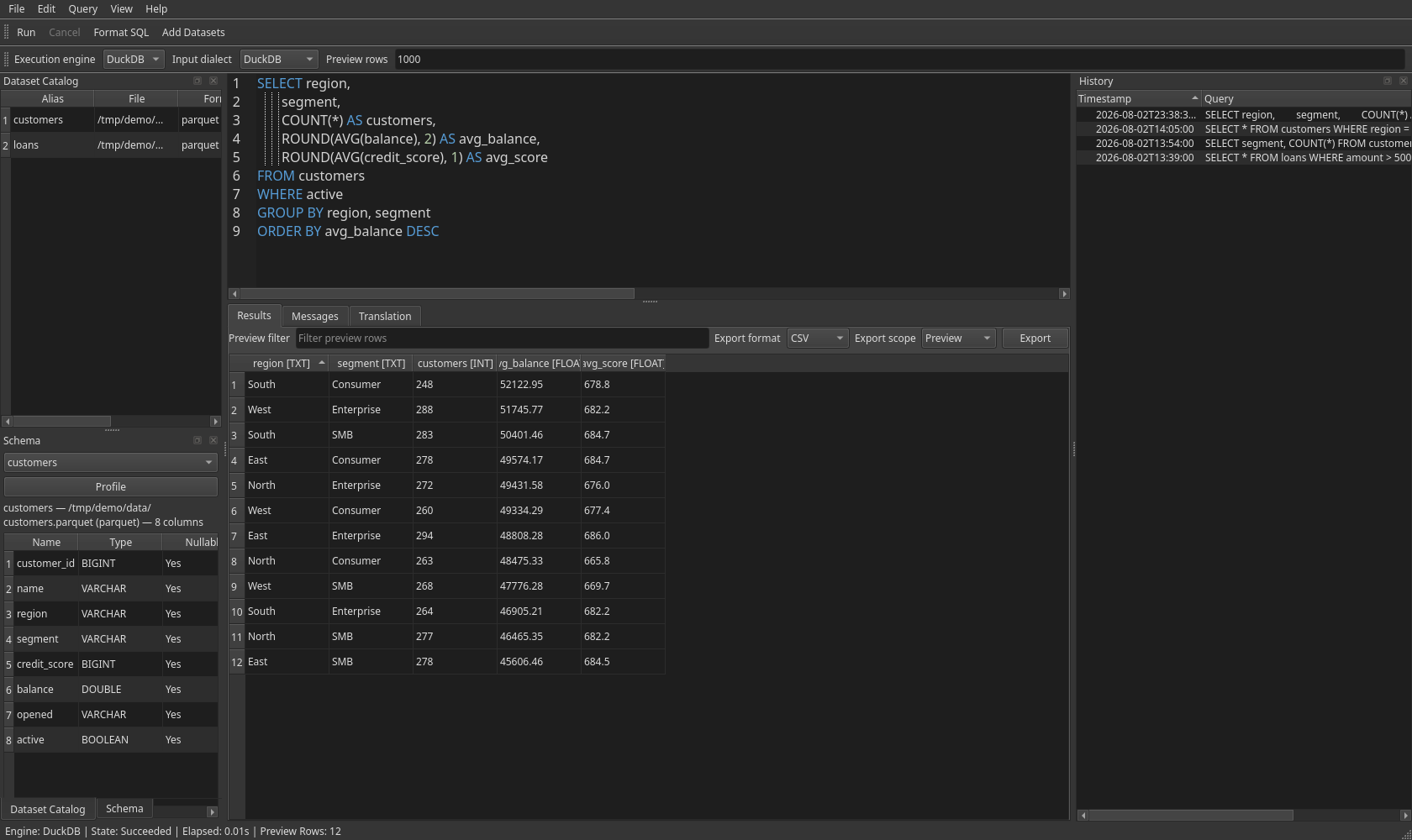
- Choose Add Datasets… or drag supported local files into the Dataset Catalog. The command opens the operating system's native multi-file dialog where Qt supports it.
- Each file receives a table alias. Rename it from the catalog context menu when needed, then use the alias in SQL. The Schema dock reports discovered columns and any schema error.
- Write SQL in the editor and press Ctrl+Return to run the selection or current statement. Ctrl+Space opens completion, and Ctrl+Shift+F formats SQL. On macOS, use the platform's equivalent shortcut conventions.
- Press Ctrl+. to request cancellation of the active query. The status bar and Messages tab report state, timing, preview rows, truncation, and errors.
- History records successful queries in
~/.wherewolf/history.json. Selecting a history entry restores its SQL only — your dataset catalog is left untouched — and does not run it. The History dock shows timestamp and query in separate sortable columns. Use File → Clear History to remove saved entries, View → Reset Layout to restore the default layout, or the View menu to reopen a dock you have closed.
The Schema dock also profiles the selected dataset — null percentage, approximate distinct
count, min, max and mean — computed with DuckDB SUMMARIZE on a background thread. Profiling
runs automatically when a dataset is added and is skipped for sources above a configurable size.
Both settings live in View → Preferences…, alongside editor font size, theme, and completion.
Window geometry, docks, splitter proportions, editor font size and theme, preview row count, recent dataset directory, profiling and completion preferences are persisted between desktop sessions.
The grid displays a bounded preview — 1,000 rows by default, adjustable from 10 to 100,000 —
preserves values for typed sorting, and supports selection, spreadsheet-compatible TSV copy,
filtering, column reordering, hiding, auto-sizing, and reset. Column headers carry a data-type
badge such as age [INT] or when [DATE], with the exact type in the tooltip. Right-click a
header to copy or insert its name, adjust columns, or choose an ordering action.
The preview filter accepts either plain text, matched as a substring, or a SQL predicate over
the previewed rows such as age > 40 or region = 'East' AND amount > 100. An invalid
expression reports the engine's error and leaves the current rows in place. Filters apply to the
preview only and cannot reach rows excluded by the row limit.
Clicking a header only sorts the local preview. While a local sort is active, Wherewolf labels it Sorted preview only. It does not rerun or alter your query. To change the result order of the query itself, use Apply Ascending Order to Query or Apply Descending Order to Query from that header's context menu, then run the resulting SQL.
Export Preview… writes the currently displayed, bounded preview. Export Full Results… re-executes the captured query rather than exporting only the preview. For DuckDB, full CSV and Parquet exports stream directly to disk without materializing the entire result in Python; full XLSX export is intentionally capped at 100,000 rows. Choose the scope and file format beside the results grid and press Export; the save dialog offers only the selected format and confirms before replacing an existing file. If a source file changed on disk after the query ran, the export reports it rather than reporting plain success. Spark has no desktop full-export adapter, so full Spark export is not available.
Wherewolf is licensed under GPL-3.0-only. Releases through 0.5.2 remain available under MIT;
their original text is retained in LICENSES/MIT-pre-0.6.txt, and those prior grants remain
valid.
Run the test suite from a source checkout:
./run.sh uv run pytestThe project uses uv, ruff, and ty; see AGENTS.md for the project execution and
cache-isolation contract.