English | 简体中文

AgentArk is an open environment framework for multimodal agents: models can see interactive tasks, write actions as code or tool calls, receive verifiable feedback, and improve through evaluation, replay, or RL.
The goal is not to freeze one benchmark. AgentArk is built as infrastructure for continuously growing interactive tasks. Its base environment can load arbitrary task mods, while each mod defines its own scene, prompt, observations, actions, scoring rules, and termination conditions. Coding agents can help turn new task ideas into verified mods; the same tasks can then be used for multimodal model evaluation, trace replay, and reinforcement learning.
More than 200 task environments have already been developed. Verified tasks are being released in batches through AgentArk Hub and Hugging Face on the way to a 1K+ task library in 2026.
This repository provides the Python package for runtime control, model evaluation, replay, environment serving, and RL training integration.

- Task scaling with coding agents. New environments are packaged as task mods, so designers, builders, and reviewers can expand the task library without changing the core runtime.
- Multimodal task evaluation. Models interact with visual and textual state, receive score and error feedback, and produce replayable traces for analysis.
- Multimodal agent training. The same runtime and task definitions can be served over HTTP for RL frameworks, including ms-swift and verl GRPO integrations.
- A broad task surface. AgentArk is designed for 2D and 3D scenes, physics calibration, timing control, path planning, video-level observation, mini-games, GUI-like tasks, and future task families that can be expressed as loadable mods with verifiable scoring.

▶ 我承认了,GPT 6,你是最会开火车的,像本up一样 |
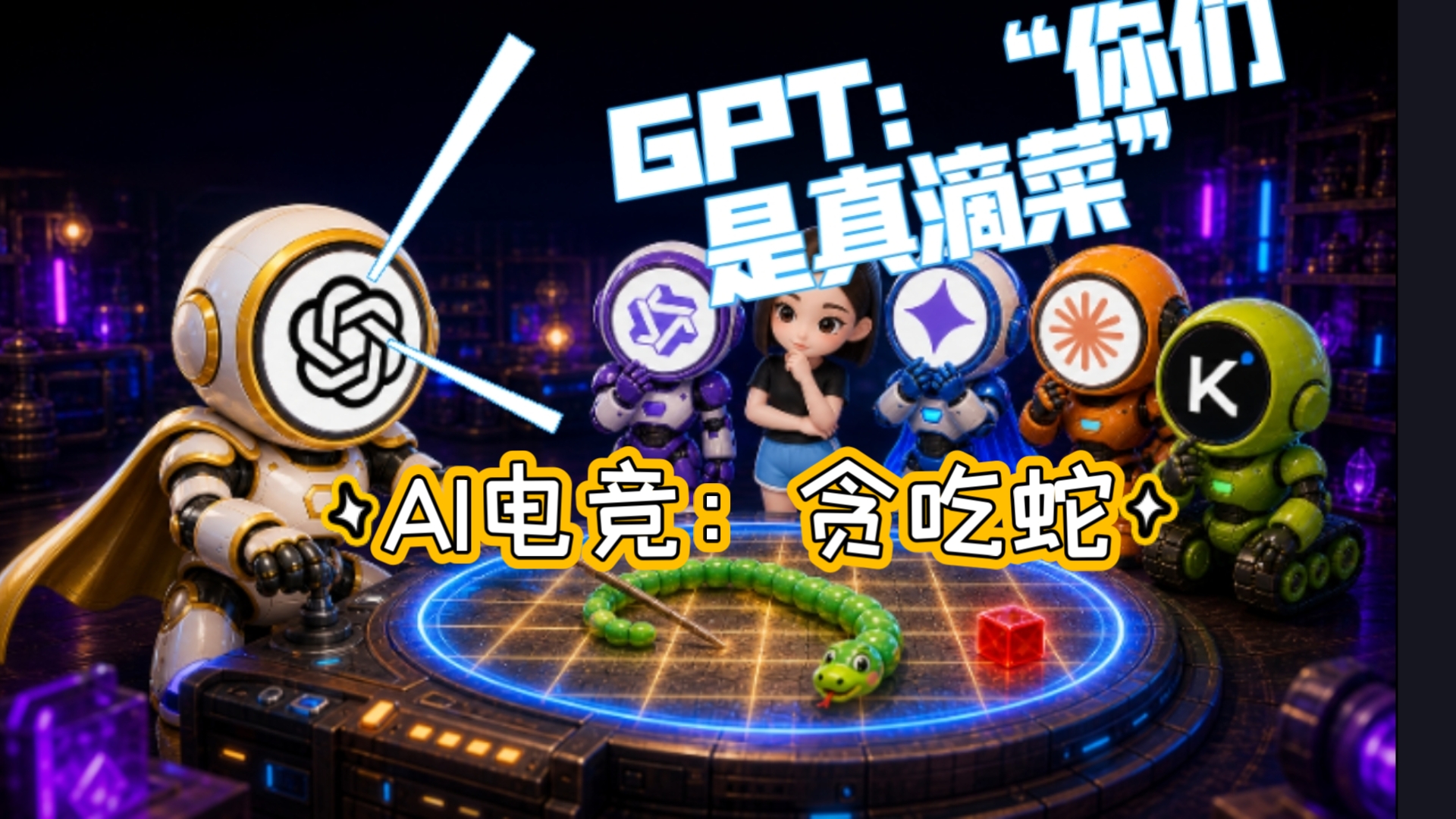
▶ GPT: 啊?你们不会玩贪吃蛇啊? |

▶ AI电竞:打弹珠 “豆姐你倒是动啊!!!” |
Click a cover or title to watch on Bilibili.
You do not need to install the local runtime before seeing what AgentArk can do. Start with the Hub and the Colab tutorials:
| Entry | What it is for |
|---|---|
| AgentArk Hub | Browse released tasks, preview media, public scoreboards, model results, and artifact links. |
| AgentArk Bench on Kaggle | Run and compare a growing selection of AgentArk tasks on Kaggle Benchmarks. |
| 01_human_play_tutorial.ipynb | Play and debug AgentArk tasks manually from Colab. |
| 02_model_replay_tutorial.ipynb | Replay saved model actions without calling a model API again. |
| 03_online_evaluation_tutorial.ipynb | Run online API evaluation against AgentArk tasks. |
| 04_rl_training_tutorial.ipynb | Launch the RL training workflow around the AgentArk env server. |
| Hugging Face artifacts | Download runtime builds, task mods, replay records, and registries. |
Kaggle evaluations use its OpenAI-compatible Model Proxy. Their leaderboard
runs use temperature: 1.0 when accepted, or omit the parameter for models that
do not allow it. The original local scoreboards on AgentArk Hub were evaluated
with temperature: 0.0, so results from the two sites use different settings
and should not be compared as identical runs.
- Environment setup: docs/setup.md
- System paper: docs/paper/AgentArk.pdf
- Colab tutorials: docs/tutorials
- Model evaluation and replay: docs/evaluation-guide.md
- RL training with ms-swift or verl: docs/rl-training.md
- Runtime sandbox details: docs/runtime-sandbox-migration.md
AgentArk local evaluation, replay, and env serving use the Python package in
this repository plus a matching packaged Unity runtime from Hugging Face.
Current runtime release: env-1.0.3, with 51 starter tasks.
See docs/setup.md for installation, runtime download, local path configuration, and smoke-test instructions.
For OpenAI-compatible HTTP providers, set an API key for the provider used by your eval config. For example, if you use the default OpenRouter-style example config:
export OPENROUTER_API_KEY=...For other OpenAI-compatible HTTP providers, change models[*].provider,
models[*].base_url, and models[*].api_key_env or set models[*].api_key
directly in your local config.
Codex SDK evaluation is also supported through provider: codex. See
docs/evaluation-guide.md for the Codex install,
AgentArk-only lean context profile, and delta message-context settings. The
lean profile is passed to evaluation SDK threads and does not modify normal
Codex configuration.
Edit config/ark_env/eval_seed1.example.yaml
so eval.cases[*].task_name exists in your runtime and models[*] matches your
selected provider. Then run:
python -m agent_ark.ark_eval.run_api_agent \
  --config config/ark_env/eval_seed1.example.yaml
For multiple seeds:
python -m agent_ark.ark_eval.run_api_agent \
  --config config/ark_env/eval_seeds_1_n.example.yaml
For parallel model/seed evaluation across multiple isolated Unity runtimes:
python -m agent_ark.ark_eval.run_parallel_api_eval \
  --config config/ark_env/parallel_api_eval.example.yaml
When eval.max_parallel_envs > 1, keep
env_cfg.runtime_sandbox.enabled: true. Each worker gets a private writable
runtime while sharing task assets through Mods/all_tasks.
Saved JSONL records can be replayed without calling a model:
python -m agent_ark.ark_eval.run_replay \
  --config config/ark_env/replay.example.yaml \
  --records tmp/DelayTrain_seed1_5.jsonl \
  --index 0
AgentArk Hub is also useful after an eval run: it shows the public task catalog and aggregate scoreboards, while this repository stores your local JSONL results. The evaluation guide covers model configs, browser visualization, human interaction, scoring fields, trajectory save/load, and replay: docs/evaluation-guide.md.
AgentArk serves its Unity runtime pool over HTTP for multi-turn, multimodal RL. The runtime wrapper and Env Server use the AgentArk Python 3.10.12 environment, while each trainer keeps its own Python environment and dependency stack.
Two GRPO integrations are available:
- ms-swift, with the trainer integration in AgentArk-enabled Swift and the Server, runbook, and temporary legacy fallback here.
- VERL, with its trainer-side implementation in
the public
agentark_rlfork.
Start with the RL integrations index to choose a framework and follow its end-to-end runbook. Shared architecture, grouping and task-selection semantics are described in the RL training guide.
The long-term goal of AgentArk is model-environment co-evolution: agents find their own capability gaps, propose new tasks, implement and verify task modules, train on those environments, and then generate harder tasks from their failures.
Near-term development will focus on:
- 1K+ task scale in 2026. Build on the 200+ task environments already developed and keep releasing verified, reproducible, trainable task mods.
- Dynamic curriculum. Select tasks based on model success rates, error types, task parameters, and capability coverage.
- Long-horizon memory. Compress observations, actions, scores, and error analysis for tasks with long interaction histories.
- Richer environment sources. Combine generated assets, 3D generation, and world models with AgentArk's verifiable task logic.
- Stronger Hub artifacts. Improve task/runtime versioning, trace artifacts, download links, and public model reports.
agent_ark.ark_env: Unity runtime lifecycle, task reset/step protocol, runtime sandboxing, env server, warmup, and HTTP client utilities.agent_ark.ark_eval: API model evaluation, parallel evaluation, replay, and trajectory save/load.integrations: framework-specific RL runbooks, Server helpers, and temporary compatibility adapters; the ms-swift built-in integration is currently in its feature branch, while the VERL trainer recipe remains in its public fork.agent_ark.interaction: local browser viewer and human-interaction hooks.
The Python package in this repository is Apache-2.0. Runtime builds, task mods, and records on Hugging Face are distributed under the license stated on the dataset card, currently CC BY-NC 4.0 unless otherwise noted.
- Email: agentark@qq.com
- WeChat:
dada_biubiubiu