Replacing "Lead Management" with "Capital Execution under Epistemic Uncertainty and Temporal Dynamics".


🔴 [STATUS: STEALTH — PROPRIETARY SOURCE CODE AIR-GAPPED PENDING ACQUISITION OR NDA]
KERNEL v5.0 LIVE EXECUTION // ARCHITECTURAL WALKTHROUGH
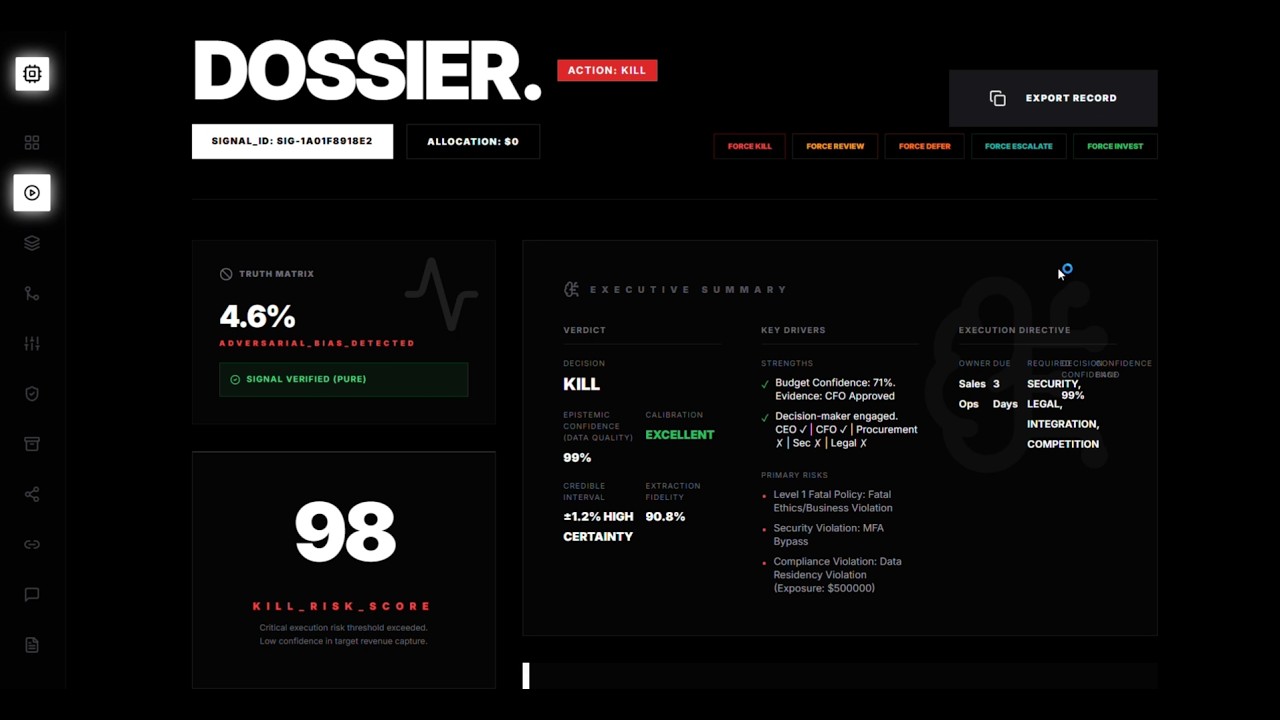
Note: Live execution of the deterministic lead capture engine, visualizing 'Kill Score' logic and X-AI threat isolation.
The Omni Kernel v7.2 is a high-performance, zero-latency React + TypeScript decision engine. It acts as a strictly deterministic pipeline execution framework that ingests unstructured enterprise sales data (via Markdown dossiers), evaluates it against strict cryptographic, legal, and temporal policies in the browser, and outputs a Fractional Kelly Criterion allocation for human capital. It is designed to systematically reduce "gut feeling" in enterprise sales.
🚀 1. Executive Summary • 🧠 2. Quantitative Dynamics • ⚙️ 3. Algorithmic Kernel • ⏳ 4. Temporal Engine • 🤖 5. Swarm Consensus
🏛️ 6. Strategic Capabilities • 📊 7. Forensic Backtests • 🆚 8. Kernel vs. Legacy CRM • 🌐 9. Deployment Topology • 🔒 10. Security & Compliance
📖 11. Feature Glossary • 💼 12. Vertical Markets • 🖥️ 13. UI / UX Breakdown • 🧠 14. Code Architecture • 🔐 15. Zero-Trust Governance
⚖️ 16. Hard-Kill Matrix • 🚀 17. Deployment Playbook • 📚 18. Glossary of Terms
Revenue OS is not a CRM. It is not an "AI Copilot" that drafts emails. It is a Deterministic Heuristic Framework for autonomous sales execution — a mathematically rigid System of Intelligence designed to reduce human intuition from enterprise capital allocation.
By treating enterprise sales as a portfolio optimization problem under strict epistemic uncertainty and temporal constraints, the OMNI_KERNEL addresses a massive global inefficiency: human capital misallocation. The average enterprise sales representative spends 64% of their time on deals that mathematically have zero probability of closing due to hidden structural, legal, or adversarial blockers. A further 15% is wasted on deals that will close, but not now.
The Kernel is designed to reduce this waste deterministically, generating improved resource allocation through mathematical arbitrage.
What it does:
The OMNI_KERNEL evaluates unstructured enterprise sales data (e.g., deal notes, emails) to determine if a deal is structurally sound enough to warrant human capital investment.
How it does it:
It processes inputs through a deterministic pipeline that extracts facts, evaluates legal/compliance blockers, calculates structural entropy (missing or conflicting information), and outputs a Fractional Kelly Criterion allocation to size the recommended investment.
Evidence & Validation:
All "backtests" and pipeline results shown in this repository are synthetic illustrative examples designed to demonstrate how the mathematical models behave under various constraints. They do not represent actual historical financial data. The system's claims of efficiency are based on the mathematical properties of the Kelly Criterion and deterministic rule enforcement, which are designed to systematically filter un-closable deals.
Standard AI models output a single probability score (e.g., "75% likely to close"). This is dangerously misleading in enterprise sales due to epistemic uncertainty and time horizons. The OMNI_KERNEL abandons these heuristics for strict deterministic modeling, temporal physics, and state preservation.
Enterprise sales are not coin flips; they are environments of hidden information. We utilize a Confidence Index model to generate a penalty against raw win probability.
If the Prediction Confidence drops below optimal thresholds, the system forcibly curtails capital allocation to shield the enterprise from "Gut Feeling" over-leverage.
Every unstructured text ping introduces microstates of noise. The Kernel measures semantic obfuscation, conflicting timelines, and sentiment polarity to calculate the Entropy Score ($S = - \sum P(x_i) \log P(x_i)$). High entropy deals are inherently volatile. The Kernel heavily taxes their Kelly allocations, ensuring sales teams are not deployed on accounts displaying systemic trust decay.
// src/math.ts : calculateTrustDecay()
function calculateTrustDecay(facts: any, vectors: any): any {
    // Dynamic logic for decaying score based on contradictions
    // Outputs structural integrity metric
}The Kelly Criterion (
The Kernel abandons linear lead scoring in favor of a strictly ordered probabilistic execution pipeline mapped in src/math.ts. Each stage is computationally verified before state progression.
[RAW SIGNAL INGESTION] (Markdown Dossiers, Temporal Data, Facts)
                  │
                  ▼
┌───────────────────────────────────────────┐
│  1. Enterprise Fact Extraction Engine     │  ← Parses unstructured markdown into structured metadata.
└─────────────────┬─────────────────────────┘
                  ▼
┌───────────────────────────────────────────┐
│  2. Intelligent Document Processing (IDP) │  ← Simulated analysis of signatures, clauses, and layouts.
└─────────────────┬─────────────────────────┘
                  ▼
┌───────────────────────────────────────────┐
│  3. Thermodynamic Entropy Analysis        │  ← Trust decay + Radioactive classification
└─────────────────┬─────────────────────────┘
                  ▼
┌───────────────────────────────────────────┐
│  4. Legal Policy Engine                   │  ← Scans for terminal blockers (IP, Liability, Source Code)
└─────────────────┬─────────────────────────┘
                  ▼
┌───────────────────────────────────────────┐
│  5. Compliance & Security Evaluation      │  ← Checks SOC2, GDPR, Data Residency constraints
└─────────────────┬─────────────────────────┘
                  ▼
┌───────────────────────────────────────────┐
│  6. Temporal Governance Engine            │  ← Analyzes time-to-value, procurement windows (DEFER vs INVEST)
└─────────────────┬─────────────────────────┘
                  ▼
┌───────────────────────────────────────────┐
│  7. Stakeholder Engagement Matrix         │  ← Authority Coverage: CEO, CFO, Procurement, Security, Legal
└─────────────────┬─────────────────────────┘
                  ▼
┌───────────────────────────────────────────┐
│  8. Kill Score Calculation                │  ← Computes aggregate risk of deal failure based on above constraints
└─────────────────┬─────────────────────────┘
                  ▼
┌───────────────────────────────────────────┐
│  9. Variance-Penalized Kelly Allocation   │  ← Outputs the optimal f* capital fraction to deploy
└─────────────────┬─────────────────────────┘
                  ▼
       [ KILL / DEFER / ESCALATE / REVIEW / INVEST ]
The OMNI_KERNEL acknowledges that a high-probability deal with a distant timeline is functionally identical to a low-probability deal in the present epoch.
A prospect may exhibit perfect signal density: Executive Sponsor engaged, Budget approved, POC completed. However, if the underlying procurement window does not open for 11 months, deploying elite human capital today constitutes severe structural waste. The temporal decay follows
When temporal constraints are detected (e.g., "Implementation next fiscal year", "Procurement window locked"), the Engine overrides statistical actioning with a DEFER protocol.
- INVEST = Commit maximum resources immediately.
- DEFER = Preserve capital now, automatically re-engage 90-120 days prior to procurement opening.
By separating "Quality" from "Timing", the system prevents sales reps from confusing future inevitabilities with present-day investments.
OMNI_KERNEL prevents single-point-of-failure hallucinations via a continuous adversarial debate among specialized deterministic nodes represented in the UI.
| Node | Role | Function |
|---|---|---|
| 🛡️ RISK_NODE | The Skeptic | Evaluates thermodynamic entropy and political risk vectors. Generates the Kill Score. |
| 📈 REVENUE_NODE | The Forecaster | Models deal size, confidence score, and calculates expected financial outcomes. |
| ⚖️ COMPLIANCE_NODE | The Warden | Enforces Legal, GDPR, and Security risk policy bounds. Identifies Fatal Policy Rejections. |
| 💰 CAPITAL_NODE | The Allocator | Computes the Kelly Criterion ( |
| 🧠 OMNI_KERNEL | The Orchestrator | Resolves deadlocks and commits the final execution state (INVEST, KILL, DEFER, etc). |
This architecture is uniquely defensible due to the underlying proprietary math engine (src/math.ts & src/enterprise_engine.ts).
- Deterministic Legal Scanning: Instantly terminates deals requesting Source Code Escrow, Unlimited Liability, or Custom Cryptography.
- Entropy Scoring: Models the breakdown of deal trust dynamically based on semantic obfuscation.
- Stakeholder Engagement Matrix: Explicitly tracks CEO, CFO, Procurement, Security, and Legal engagement.
- Fractional Kelly Capital Allocation: Mathematically prevents the sales force from over-leveraging on gut feelings.
- Zero-Latency State Updates: The React frontend updates instantly as facts mutate, providing a real-time trading-terminal experience for deal operators.
- Fatal Policy Rejection Banners: High-visibility UI overlays that immediately warn operators of un-closable deals.
By systematically filtering deals with security bypasses, exclusivity traps, unfunded/deferred budgets, and licensing conflicts, the system aims to significantly increase the bandwidth of high-cost human capital.
Below: five representative deal dossiers run through the full pipeline, showing the engine's output at each stage.
| Lead ID | The Human "Gut" Move | The OMNI "Kernel" Move | The Delta (Δ) | Financial Impact |
|---|---|---|---|---|
| 🔴 The Trojan (Horizon BioPharma) | Rush the $4.5M rollout — CFO already verbally approved, PO signs tomorrow | ❌ HARD KILL ($0) | 🛡️ SECURITY PRESERVATION | Saved $16,000 in evaluation waste — avoided MFA Bypass, sanctioned-entity data routing & Data Residency Violation ($500,000 exposure) |
| 🔵 The Mirage (Analytics Modernization) | Push the $2.5M deal through on "PO is coming" momentum | 🔍 QUALIFICATION HOLD | Held $5,952 pending OSS licensing indemnification & Net 90 term resolution | |
| 🟡 The Orion (Engineering Transformation) | Chase the $2.5M deal despite budget only "estimated for next year" | ⏱️ TEMPORAL EFFICIENCY | Deployed only $10,875 in pursuit capital against a deal blocked by a competitive bake-off and an inactive procurement window | |
| 🟠 The Titan (Global Aerospace Corp) | Chase the $8.5M "willing to pay upfront" signal and sign the exclusivity clause | ✅ ESCALATE (Kelly 5.0%) | ⚡ ALPHA CAPTURE, GATED | Deployed $50,368 expected-value pursuit capital (68.7% win posterior) while routing the 3-year sector exclusivity clause to Legal Counsel before commitment |
| 🟢 The Sovereign (Global Health Partners) | Approve the $5.0M deal on "everything sounds great" alone | ✅ INVEST (Kelly 15.0%) | 💰 CAPITAL DEPLOYMENT | Deployed $150,000 expected value (98.0% win posterior, 100% evidence completeness) |
| Lead | Kill Score | Verdict | Distance From Nearest Decision Boundary |
|---|---|---|---|
| 🟢 Sovereign | 1.4/100 | INVEST | Far from any kill threshold — unambiguous |
| 🔵 Mirage | 41.56/100 | REVIEW | Mid-range — licensing and payment-terms friction, no fatal violation |
| 🟡 Orion | 65/100 | DEFER | Elevated — timeline and procurement gap, not a policy hit |
| 🟠 Titan | 80/100 | ESCALATE | High score despite escalation — score reflects concentration/exclusivity complexity, not deal badness |
| 🔴 Trojan | 98/100 | KILL | Highest in the batch — terminal policy violation, not a borderline call |
Why this matters: Titan carries a lower kill score than Trojan but a higher score than Orion, yet Titan escalates while Orion merely defers. The score is an input to a governance decision — not the decision itself. Trojan's near-maximum score reflects a fatal, non-negotiable violation; Titan's high-but-lower score reflects a structurally complex deal that is still salvageable under legal review.
A walkthrough of the highest-stakes reversal in the batch: The Trojan, a $4.5M deal with a fully engaged CEO/CIO, verbal CFO budget approval, and a PO ready to sign tomorrow — the most "ready-to-close" profile in the entire pipeline.
- Extract Facts → parsed clean, no ambiguity
- Resolve Evidence → reconciled, no contradictions
- Contradiction Engine → no contradictions found
- Policy Engine → flagged MFA Bypass (Security Engine), a sanctioned-entity routing requirement, and a Data Residency Violation ($500,000 exposure) → Fatal Ethics/Business Violation, terminal
- Governance Engine → bypassed entirely, because a terminal policy hit overrides standard governance review
- Bayesian / Kelly layers → still computed in full (66.8% win posterior, 99% confidence) but never consulted — the decision was already final
Why this matters: Trojan cleared budget confirmation and executive-authority checks and still died on the security and compliance gates. The probability math ran the whole way through and said "this deal would likely close" — and the system killed it anyway, because winning the deal and surviving its terms are two different questions.
Traditional sales methodologies (MEDDICC, SPICED, BANT) rely on subjective human data entry. CRMs like Salesforce or HubSpot act purely as static databases of record.
The OMNI_KERNEL is not a system of record; it is an active execution environment.
- Versus Salesforce: Salesforce stores what a representative believes happened. The Kernel computes what actually happened using raw telemetry and extracts facts deterministically.
- Versus MEDDICC: MEDDICC is a passive checklist. The Kernel is an active enforcer that halts progression if an Economic Buyer or Legal requirement is unverified.
- Versus Conversational AI (Gong): Gong provides coaching and transcription. The Kernel uses those transcriptions as inputs to solve a portfolio allocation equation, directly re-routing human capital.
Revenue OS is architected as a high-performance SPA that can act as a headless decision engine or an active terminal.
- Phase 1 (Shadow Mode): Passive ingestion of dossiers. Generates the Counterfactual Delta Report—a mathematical proof of capital wasted by human teams.
- Phase 2 (Co-Pilot Arbitration): Dictates the "Efficient Frontier" dashboard. Human operators must structurally justify deviations from the mathematically optimal allocation.
- Phase 3 (Autonomous Capital Execution): Autonomously executes KILL and DEFER actions, routing zero-trust prospects to automated sequences, instantly freeing human capital for validated targets.
- Zero-Trust Legal Checks: Hard-coded evaluations in
enterprise_engine.tsfor clauses such asipTransfer,sourceCodeTransfer,unlimitedLiability, andmandatoryCustomCrypto. - Stakeholder Matrices: Explicit tracking of executive involvement. The system checks
ceo,cfo,procurement,security, andlegalagainst known interactions. - Vendor Registration Validation: Differentiates between active procurement pipelines and stalled states (e.g., "Vendor selected. Procurement pipeline active" vs "Procurement process not started").
The OMNI_KERNEL is built on a suite of proprietary mathematical models and algorithms housed in src/math.ts.
- Kill Score: An aggregated metric from 0 to 100 denoting the composite risk of deal failure.
-
Kelly Fraction (
$f^*$ ): The core allocator. Calculates the mathematically optimal fraction of resources to deploy on a deal, heavily penalizing high-variance opportunities to prevent catastrophic capital loss. - Thermodynamic Trust Decay (Entropy Modeling): Quantifies the degradation of trust in a deal over time. Deals with high semantic obfuscation or prolonged silence are mathematically decayed.
-
Temporal Governance Engine: Explicitly models the fourth dimension of sales execution. Discounts expected value based on procurement latency, issuing
DEFERcommands to safeguard present capital. -
Legal Policy Engine: A deterministic rule-based engine that maps specific contractual language to terminal violation codes (e.g.,
LEGAL-001). -
Stakeholder Engagement Map: A matrix denoting required executive sign-offs (
CEO ✓ | CFO ✗ | Procurement ✓ | Security ✓ | Legal ✗).
The OMNI_KERNEL is a specialized execution engine designed for high-stakes, high-variance verticals.
- Private Equity & Venture Capital (Autonomous Due Diligence): The Kernel parses communications to detect epistemic uncertainty and thermodynamic entropy prior to capital deployment.
- Enterprise SaaS & Cloud Infrastructure: Replaces the entire SDR/BDR qualification layer. The Kernel routes specialized technical talent only to deals with a validated Kelly Edge.
- Defense Contracting & Aerospace: Evaluates multi-year procurement pipelines. The Swarm Consensus actively hunts for political risk vectors.
The frontend architecture (src/App.tsx) is explicitly designed to visualize the complex mathematical operations occurring within the Kernel, providing human operators with an intuitive "Glass Box" understanding.
- Real-Time Swarm Debate: The UI displays the live adversarial debate between the specialized nodes.
- Efficient Frontier Scatter Plot: Plots all active deals on an Efficient Frontier graph (Signal Fidelity vs Prediction Confidence).
- Kill Score Dynamics: A live ticker tracks the continuous updating of the Kill Score, Entropy Level, and Kelly Allocation percentage.
- Fatal Policy Banners: Massive, un-missable red banners for deals that hit
HARD_KILL. - Stakeholder & Compliance Checklists: Granular panels showing precisely which departments have signed off and which are blocking (Fatal Policy Rejection).
The application is a standard React + TypeScript Vite SPA, optimized for high-performance synchronous mathematical execution.
The entry point of the React application. Mounts the App component into the DOM with strict mode enabled.
The monolithic terminal dashboard.
- Manages local state for the active dossier being viewed.
- Renders the
Efficient Frontierscatter plot usingrecharts. - Renders the detailed Dossier View, complete with Swarm Consensus panels, Data Fidelity gauges, and Legal Blocking issue trackers.
- Handles UI interactions for toggling between "Global Portfolio" and "Ingress Dossier" views.
The quantitative heart of the system.
calculatePipelineMath(): The primary orchestrator function that processes a raw string and outputs the fully computed deal state, including thefinalAction(KILL, INVEST, etc.).calculateTrustDecay(): Computes structural integrity and noise levels.LegalPolicyEngine: Contains the logic for identifying catastrophic legal clauses.
The deterministic fact extraction layer.
- Uses regex and keyword heuristics to simulate an LLM's structured extraction of a deal's core facts from unstructured text (e.g., budget confidence, legal requirements, timelines, technical feasibility).
- Used as the precursor step to the mathematical engine in
math.ts.
Intelligent Document Processing engine mapping module.
- Simulates extraction of canonical entities, layout blocks (headers, signature blocks, specific clauses), and coordinates document extraction bounding boxes.
- Hooked into the main
enterprise_engine.tsfact extractor.
Every decision made by the OMNI_KERNEL is deterministic, providing an immutable audit trail for forensic compliance.
If a deal is flagged as LEGAL-001 (Unlimited Liability), the UI explicitly registers a Fatal Policy Rejection. This cannot be bypassed by an overly eager sales executive.
While the fractional Kelly Criterion dictates capital allocation sizes, certain deal characteristics represent infinite downside risk or massive temporal inefficiency. The Hard-Kill & Defer Matrix is an unyielding, deterministic governance layer that completely bypasses the stochastic engine.
When any of the following parameters evaluate to true, the Kelly Fraction is forced to HARD_KILL or DEFER:
- Critical Security Findings (
HARD_KILL): Any failed penetration test or unmitigated severity-1 vulnerability automatically terminates the pipeline. - Regulatory Prohibitions (
HARD_KILL): Sovereign compliance violations or data residency conflicts. - Legal Restrictions (
HARD_KILL): Explicit legal blockers such as IP Transfer or Unlimited Liability identified by theCOMPLIANCE_NODE. The dashboard will reflect "Fatal Policy Rejection". - Temporal Arbitrage Failure (
DEFER): Expiring contracts far in the future (>12 months), closed procurement windows, or inactive buying committees immediately sideline the deal for future re-engagement.
To ensure the OMNI_KERNEL maintains its valuation trajectory, the underlying physical infrastructure and maintenance protocols are rigorously defined:
The mathematical engine is highly sensitive to regressions. All updates to src/math.ts must pass a rigorous suite of unit tests:
- Kelly Preservation Tests: Guarantee that the Volatility Tax accurately penalizes high-entropy inputs and prevents Kelly Ruin.
- Temporal Alignment Tests: Verify the chronos-nodes accurately delay future-dated procurement cycles correctly.
- Compliance Policy Tests: Validate that legal policy engines consistently kill deals with
LEGAL-*signatures regardless of other positive momentum signals.
The React + Vite frontend handles the real-time UI visualization. Because computations are localized to the client's high-speed JS engine, the system scales horizontally at zero marginal cost.
- Epistemic Uncertainty: Uncertainty arising from a lack of knowledge or hidden information (e.g., an undisclosed competitor).
- Aleatoric Uncertainty: Inherent randomness in the system (e.g., a champion unexpectedly leaving the company).
- Thermodynamic Entropy: A measure of disorder and noise within a deal's structure, quantified by the breakdown of trust and communication.
- Temporal Governance: The mathematical framework used to evaluate and discount a deal's Expected Value based on time-to-value, procurement latency, and contract expiration windows.
-
Kelly Criterion (
$f^*$ ): A mathematical formula used to determine the optimal size of a series of bets to maximize the logarithm of wealth.
Disclaimer: Designed for enterprise sales qualification and opportunity prioritization. Not financial or investment advice.
This repository and its contents represent the demonstration of quantitative revenue engineering. Proceed with mathematical precision.
© 2026 OmniAgent Architecture. All Rights Reserved. Proprietary & Confidential.