
This repository provides a public PyTorch implementation of the paper "DAN: A Segmentation-Free Document Attention Network for Handwritten Document Recognition." The work addresses handwritten document recognition in an end-to-end manner, without explicit text segmentation, by leveraging a segmentation-free attention-based architecture. The model is designed to jointly capture handwritten text and page-level structure while remaining robust to variations in slant, alignment, and document layout.
This version has been adapted as part of my thesis work and updated to operate on real text images, with an emphasis on realistic document recognition scenarios rather than synthetic-only settings. The implementation preserves the original methodological foundations of the DAN while incorporating the necessary changes for experimentation on authentic document data.
A central contribution of the thesis is the integration of self-supervised learning (SSL) into the DAN framework. Specifically, this work investigates the combination of contrastive learning through SimCLR and masked image modeling (MIM), implemented within a distributed Spark-based training pipeline. These SSL objectives are designed to learn robust visual representations from unlabeled handwritten document data, improving downstream recognition performance and generalization in settings with limited annotation. The resulting approach bridges representation learning and document recognition, enabling the network to exploit large-scale unlabeled image collections more effectively than purely supervised training alone.
The utils/ directory contains a collection of small auxiliary programs used to support the main DAN pipeline. These scripts are not part of the core model architecture, but they are essential for dataset preparation, exploratory analysis, and experimental validation. For example, utilities such as cleanupREAD.py are used to sanitize and reorganize dataset files and annotations, ensuring that the training data is consistent and correctly formatted. Other scripts in the TSNE/ and kNN/ modules are dedicated to embedding analysis: they project learned representations into lower-dimensional spaces and examine nearest-neighbor relationships between samples, providing qualitative insight into the structure of the feature space.
These utility programs are particularly useful for diagnosing dataset issues, evaluating representation quality, and analyzing how the model clusters handwritten text samples under different learning settings. In the context of this thesis, they also support the SSL-based experimental workflow by facilitating data inspection, preprocessing verification, and representation-level analysis of the learned document embeddings.
This repository is a public implementation of the paper: "DAN: a Segmentation-free Document Attention Network for Handwritten Document Recognition".

The model uses a character-level attention to handle slanted lines:

The paper is available at https://arxiv.org/abs/2203.12273.
To discover my other works, here is my academic page.
Click to see the demo:
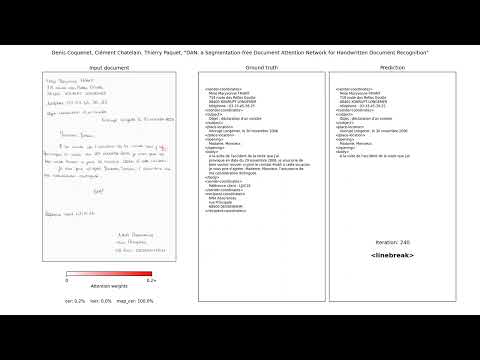
This work focus on handwritten text and layout recognition through the use of an end-to-end segmentation-free attention-based network. We evaluate the DAN on two public datasets: RIMES and READ 2016 at single-page and double-page levels.
We obtained the following results:
| CER (%) | WER (%) | LOER (%) | mAP_cer (%) | |
|---|---|---|---|---|
| RIMES (single page) | 4.54 | 11.85 | 3.82 | 93.74 |
| READ 2016 (single page) | 3.43 | 13.05 | 5.17 | 93.32 |
| READ 2016 (double page) | 3.70 | 14.15 | 4.98 | 93.09 |
Pretrained model weights are available here and here.
Table of contents:
We used Python 3.9.1, Pytorch 1.8.2 and CUDA 10.2 for the scripts.
Clone the repository:
git clone https://github.com/FactoDeepLearning/DAN.git
Install the dependencies:
pip install -r requirements.txt
An example script file is available at OCR/document_OCR/dan/predict_examples to recognize images directly from paths using trained weights
This section is dedicated to the datasets used in the paper: download and formatting instructions are provided for experiment replication purposes.
RIMES dataset at page level was distributed during the evaluation compaign of 2009.
READ 2016 dataset corresponds to the one used in the ICFHR 2016 competition on handwritten text recognition. It can be found here
Raw dataset files must be placed in Datasets/raw/{dataset_name}
where dataset name is "READ 2016" or "RIMES"
python3 Datasets/dataset_formatters/read2016_formatter.py
python3 Datasets/dataset_formatters/rimes_formatter.py
python3 OCR/line_OCR/ctc/main_syn_line.py
There are two lines in this script to adapt to the used dataset:
model.generate_syn_line_dataset("READ_2016_syn_line")
dataset_name = "READ_2016"
python3 OCR/line_OCR/ctc/main_line_ctc.py
There are two lines in this script to adapt to the used dataset:
dataset_name = "READ_2016"
"output_folder": "FCN_read_line_syn"
Weights and evaluation results are stored in OCR/line_OCR/ctc/outputs
python3 OCR/document_OCR/dan/main_dan.py
The following lines must be adapted to the dataset used and pre-training folder names:
dataset_name = "READ_2016"
"transfer_learning": {
    # model_name: [state_dict_name, checkpoint_path, learnable, strict]
    "encoder": ["encoder", "../../line_OCR/ctc/outputs/FCN_read_2016_line_syn/checkpoints/best.pt", True, True],
    "decoder": ["decoder", "../../line_OCR/ctc/outputs/FCN_read_2016_line_syn/best.pt", True, False],
},
Weights and evaluation results are stored in OCR/document_OCR/dan/outputs
All hyperparameters are specified and editable in the training scripts (meaning are in comments).
Evaluation is performed just after training ending (training is stopped when the maximum elapsed time is reached or after a maximum number of epoch as specified in the training script).
The outputs files are split into two subfolders: "checkpoints" and "results".
"checkpoints" contains model weights for the last trained epoch and for the epoch giving the best valid CER.
"results" contains tensorboard log for loss and metrics as well as text file for used hyperparameters and results of evaluation.
@article{Coquenet2023b,
  author = {Coquenet, Denis and Chatelain, Clément and Paquet, Thierry},
  title = {DAN: a Segmentation-free Document Attention Network for Handwritten Document Recognition},
  doi={10.1109/TPAMI.2023.3235826}
  journal={IEEE Transactions on Pattern Analysis and Machine Intelligence},
  volume={45},
  number={7},
  pages={8227-8243},
  year = {2023},
}This whole project is under CeCILL-C license.