





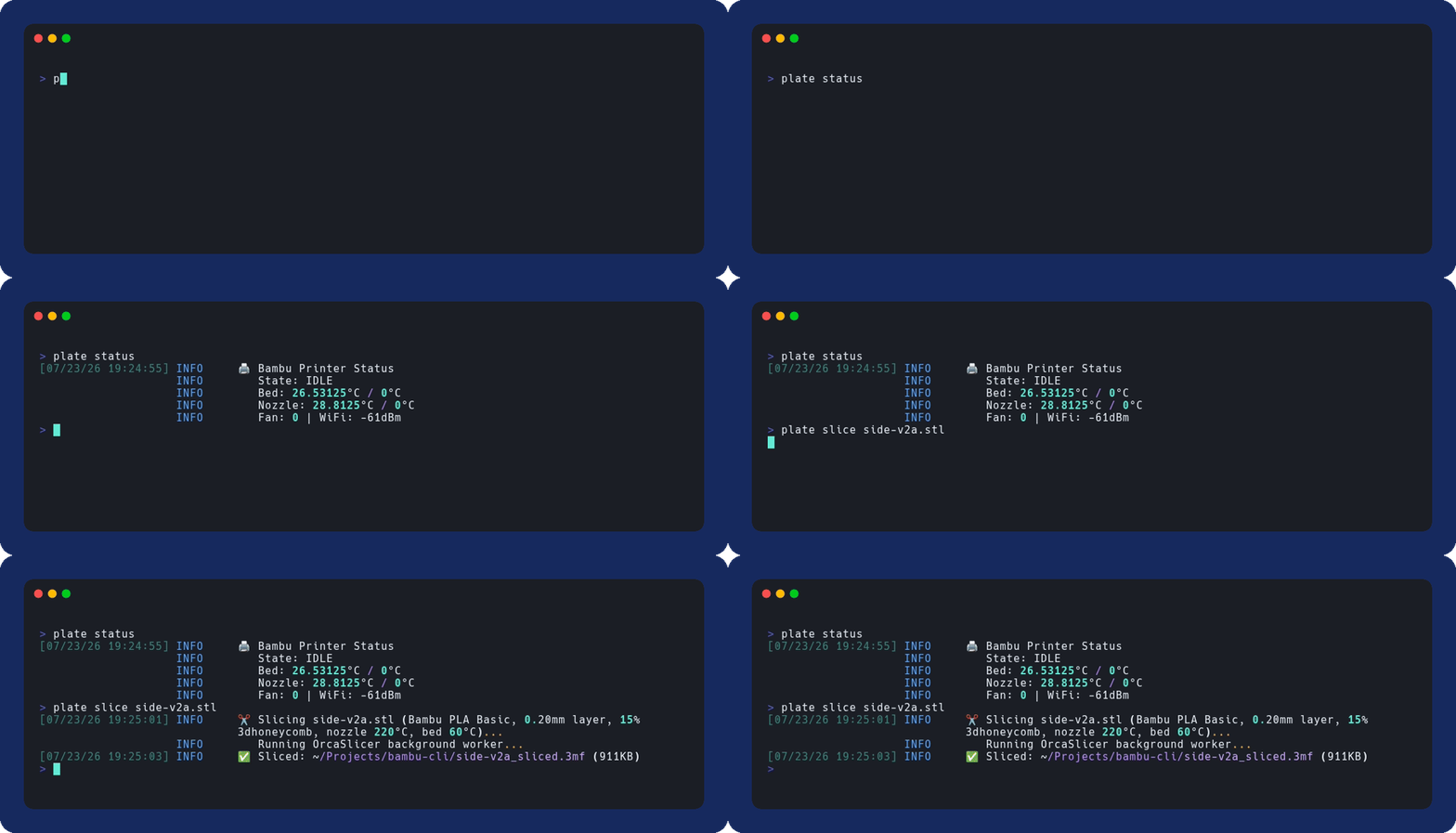
Paste a Printables link, get a physical print. plate downloads the model, slices it with OrcaSlicer, and sends it to your Bambu Lab printer — one guided command, entirely on your local network. No cloud account, no telemetry. Runs on Linux, macOS, and Windows, driven by hand or by AI agents.
model URL or file  →  download  →  slice (OrcaSlicer)  →  upload  →  print
                        one command:  plate go
Supports: any Bambu Lab printer with LAN mode — P1P, P1S, X1C, X1E, A1, A1 Mini. Hardware-tested on the P1 series (P1P/P1S) only. The rest speak the same LAN protocols and are expected to work, but are unverified on real hardware — treat them as best-effort and please open an issue with what you hit. One caveat: plate snapshot grabs the camera directly (no extra software) on P1/A1-class printers. X1-series cameras need a locally-running Docker streamer, and that path is opt-in (camera_allow_streamer or --allow-camera-streamer) because the streamer does not honour cert_fingerprint.
Requirements: Python 3.10+, and OrcaSlicer installed locally to slice — it is a second slicer app, not Bambu Studio, and plate cannot slice without it. plate go, plate job, and plate slice shell out to the OrcaSlicer binary; download, status, upload, and print do not need it. plate setup auto-detects the usual install locations (macOS app bundle, Windows Program Files, and on Linux a $PATH binary, Flatpak export, or AppImage), and plate preflight (or plate config validate) tells you if it can't find one.
Fastest way to get OrcaSlicer, if you don't have it:
winget install --id SoftFever.OrcaSlicer          # Windows
brew install --cask orcaslicer                    # macOS
flatpak install -y flathub com.orcaslicer.OrcaSlicer   # Linux
pipx install platecli
# or
uv tool install platecli
# or
pip install platecliPreviously published on PyPI as bambu-local-cli (yanked). The project is now platecli; the installed command is plate.
No printer needed — simulation mode fakes one so you can kick the tires right away:
plate --sim status🖨️ Bambu Printer Status
State: IDLE
Bed: 25°C / 0°C
Nozzle: 25°C / 0°C
Fan: 0 | WiFi: -42dBm
AMS:
Unit 0 (humidity 5, 26.0°C)
▶ Slot 0: PLA #F2F2F2 | 90%
Slot 1: PETG #0A0AC8 | 60%
Slot 2: empty
Slot 3: TPU #000000 | 45%
Timestamps and log-level prefixes trimmed for brevity.
Four steps, no flags to learn:
- Install OrcaSlicer (see Install).
plateruns it to slice; it is a second slicer app, not Bambu Studio. - Turn on LAN mode on the printer's touchscreen and note the IP address, serial number, and LAN access code shown next to it. The access code is not your Bambu account password, and it changes every time LAN mode is toggled or the printer is factory-reset — re-run
plate setupif it stops connecting. plate setupasks for those three values and finds OrcaSlicer for you.plate doctorthen checks the connection end to end (optional).plate go— paste a model link (or a local file), pick a material and quality, look at the time and filament estimate, and say yes. Plainplatein a terminal opens the same wizard.
plate setup
plate doctor    # optional: verify the connection end to end
plate go        # or: plate go "https://www.printables.com/model/3161-3d-benchy"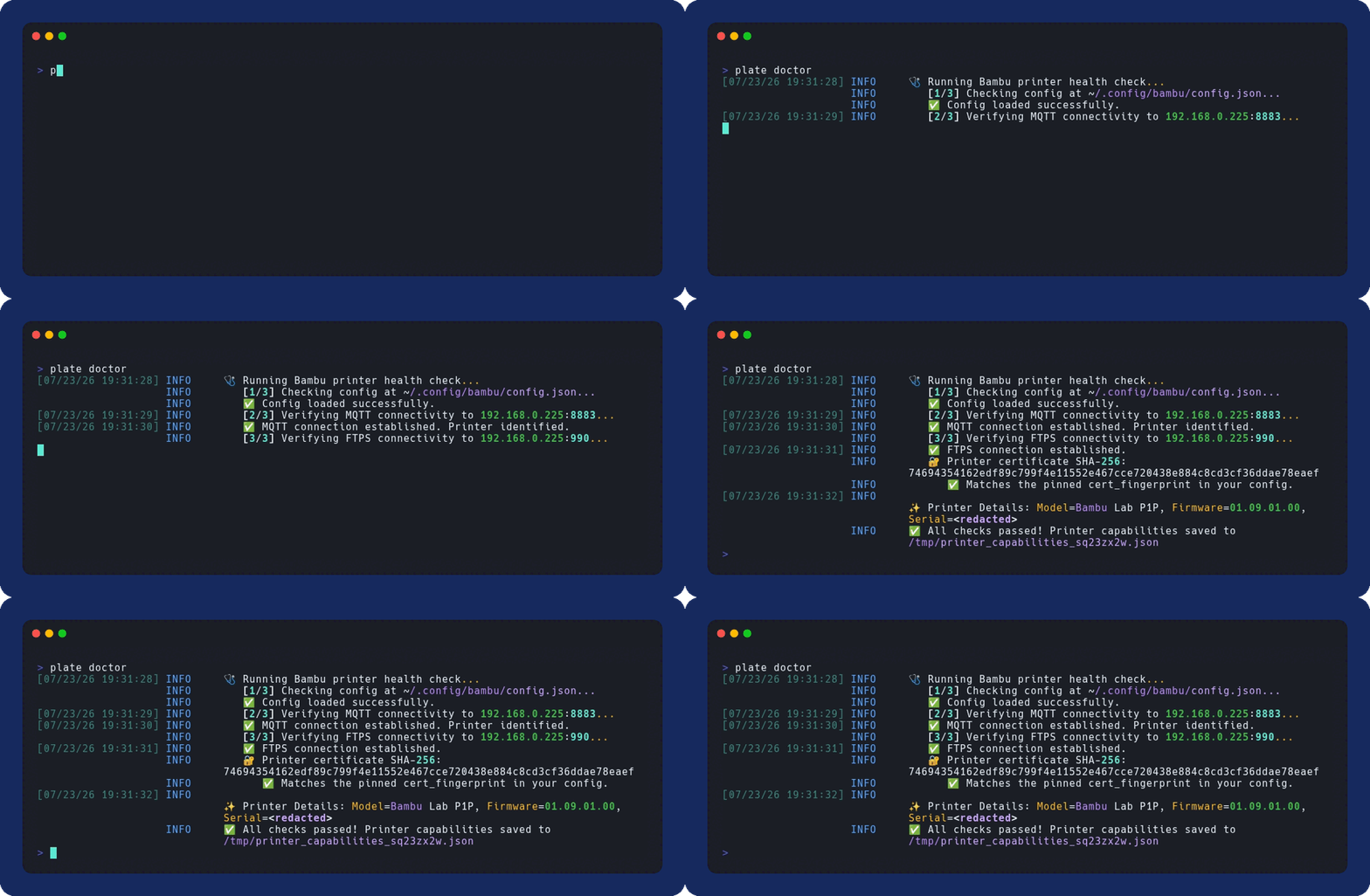
The wizard walks you from a model URL (or local file) to a running print: paste a source, confirm the printer, pick a material and quality preset, answer one supports question, then see a time and filament preview before a final confirm. OrcaSlicer still does the slicing underneath — you just never touch its settings. If your printer has an AMS, the material step defaults to whatever filament is loaded. Declining the final question offers upload-only, and cancelling keeps the sliced file.
plate go needs an interactive terminal. Everything it asks maps to a flag on plate job, which runs the same download → slice → upload → print pipeline in one shot, so the result is identical:
plate job "https://www.printables.com/model/3161-3d-benchy" --confirm--confirm is what starts the print. Without it, job / send still download, slice, and upload the file to the printer — they exit 0 with "status": "uploaded_not_printed", and the file sits on the printer unstarted. The commands that act on the printer directly are stricter: print, stop, pause, resume, gcode, and delete refuse without --confirm (exit code 5) and do nothing. (light is exempt; an LED is not a physical action.)
pip install 'platecli[tui]'          # or: pipx install 'platecli[tui]'
                                     # or: uv tool install 'platecli[tui]'
plate tui    # or: plate tui --sim to explore it without a printer
Install the extra the same way you installed plate — a pip install into your
shell's Python does not reach a pipx / uv tool environment. Already installed
without it? pipx install --force 'platecli[tui]' (or pipx inject platecli textual).
plate tui is a live view of your printer: state, temperatures, layer and progress, and the AMS trays, on one screen that keeps updating — plus a job monitor that follows a running print to completion. You can start a print from it too, through the same prepare-and-confirm flow the wizard uses, so you never have to leave the screen.
It is a front-end, not new machinery: it slices and builds the job request through the same shared code plate go runs, so the two cannot drift. Every safety rule holds — a print only ever starts from the confirm dialog, cancelling keeps the sliced file, and leaving the monitor never stops a print. Textual is an optional extra and never a runtime dependency, so plate go keeps working with nothing extra installed on SSH, dumb terminals, and with screen readers.

- One command, whole pipeline —
plate goasks the questions;plate job <url> --confirmtakes flags. Both download, slice, upload, and print in one shot; or rundownload/slice/upload/printindividually. - Fully local & private — talks straight to the printer over your LAN; no Bambu cloud account, ever.
- Deliberate-action gate — physical commands refuse without
--confirm(exit5), so a typo, a truncated argument list, or a replayed read-only command can't start a print. It is a gate against accidents, not an authorization boundary:platecannot tell your--confirmfrom an agent's, so anything you let runplatecan pass the flag. Sandbox agents accordingly. - AI-agent ready — every command speaks
--jsonwith published schemas, plus a--simmode for hardware-free automation. - Watch it live —
plate status --monitorfollows a print with a live progress bar until it finishes, or run the full-screenplate tui(optional[tui]extra) for a dashboard you can also start a print from. - Fixes itself findable —
plate doctorchecks network, FTPS, and MQTT health and tells you exactly what's wrong. - Hardened where it counts — TLS certificate pinning, SSRF-guarded downloads, and size-capped ZIP extraction.
The cloud-free Bambu ecosystem is in good shape, and for many people one of these is the better answer:
| Project | What it is | Reach for it when |
|---|---|---|
| Bambuddy (~2.6k ★) | Self-hosted web command center, from a single printer up to a print farm | You want a polished dashboard, a print farm, or a full cloud replacement |
| ha-bambulab (~2.3k ★) | The Home Assistant integration — sensors, cameras, automations | Your printer should be part of your smart home |
| bambulabs_api (~320 ★) / pybambu (~60 ★) | Maintained Python libraries for the printer protocols | You're writing your own application, not running a tool |
| davglass/bambu-cli (~95 ★, archived) | A Node.js CLI with a rich command set (unrelated project, same name) | You live in Node and are happy with a project that is no longer maintained |
| platecli | This — a Python CLI for the whole pipeline | You want one command from a model link to a finished print, scriptable and cloud-free |
platecli's own emphasis is the end-to-end pipeline as a single command:
plate job <url> --confirm runs download → slice (OrcaSlicer) → upload → print,
with no account, no daemon, and no web UI. Every command speaks --json against
published JSON Schemas,
and --sim gives you a complete fake printer so scripts and AI agents can be
developed and tested with no hardware at all. If you want a dashboard or a
smart-home surface, the projects above are the better fit; if you want a pipeline
you can put in a shell script or hand to an agent, use this.
Every command emits machine-readable --json output backed by published JSON Schemas, --sim provides a canned printer (not a protocol test) for development without hardware, and the --confirm gate means a print never starts by accident — note that job / send without --confirm still upload (uploaded_not_printed); only the six direct printer commands refuse outright. Two commands are deliberately human-only — the go wizard and the tui full-screen UI refuse --json and a non-TTY stdin with exit 5; plate job <url> --confirm is the machine path that does the same work. See the user guide and docs/api.md for the JSON contracts and stability policy.
- User guide — full setup, config reference, slicing & AMS mapping, print monitoring, and every flag
- Troubleshooting — keyed by the error message you actually saw: access codes, LAN mode, cert pins, FTPS, OrcaSlicer, camera
- AGENTS.md — architecture and safety notes for agents and automation
- docs/api.md — JSON contracts, support matrix, and stability policy
- docs/schemas/ — machine-checkable JSON Schema files
- SECURITY.md — threat model, reporting, known limitations
- CHANGELOG.md — release notes
- CONTRIBUTING.md — dev setup, tests, releases
- Discussions — questions, show-and-tell, and community conversation
plate can start a print with nobody standing at the machine, which is exactly the point — and exactly the risk. An FDM printer is a hot, moving appliance: a failed print can jam, spaghetti, damage the hotend, or in rare cases start a fire. Keep the printer in view of a person or a camera, don't kick off long jobs overnight or in an empty house, and leave your printer's own firmware safety features on. plate uploads a job and starts it; it does not watch the plate for failures and will not stop a print that is going wrong. What the machine does is your responsibility.
platecli is maintained by one person in their spare time. Bug reports and pull requests are genuinely welcome — open an issue with your plate doctor output attached and I'll get to it when I can. There is no response-time guarantee, and feature requests may sit or be declined to keep the tool small and local-only. If you need something faster than that, fork it — it's MIT.
Status: Beta, pre-1.0 — APIs and config keys follow the stability policy in docs/api.md. The current release is whatever the PyPI badge at the top of this page shows; plate --version reports the copy you have installed.
Disclaimer: platecli is an unofficial, community-developed tool. It is not affiliated with, endorsed by, or supported by Bambu Lab. "Bambu Lab" and product names are trademarks of their respective owners, used here only to describe compatibility. The printer protocols (MQTT/FTPS) are reverse-engineered; a firmware update may break functionality without warning — run
plate doctorafter printer updates.
MIT — Use freely, modify as needed.